The Urban Cartographer’s February 2026 Photo Diary

BACK TO JANUARY 2026 VIEW THE QUICK AND SIMPLE GALLERY INDEX NEW: OUR EQUIPMENT IN DETAIL M4 PROMISE AND TAHOE REALITY BELFAST CENTRAL SCROLLING GALLERY STREET ART SCROLLING GALLERY BETA TEST - NEW TYPE OF PHOTO GALLERY

The Scrolling Galleries Are Experimental

Select + For Photo Catalogues By Month

THE URBAN CARTOGRAPHER
VISIT THE GLOBAL MENU

FEBRUARY

REVISIT JANUARY 2025

THE MAIN EVENT WILL BE A VISIT TO KILKENNY

URBAN EXPRESSION

Should I Cancel My Trip To Kilkenny?

It is completely understandable that myself and everyone else is feeling "weather-beaten" at this point. After the record-breaking deluge I experienced in Belfast and the persistent rain in Dublin, the thought of heading into another potentially wet week in Kilkenny feels like a gamble where the house always wins.

However, based on the specific forecast for the week of Monday, February 23rd, there is actually a compelling reason not to cancel just yet.

The Forecast: A Rare "Dry Spell" Signal

For the first time in months, the long-range models are showing a significant shift in the weather pattern for that exact week.

High Pressure Building: Met Éireann’s extended range forecast indicates that from Monday, February 23rd to Sunday, March 1st, atmospheric pressure is expected to build over Ireland.

Below-Average Rainfall: For your specific window, rainfall amounts are actually predicted to be below normal for late February.

Above-Average Temperatures: It is likely to be slightly milder than the current "Arctic blast" we are seeing this week.

The "Waterlogged" Reality

While the sky might finally clear, I am concerned about the ground conditions. Even if it doesn't rain a drop during the visit, Kilkenny will be extremely waterlogged.

River Levels: The River Nore in Kilkenny city and surrounding towns (like Thomastown and Inistioge) has been at or above bank-full levels recently due to Storm Chandra.

I have decided not to cancel yet. Because the forecast is actually trending toward a "drier than average" week (a rarity lately!), I plan on waiting until Thursday, February 19th to make my final call. By then, the 7-day forecast will be much more accurate.

If the high pressure holds, I might finally break your Kilkenny rain curse.


AT THE BULLITT HOTEL IN BELFAST

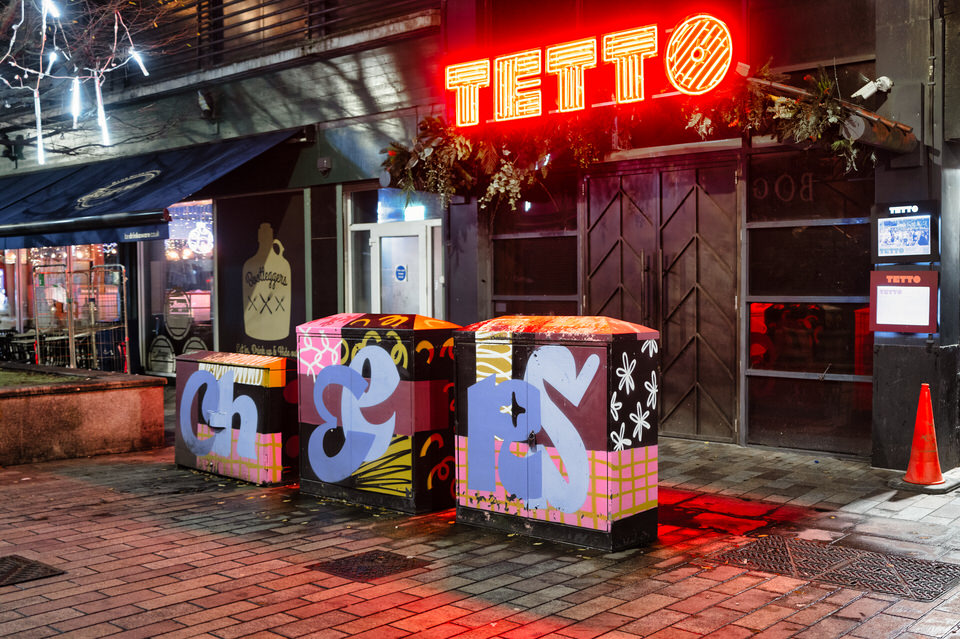
CHEERS BY ZIPPY

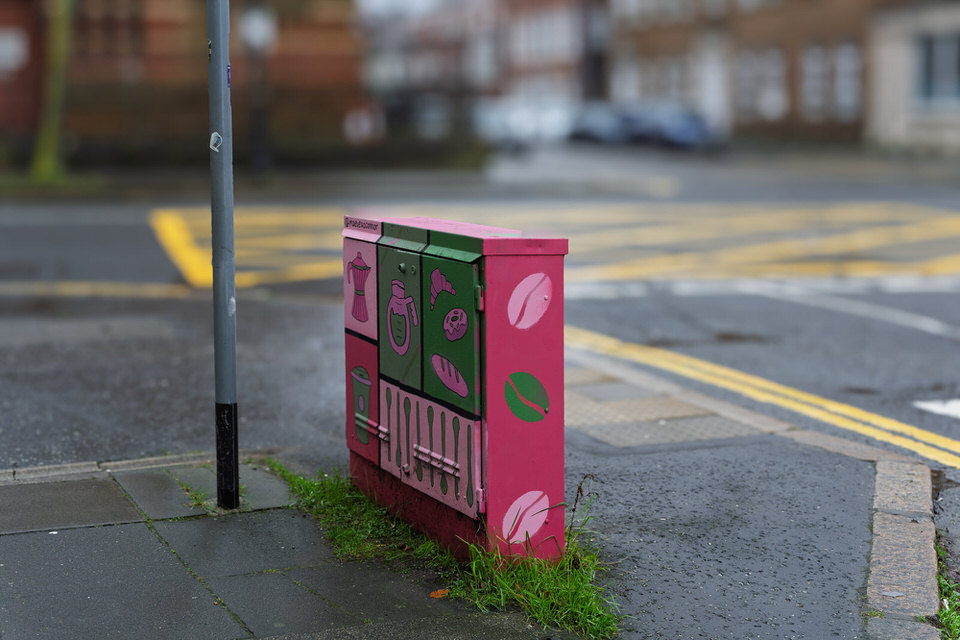
The artwork was commissioned to celebrate the city centre’s vibrant nightlife and social culture, hence the "Cheers" and pint glass motifs. The installation spans a cluster of three utility boxes, rendered in a bold, graphic style with striking blues, pinks, and yellows. The atmospheric neon red glow visible in my images emanates from the TETTO signage positioned above the hotel entrance.

MORE INFORMATION
BELFAST IN DECEMBER

VARIOUS SCULPTURES BY THIS ARTIST

MAURICE HARRON

Harron was born and grew up in Derry, Northern Ireland. He studied sculpture at the Ulster College of Art and Design in Belfast.

Much of his work is public art sculpture and he has works sited in Northern Ireland and in the Republic of Ireland. Two of his most acclaimed commissions are Reconcilition/Hands Across the Divide in Carlisle Square, Derry, overlooking the Craigavon Bridge crossing the River Foyle, and the Gaelic Chieftain, arguably his most experimental and impressive piece sited in the Curlew Mountains, County Roscommon. This statue overlooks the site of the Battle of Curlew Pass, fought in August 1599, when a Gaelic Irish force under Hugh Roe O'Donnell defeated an English column during the Nine Years War.

Select + To View More Menu Options

JANUARY 2026 PHOTO DIARY DECEMBER 2025 PHOTO DIARY EXAMPLES OF STREET ART PAINT-A-BOX STREET ART MAY 2025 VISIT TO BELFAST CITY DECEMBER 2025 VISIT TO BELFAST CITY THE DECEMBER 2024 PHOTO COLLECTIONS ABOUT THE URBAN CARTOGRAPHER CHRISTMAS 2025 VISIT TO DUN LAOGHAIRE THE FUJI X100 VI FITTED WITH THE TCL-X100 II

The Urban Cartographer documents the overlooked history and hidden infrastructure of Irish cities. Moving beyond the tourist map, the project explores the public spaces where history and memory intersect—from the forgotten symbolism of Victorian cemeteries to the industrial markers that shaped the urban landscape. Through photography and research, The Urban Cartographer charts the stories written on the city's walls, revealing the layers of the past that exist beneath our feet.

CHRISTMAS IN DUN LAOGHAIRE
REVISIT JANUARY 2024

I WAS BASED IN DUN LAOGHAIRE AND DALKEY FOR CHRISTMAS 2025

PHOTOGRAPHED DECEMBER 2025

BY VIVIEN BURNSIDE

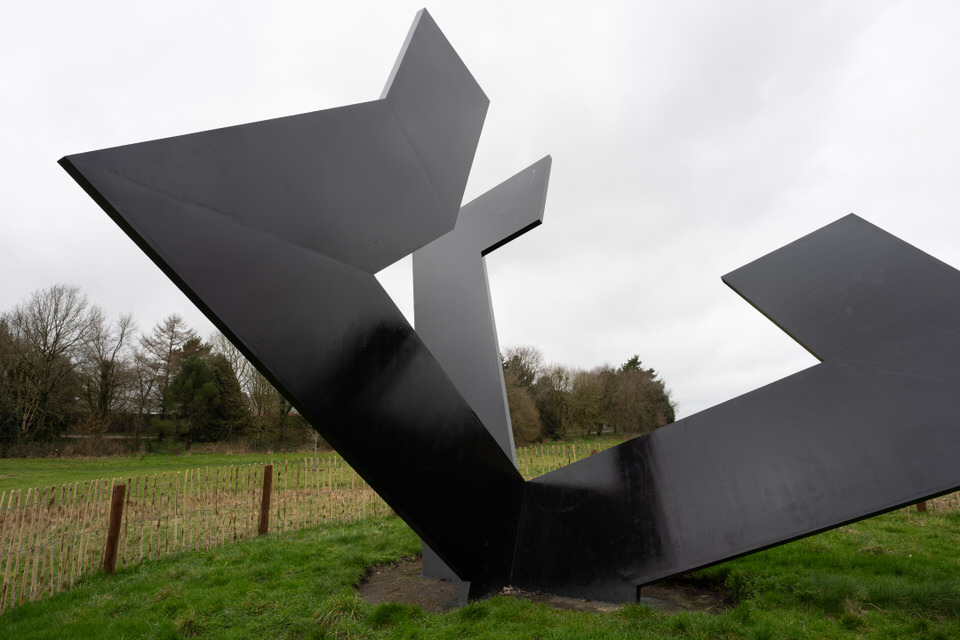
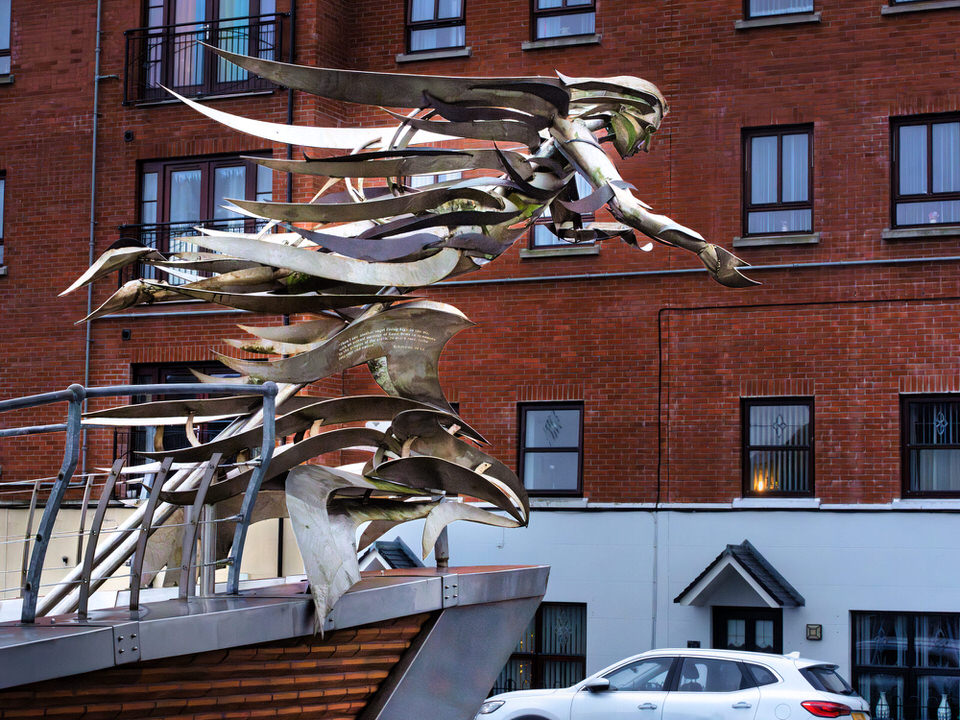
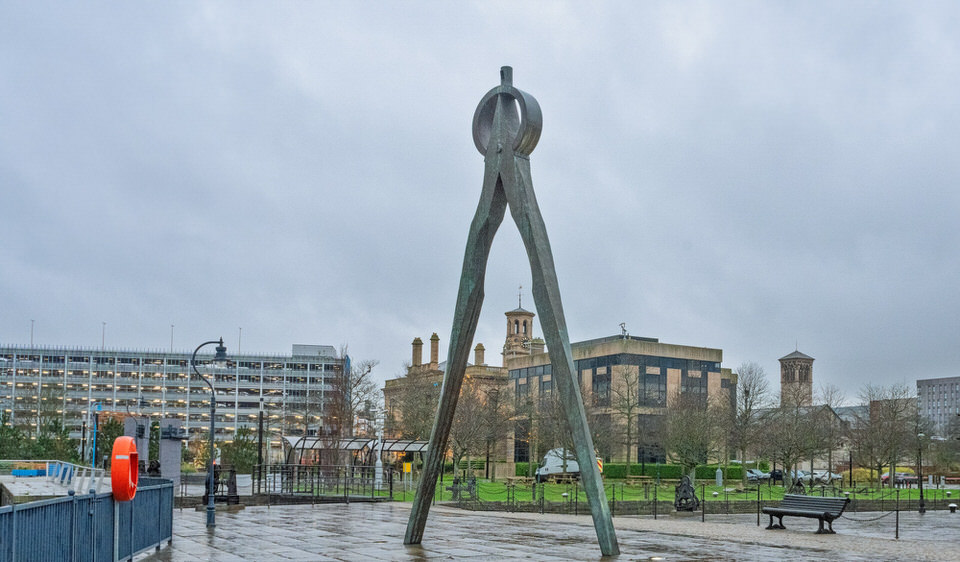
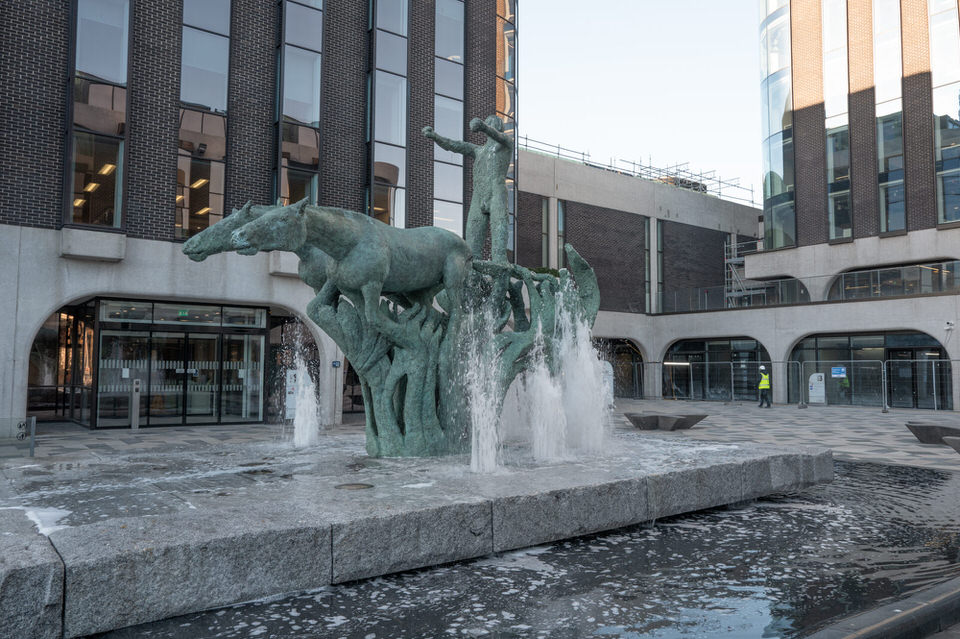
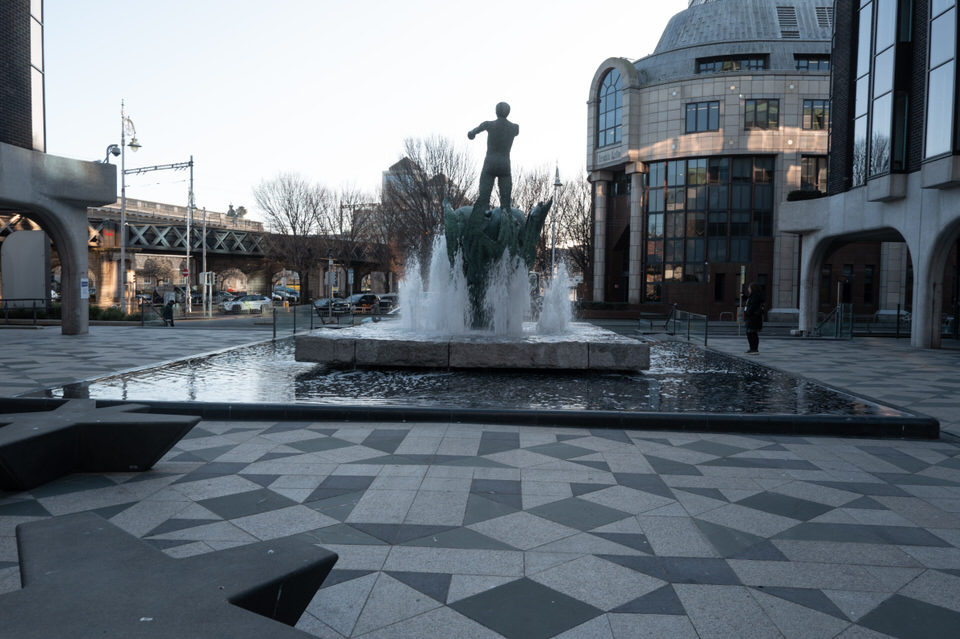
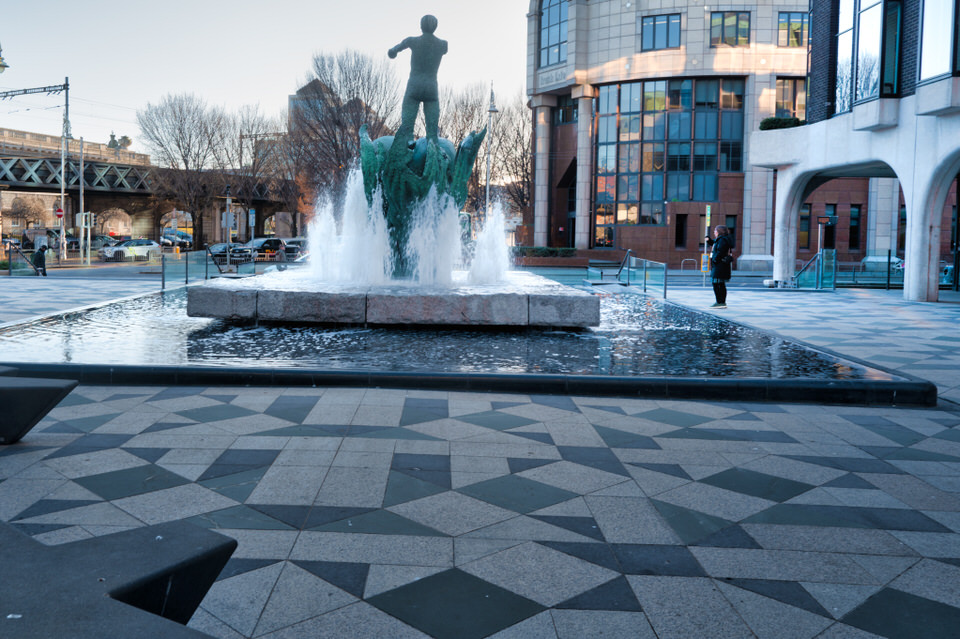
Located at the historic Clarendon Dock within the City Quays area of Belfast, "The Dividers" is a striking piece of public art that has become a landmark of the city’s maritime regeneration. Commissioned by the Laganside Corporation and installed in 2002, the sculpture was created by the acclaimed local artist Vivien Burnside.

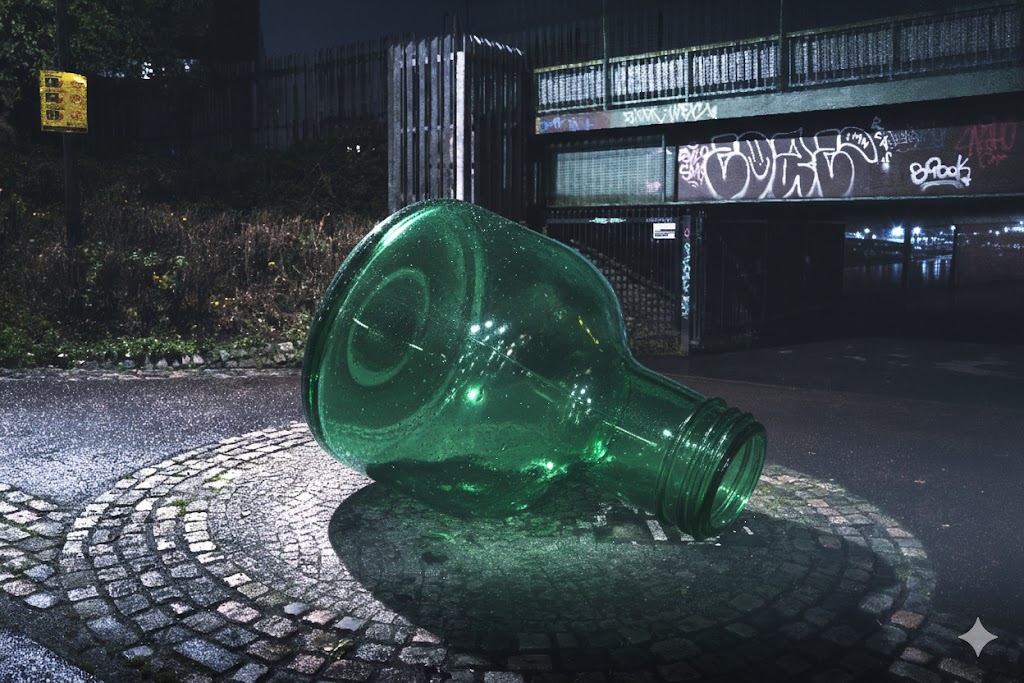
GENERATED BY NANO BANANA

THE FAKE AND THE REALITY

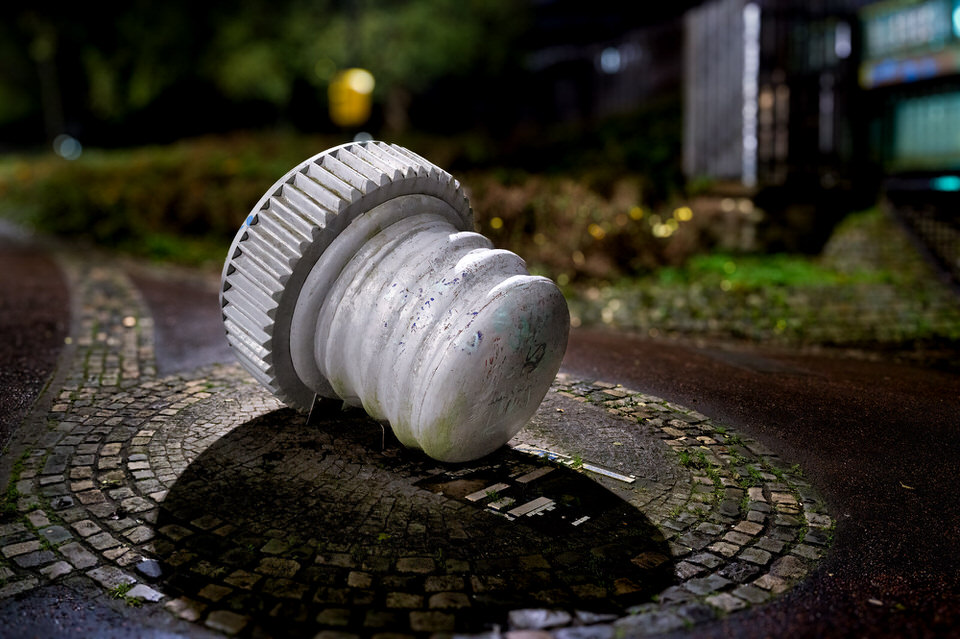
In Belfast at an entrance to the Gasworks, under a railway bridge, there is a giant sculpture of a vintage vulcanite screw bottle stopper, a design that dates back to the late 19th century. For fun, and out of interest, I invited Nano Banana to generate an image of a typical bottle that would be fitted with a screw stopper and this is the result

MORE INFORMATION
DECEMBER 2025 VISIT TO BELFAST
MAY 2025 VISIT TO BELFAST

BY RACHEL JOYNT

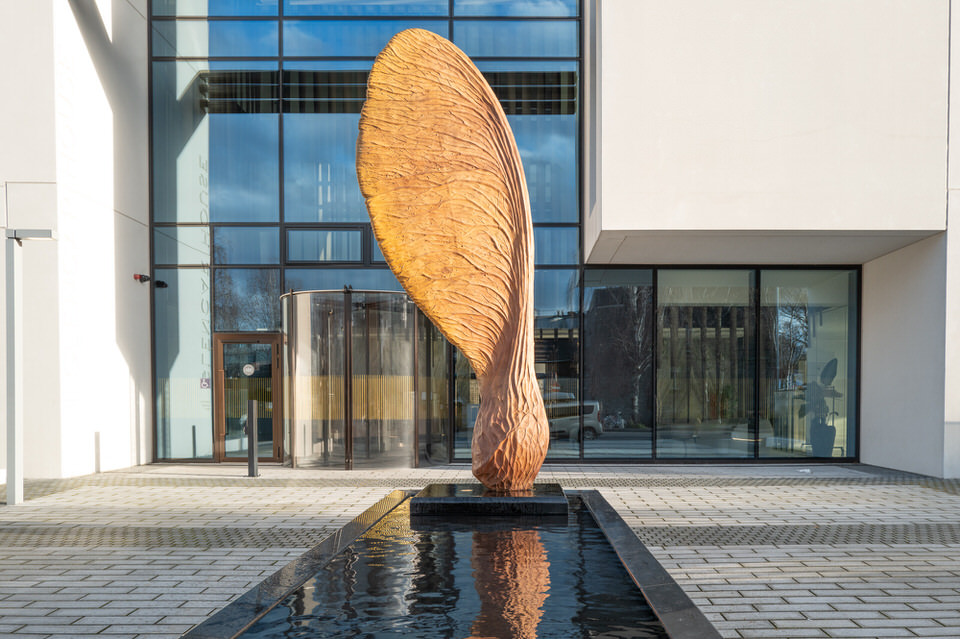
AT GLENCAR HOUSE BALLSBRIDGE

Rachel is one of Ireland’s most celebrated public artists. Her work often takes small, organic objects—seeds, shells, acorns—and scales them to monumental proportions. Her other notable works include:

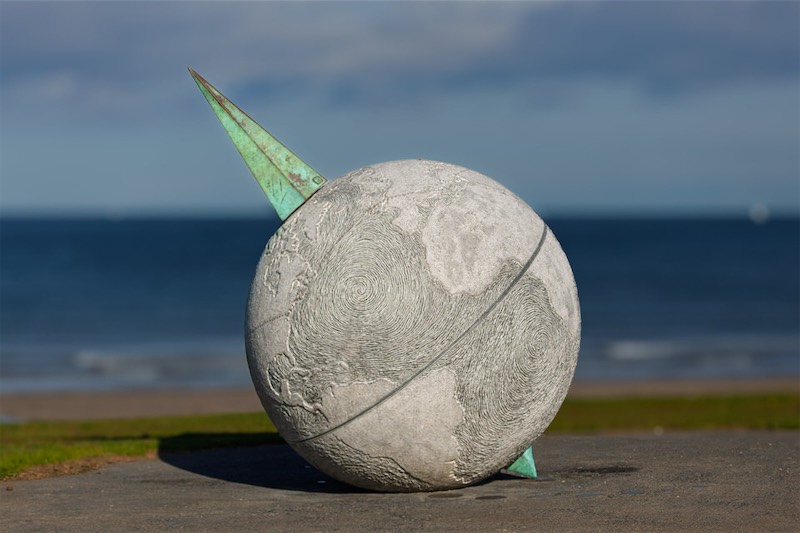
Perpetual Motion (Naas Road): The famous giant "map" sphere on the M7.

The People’s Acorn (Áras an Uachtaráin): A bronze acorn in the President’s gardens containing a time capsule of Irish history.

Mothership (Sandycove): A bronze sea urchin on the rocks of the South Dublin coast.

Noah’s Egg (UCD): A large bronze egg with a celestial interior at the Veterinary Sciences Centre.

LEICA MAY BE FOR SALE

It is more than just a vague rumor—as of late January 2026, major news outlets like Bloomberg and various photography insiders are reporting that Leica Camera AG is actively exploring a sale of a controlling stake.

Here is the breakdown of the current situation:

The Current Status

The Sellers: The potential sale involves the two primary owners: the Kaufmann family (which holds 55% via ACM Projektentwicklung) and the US private equity firm Blackstone Inc. (which holds 45%).

The Valuation: The iconic German brand is reportedly being valued at approximately €1 billion (roughly $1.2 billion USD).

The Chinese Connection: One of the most prominent potential bidders is HSG (formerly known as Sequoia Capital China). Their interest is significant given Leica's deep existing ties to the Chinese market through successful partnerships with Huawei and Xiaomi.

Potential Buyers

While negotiations are still in the early stages and no deal is guaranteed, several names have emerged:

HSG (HongShan): A powerhouse in Chinese private equity.

Altor Equity Partners: A Swedish private equity firm.

Zeiss: Rumors suggest Leica’s German rival might also be interested in a defensive or strategic acquisition.

Xiaomi: While fans have speculated about a direct buyout by Xiaomi due to their current technical partnership, most analysts see them as a less likely "heavy asset" buyer compared to private equity firms.

Why now?

Leica has had a record-breaking few years, reaching nearly €600 million in revenue for the fiscal year ending in 2025. However, Blackstone has held its stake since 2011 and is likely looking for an exit to realize its investment. Additionally, Dr. Andreas Kaufmann, who is credited with Leica's modern revival, is now in his 70s, leading to questions about the brand's long-term succession.

Note: Even if a sale occurs, it is common for the Kaufmann family to retain a minority stake or a role in the company to ensure "brand continuity" and protect the "Made in Germany" prestige that defines Leica's value.


A WALK ALONG THE STORMONT WOODLAND TRAIL

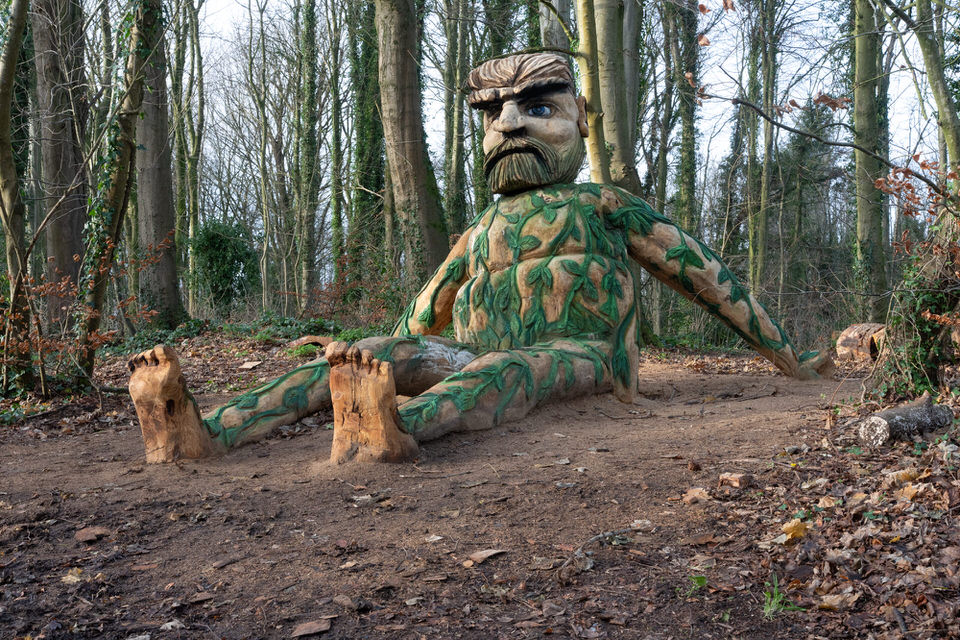
THE FOREST GIANT

The undoubted centrepiece of this walk is the Forest Giant. It is a striking, large-scale wooden figure, carved to depict a man reclining in deep slumber. What makes this sculpture so photogenic is how it interacts with its environment; it was designed to look as if it is merging with the earth itself.

The craftsmanship is lovely, featuring intricate ivy-like relief carvings trailing across the giant's torso and limbs. It feels less like a statue placed on the ground, and more like an ancient spirit rising from the soil.

THE HOMELESS JESUS

JAMES CONNOLLY

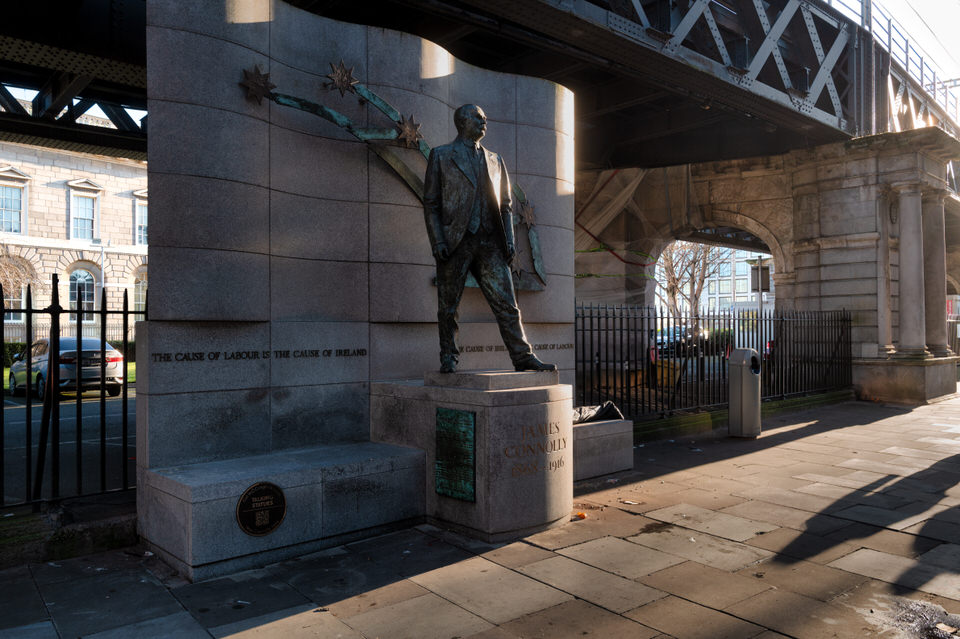
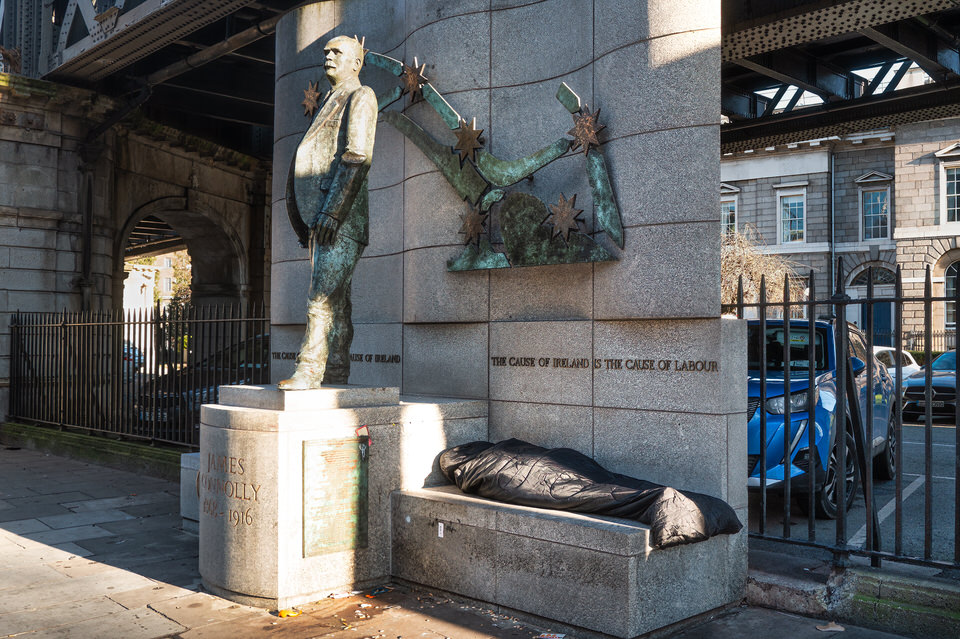
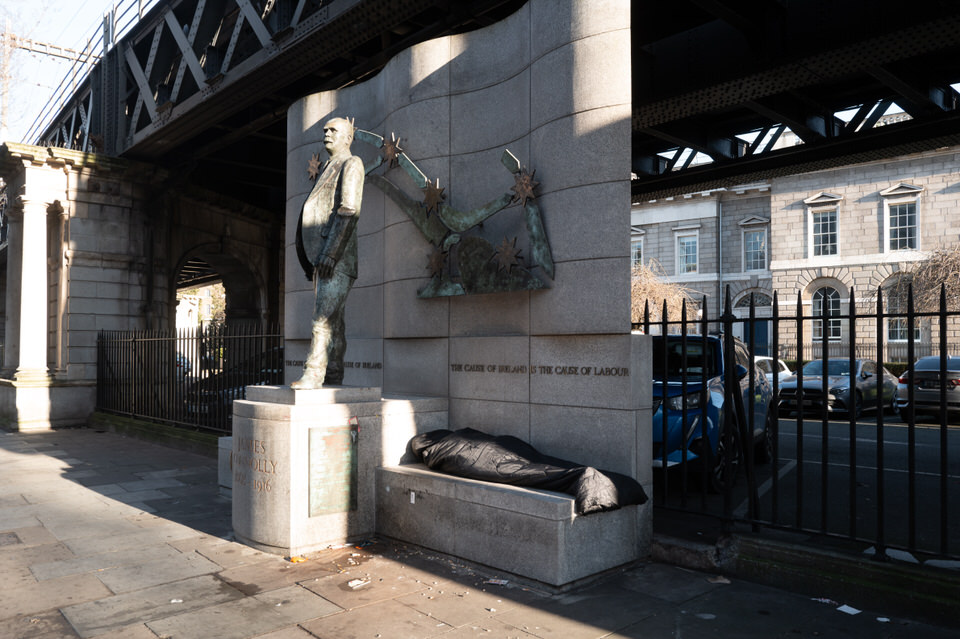
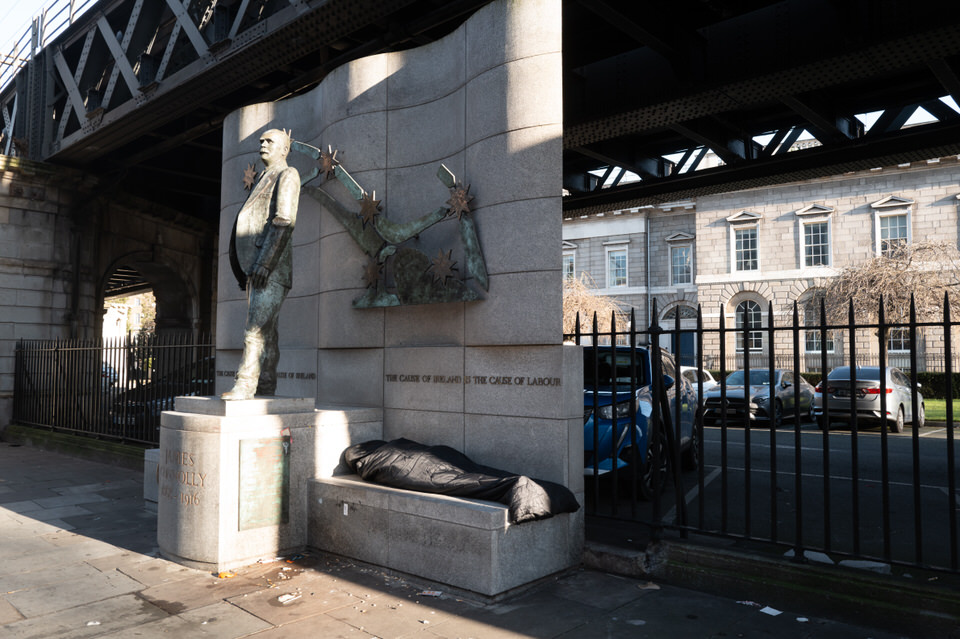
I normally avoid photographing homeless people. It often feels intrusive, a capture of someone’s lowest moment for the sake of an image. But standing beneath the railway bridge at Beresford Place, I could not avoid taking this photograph. The juxtaposition was too screamingly serious to ignore.

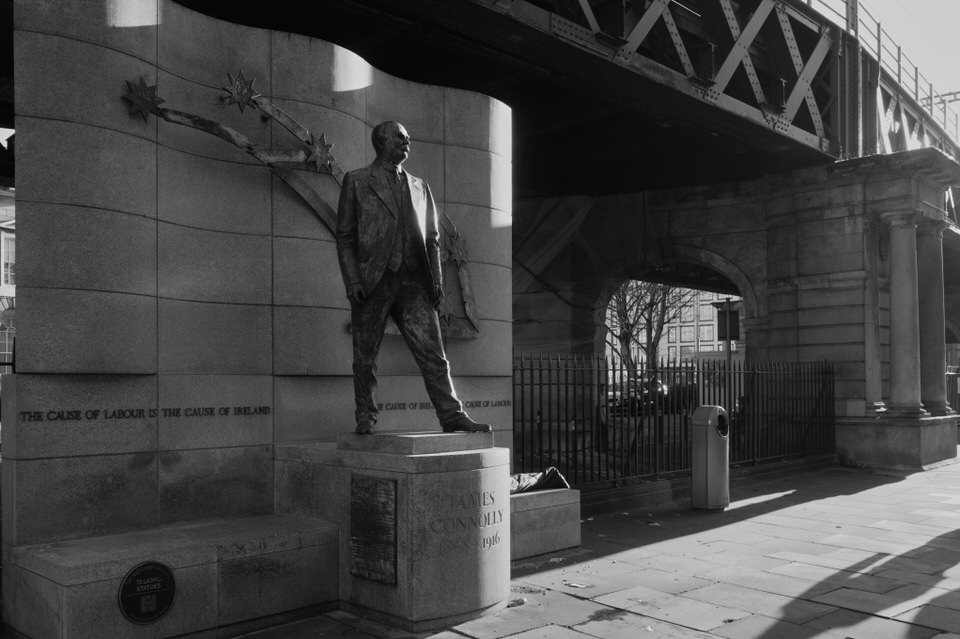
Here lies a real human being, shrouded in a sleeping bag, resting on the cold granite plinth of the James Connolly Memorial. Above them stands the bronze statue of Connolly himself—the socialist republican, the trade union leader, the man who famously declared:

"The cause of Ireland is the cause of labour."

The irony is heartbreaking. Connolly was executed in 1916 not just for a flag or a parliament, but for the liberation of the working class and the destitute. He fought against the very poverty that now curls up at the feet of his likeness. Situated in the shadow of The Custom House—once the symbol of British administration and now a seat of Irish government—this scene asks a difficult question: Has the cause of labour been forgotten?

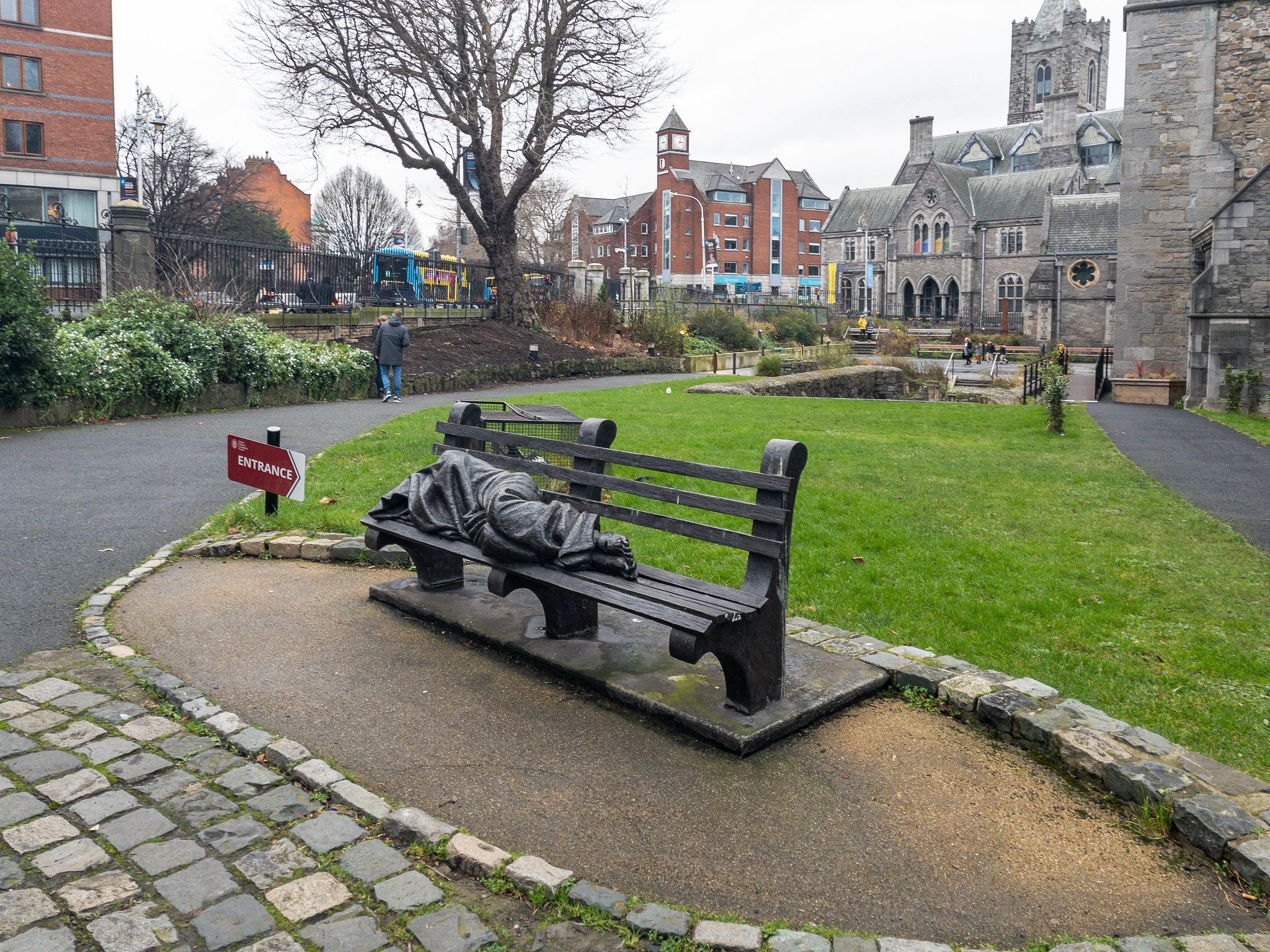
This image inescapably reminds me of the "Homeless Jesus" sculpture located in the grounds of Christ Church Cathedral, just a short walk away across the city. That bronze cast by Timothy Schmalz depicts a figure sleeping on a park bench, almost identical in form to the person sleeping on Connolly’s memorial.

In the sculpture, the figure’s face and hands are obscured by a blanket. Only the crucifixion wounds on the feet reveal the identity. It is a "visual translation" of the Gospel of Matthew: "Truly I tell you, just as you did it to one of the least of these who are members of my family, you did it to me."

Schmalz intended his work to be provocative. He said, "That's essentially what the sculpture is there to do. It's meant to challenge people."

The sculpture challenges us with bronze; the Connolly memorial challenges us with flesh and blood. When we look at the "Homeless Jesus," we are moved by the artistic representation of divinity in poverty. But when we look at the Custom House memorial, we are confronted with the reality of it.

Connolly stands tall, chest out, gazing towards a future he died to create. But the reality of that future is sleeping on the hard stone beneath him. If the "Homeless Jesus" is a test of our spiritual empathy, the person sleeping at the feet of James Connolly is a test of our societal failure.

I USED A LEICA Q3

HENRIETTA PLACE

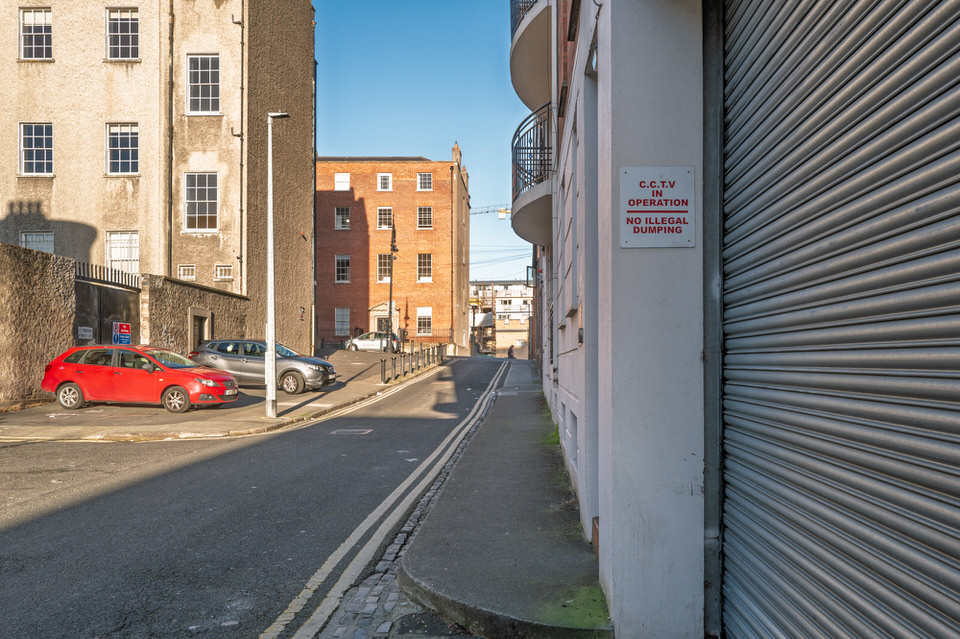
Henrietta Place, the laneway connecting Henrietta Street to North King Street, possesses a character that has shifted dramatically over three centuries. Once a vital artery for the linen trade and a service lane for Dublin's elite, the section nearest North King Street is today frequently described as a "rat run." Drivers often utilise this narrow stretch as a shortcut to bypass traffic, creating a jarring contrast between the area's rich heritage and its modern, functional use which can make pedestrian access—particularly at night—less than ideal.

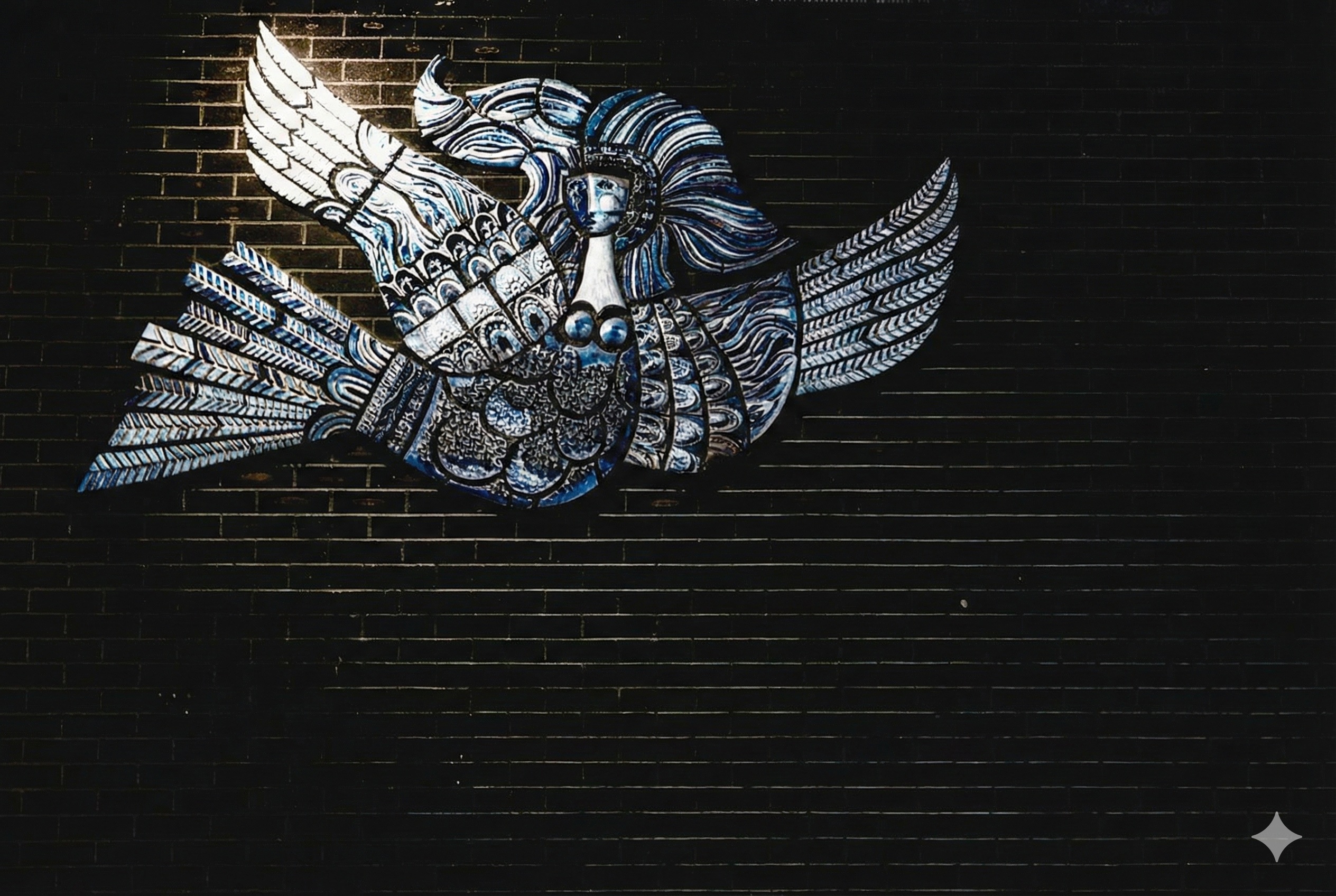
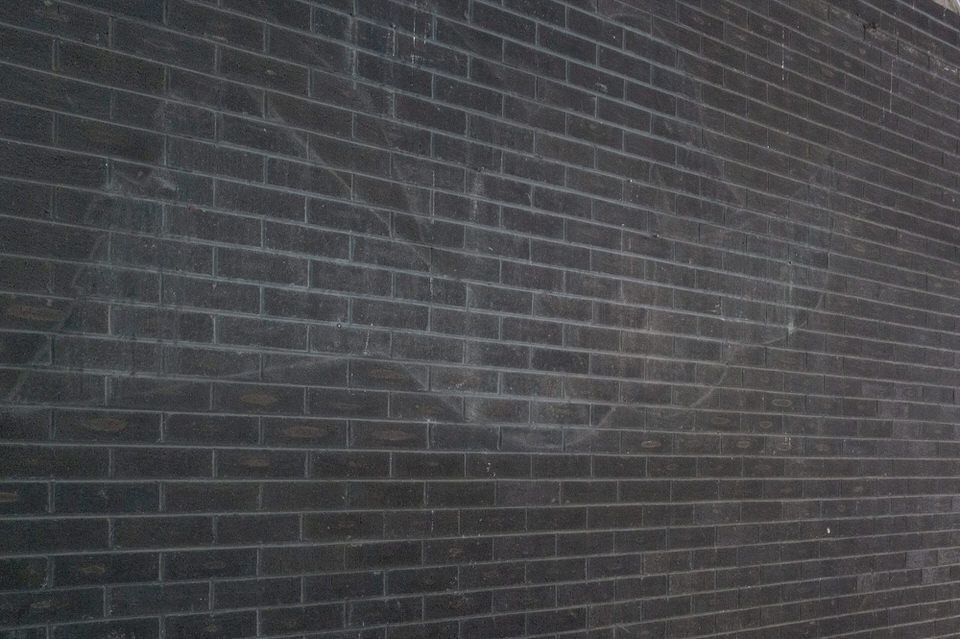
AI WAS USED TO ENHANCE THE HARPY IMAGE

BEFORE AND AFTER

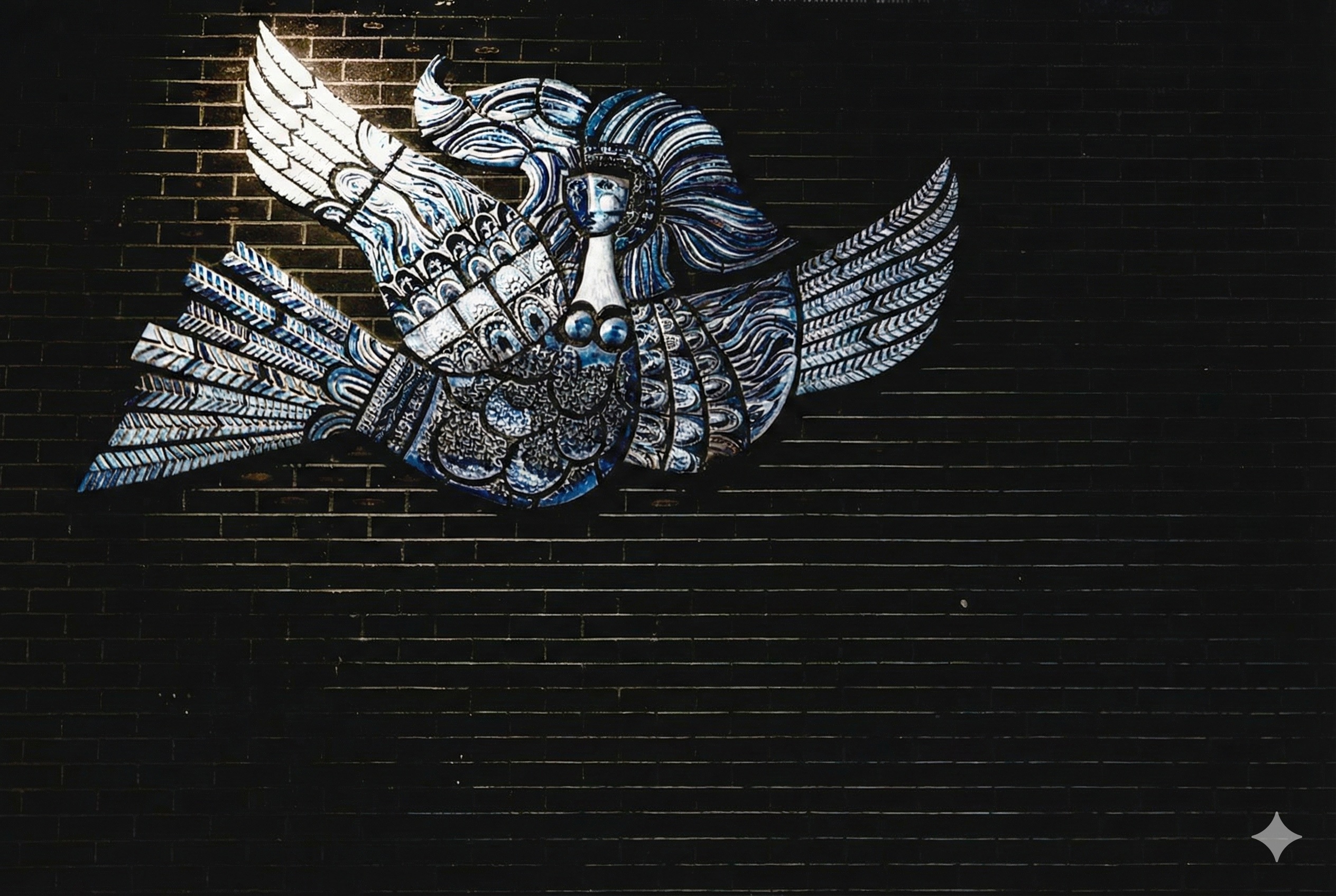
There were no press releases for The Harpy. No announcements were made about its "preservation." It was simply allowed to sit until it perhaps became a maintenance nuisance, and then it was erased, leaving only a shadow on the wall to prove it was ever there at all. The "City within a City" is slowly becoming just another office block, and its unique artistic identity has been stripped away, piece by quiet piece.

THE SAD STORY
THE MISSING MURALS

THE MAD MILKMAN

CHARIOTS OF LIFE

The Vanishing Art of the Irish Life Centre: The Harpy, The Mad Milkman, and the Ghost on the Wall

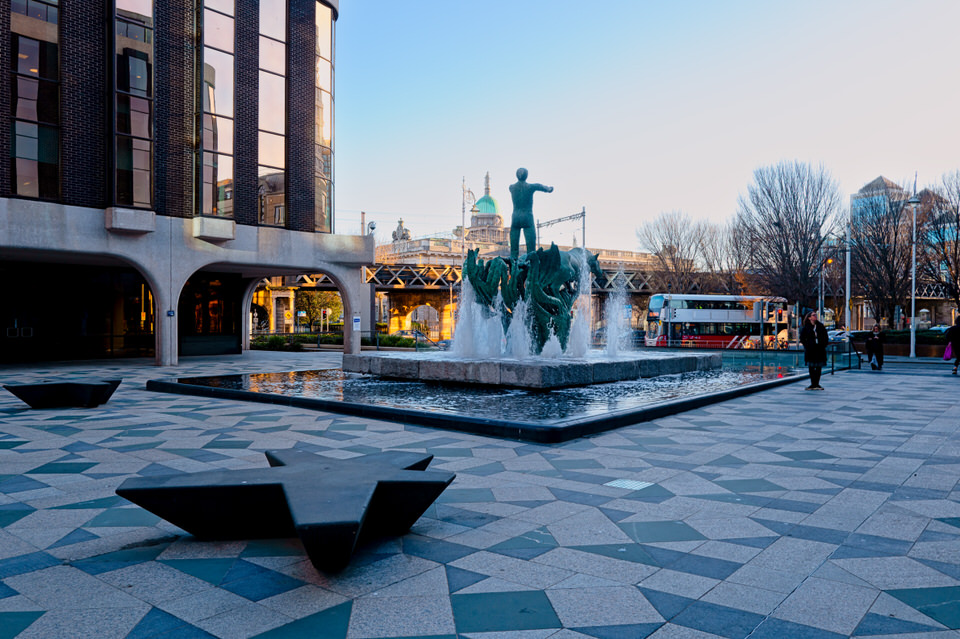
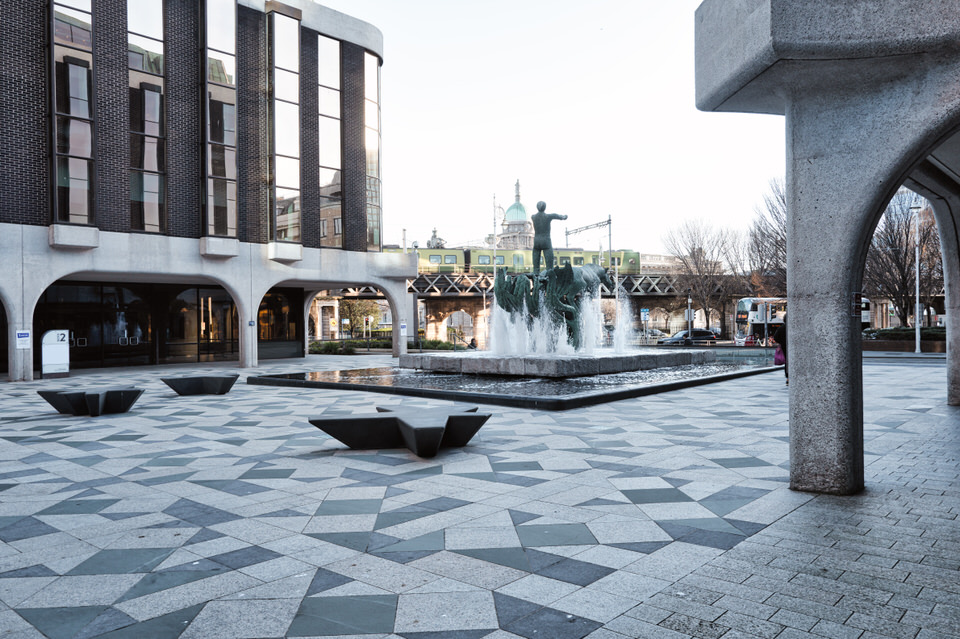
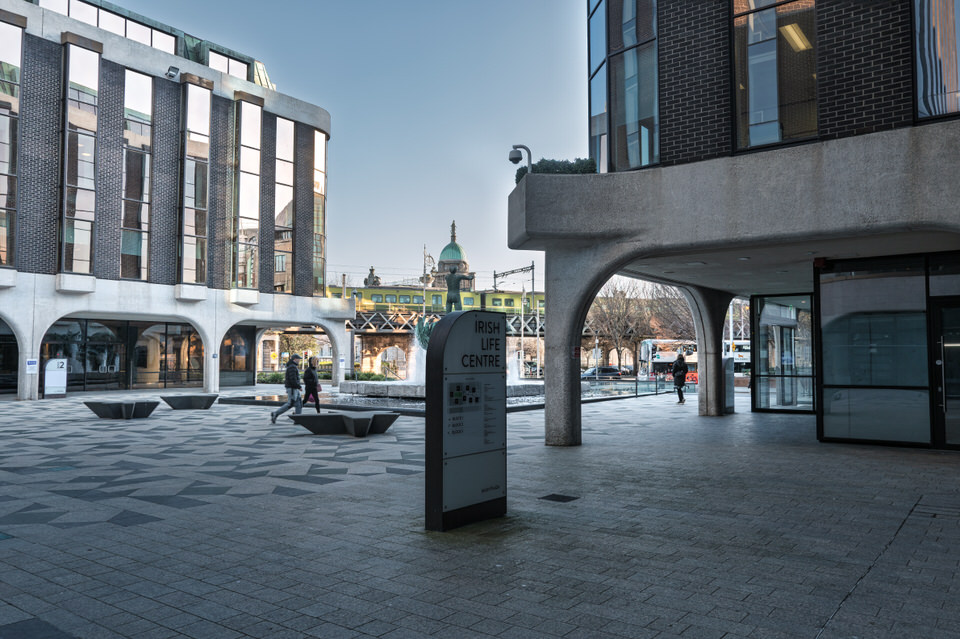
For years, I have documented the changing face of Dublin, often racing against time to photograph public art before it disappears. The Irish Life Centre on Abbey Street was once promoted as a "City within a City"—a cultural hub adorned with ambitious commissions by masters like Oisín Kelly, Alexandra Wejchert, and Desmond Kinney.

Back in the day, big corporations demonstrated their importance by promoting art and culture. They commissioned works not just for decoration, but as a statement of civic pride. But over the years, a different reality has set in. Today, I must close the file on one of the centre's lingering mysteries, and in doing so, highlight a prime example of how this corporate patronage has shifted to a strategy of "demolition by neglect."

PHOTO COLLECTION
MISSING ART AT IRISH LIFE
image-262809-1.jpg
image-262808-1.jpg
image-262807-1.jpg
image-262806-1.jpg
image-262806-1.jpg
image-262805-1.jpg
image-262804-1.jpg

PHOTOGRAPHED 4 JANUARY 2026

BY PAWEL JASINSKI

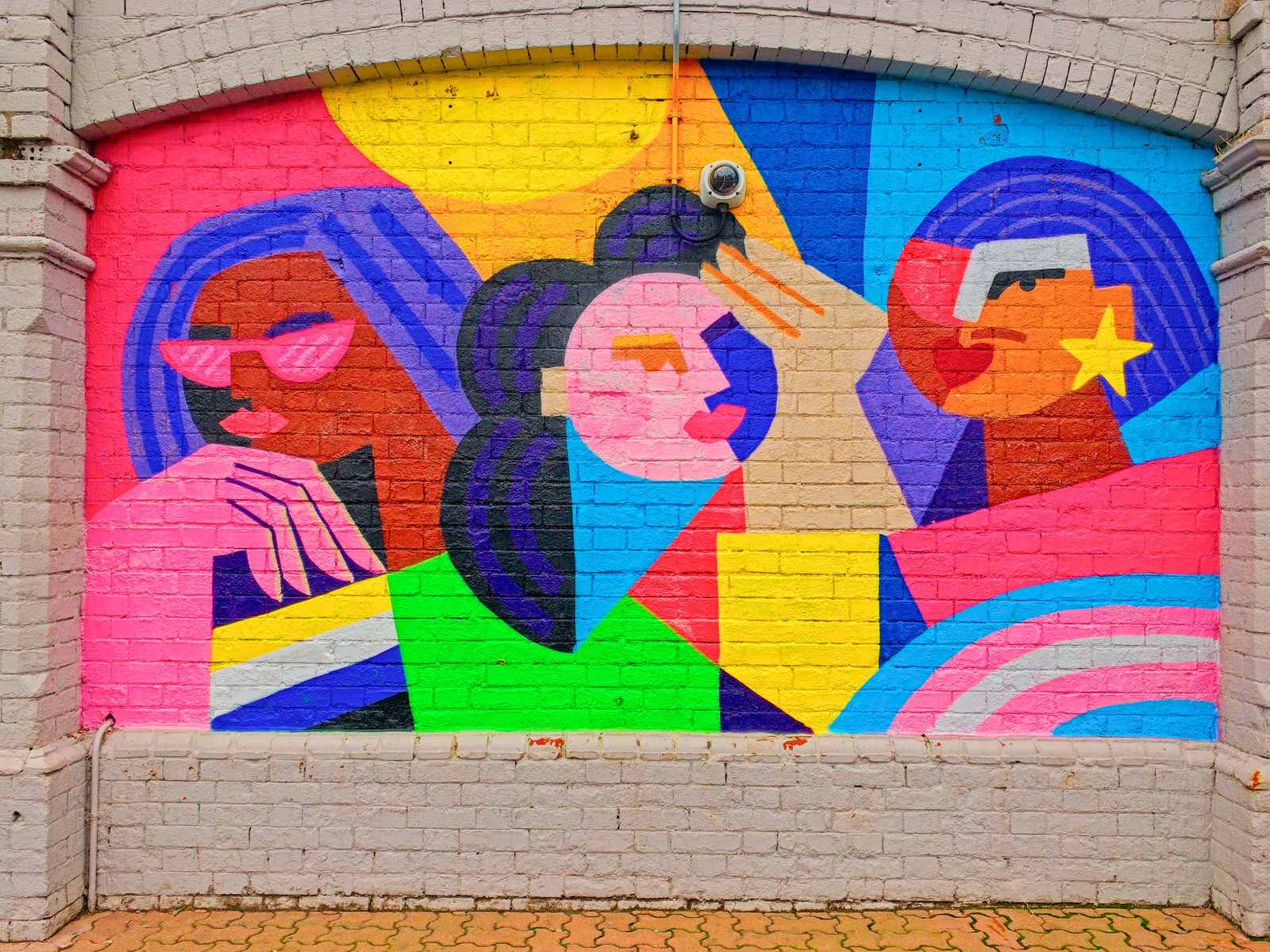
Pawel Jasinski is a Polish-born, Dublin-based artist known for his vibrant contributions to the Irish art scene. From his "Paint-A-Box" street art on Bolton Street to his iconic portrait of Paul Brady at The Icon Factory in Temple Bar, Jasinski’s work brings colour and whimsy to Dublin's city centre. Discover the artist whose painting "Woman at Temple Bar" was recognised by The Hunt Museum and who has exhibited at Krakow's legendary Piwnica pod Baranami

LEICA Q3 WITH UPDATED FIRMWARE

EAST HANOVER STREET


Historical and Social Significance

The street is perhaps most famous for being the location of Pearse House, a massive social housing complex completed in 1936. Designed by the renowned city architect Herbert George Simms, it remains a landmark of Art Deco-inspired municipal design. Built as part of a major initiative to replace inner-city tenements, its red-brick facades and open courtyards represent a pivotal era in Dublin’s social history.

In contrast, the eastern end of the street has undergone radical redevelopment. Once an industrial zone characterised by gasworks and warehouses, it now forms part of the "Silicon Docks."

LEICA Q3

PROBLEMS WITH THE 4.0.0 FIRMWARE UPGRADE

OUR CAMERAS IN DETAIL

Version 4.0.0 Geotagging Issues

For me this is/was a major issue

When I updated the Leica Q3 firmware to 4.0.0 all indications were that Geotagging was no longer functional and after many hours of experimenting I gave up. However, I decided to photograph the city at random to see if any photographs would be tagged and according to the camera there evidence of location information but that was mot the end of the story.

The "Expensive Brick" Dilemma: Solving the Leica Q3 Geotagging Mystery

As a street photographer, my process is simple: I wander the built environment at random, following the light and the architecture. I often have no idea exactly where I am at any given moment, which makes accurate geotagging a non-negotiable requirement. Without it, a camera—no matter how prestigious—is little more than an expensive brick to me.

After updating my Leica Q3 to Firmware V4.0.0, I hit a wall. I was met with a slashed-out Bluetooth symbol, constant connection drops, and a confusing "No Internet" error message. Most frustratingly, the camera’s display insisted there was no GPS data, even though my iPhone was right in my pocket.

I sought expert advice to understand why my Sony and Fuji systems worked flawlessly while the Leica seemed to be failing. As it turns out, the "issue" is a mix of Leica’s unique architecture and some non-intuitive settings.

The Explanation: Why It’s Smarter (and Dumber) Than It Looks

The mystery of why my photos were correctly tagged in Lightroom but showed "no info" on the camera screen comes down to three quirks:

Asynchronous Syncing: Leica uses a "handshake" system. If the Bluetooth link is asleep when the shutter clicks, the app and camera backfill the GPS data a few seconds later. Lightroom sees this updated metadata, but the camera’s internal preview often fails to refresh the display, leading to total confusion for the shooter.

The "Stroke" through the Bluetooth Symbol: This doesn't mean it’s broken. It indicates the camera is in a "sleep" state to save battery. It uses Bluetooth Low Energy (BLE) to ping the phone, only waking up fully the moment you take a shot.

The Icon Color: A solid white icon requires a "hot" live lock. If it’s only grey or an outline, the camera is simply waiting for a fresh coordinate update from the phone’s location services.

The Street Photographer's "Fix"

If you are experiencing similar drops on V4.0.0, here is the protocol I’ve adopted to ensure my wanderings are accurately recorded:

Switch to 2.4GHz: In Connectivity > WLAN Settings, move away from 5GHz. It’s faster for transfers but much less stable for the persistent background connection needed for GPS.

The "Always On" Hack: Since the FOTOS app lacks a "Background App Refresh" toggle, you must go to iOS Settings > Privacy > Location Services > Leica FOTOS and set it to "Always." This prevents the iPhone from killing the app while it's in your pocket.

Check Eco Mode: Ensure aggressive power saving isn't cutting your Bluetooth connection the moment you look away from the EVF.

It’s a relief to know the camera isn't a "brick" after all—it just requires a very specific handshake to keep the map updated while I lose myself in the city.

It should be noted that I had implemented all the above settings before seeking advice and all indications were that Geotagging was not active ... that is still the case so if one is out in the field it is impossible to confirm that location information has been captured. Also Lightroom indicated that there were issues with embedded information in some of the images.


Critical Settings for V4.0.0 Street Use

1. Disable "Focus Peaking in AF"

A common "annoyance" reported with V4.0.0 is that Focus Peaking (the red/green outlines) can stay active even in Autofocus mode. For street shooting, this is distracting.

Go to: Focusing > Focus Assist > Focus Peaking and ensure it is set to Off or set to trigger only in MF.

2. Configure the "New" Control Center

V4.0.0 introduced the SL3-style "Control Center" (the icon-heavy screen). You can now tap and hold icons here to rearrange them.

Prioritize: Place Leica Looks, Format SD Card, and Connection Settings on the first page. Since you rely on geotagging, having the connection icon easily reachable for a manual "re-handshake" is useful.

3. AF-C vs. iAF

Firmware 4.0.0 significantly improves iAF (Intelligent AF).

The Strategy: Set the camera to iAF. It will act as AF-S (single) for static architecture but will automatically switch to AF-C (continuous tracking) the moment a person walks into your frame. This is perfect for your "wandering" style.

4. The "Favorites" Fix

Leica moved the Favorites menu in 4.0.0. If you feel you've lost it:

Go into the Main Menu and look for the Star icon or the User Profiles section. You can still create a custom list of menu items, but you now access it by swiping right or pressing the Menu button twice from the Live View.


Why Would You Choose To Upgrade?

To a street photographer, a firmware update can feel like a double-edged sword: you want the performance gains, but you don't want to lose the "muscle memory" of a camera that has become an extension of your hand.

The Leica Q3 Firmware 4.0.0 (released December 2025) is the most significant overhaul since the camera’s launch. It isn't just a bug fix; it’s a total transformation of how the camera "thinks" and feels.

Here is why you would choose to make the jump, and what exactly has changed under the hood.

Why Upgrade? The "Street" Benefits

For a typical street photography style—wandering, reacting, and relying on the camera's autonomy—there are three "headline" reasons to upgrade:

Speed of Operation: The start-up and wake-from-sleep times have been significantly reduced. In street photography, the difference between a half-second and a full second is often the difference between a shot and a memory.

Autofocus Intelligence: The Q3 now uses AI-assisted models to recognise eyes, faces, and bodies more reliably. If you are shooting "from the hip" or in crowded environments, the camera is now much better at staying locked onto a human subject.

UI Modernisation: The interface has been unified with the newer Leica SL3. It’s cleaner, snappier, and for the first time, the entire menu system is fully touch-controllable.

What’s New: The Breakdown

1. The AF Overhaul

AI Subject Recognition: Expanded to include humans (eye/face/body) and a wider range of animals (birds, cats, dogs).

Refined Tracking: The tracking algorithm now automatically adjusts the size and shape of the focus field as the subject moves, making it far more "sticky."

Simplified Menus: "Multi-Field" and "Spot" have been consolidated. There is also a new AF Acquisition menu available in the Control Center for faster toggling between focus styles.

2. Interface & UX Changes

SL3-Style Design: New icons and a reorganised "Control Centre" (the screen you see when you press Menu).

Portrait Orientation Support: The info bars in Live View now rotate when you hold the camera vertically—a small but massive win for composition.

Leica Looks Intensity: You can now adjust the intensity of Leica Looks (filters), allowing for a more subtle look rather than a 0 or 100 approach.

3. Productivity & Maintenance

Battery Health: A new menu now displays the actual health/condition of your BP-SCL6 battery.

Automatic Restore: If you are updating from V3.1.1 or higher, the camera will now automatically back up and restore your user profiles and settings after the update—saving you an hour of menu diving.

FOTOS App Connectivity: While the "geotagging" logic remains the same (as discussed in your previous issue), the actual speed of transferring media to the app has been improved.

The "Street Photographer's" Warning

While the update is excellent, there are two "quirks" you should prepare for:

The Favourites Menu: Some users have noted that the classic "Favourites" menu has been rearranged or consolidated. You may need to spend 10 minutes re-mapping your favourite shortcuts to the new structure.

Focus Peaking: In V4.0.0, focus peaking can sometimes appear in AF mode by default. You may want to toggle this off in the settings if you find the red outlines distracting while the camera is auto-focusing.


LET’S EXPLORE

DUBLIN CITY

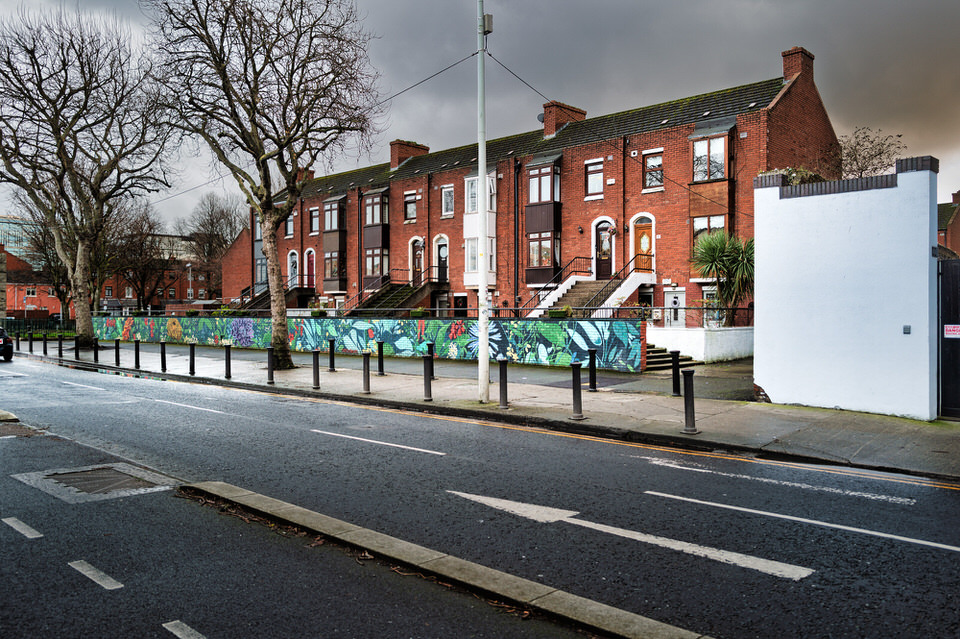
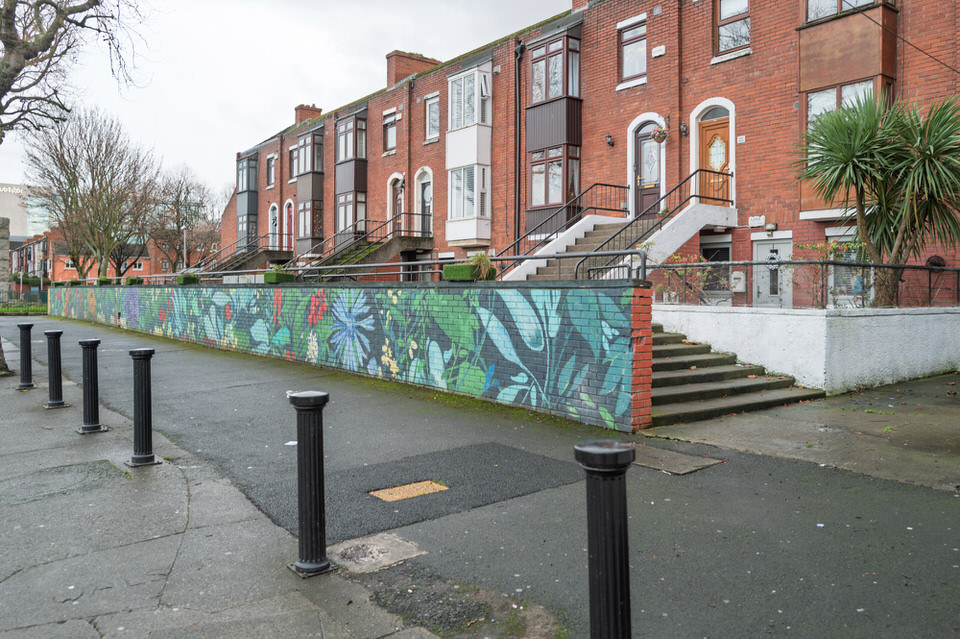
Very Long Mural On City Quay

This vibrant and exceptionally long mural is a prominent feature of City Quay in Dublin, located on the south bank of the River Liffey.

About the Mural

The mural, which stretches along a significant length of the low wall bordering the pavement and residential area, is titled "The Pollinator Wall". It was created by the Irish artist Holly Pereira in collaboration with Dublin City Council and local community groups.

Theme: The artwork is a celebration of Irish biodiversity, specifically focusing on the importance of pollinators like bees and butterflies. It features a continuous, colourful sequence of native Irish wildflowers, including dandelions, poppies, and ox-eye daisies, set against a lush green background.

Purpose: Beyond its aesthetic appeal, the mural was designed to brighten the "urban canyon" of the quays and raise awareness about the All-Ireland Pollinator Plan. It transforms a once-grey transit route into a "wildflower meadow" for pedestrians.

Style: Pereira is known for her bold, graphic, and colourful style, often blending flora with typography or folk-art motifs.

A Short Account of City Quay

City Quay is one of Dublin’s oldest and most historically significant quayside areas. Situated between Tara Street and the Samuel Beckett Bridge, it has undergone a dramatic transformation over the centuries.

Maritime History: Established in 1715, it was once a bustling hub for the coal trade and shipping. For decades, it was defined by the presence of sailors, stevedores, and the constant unloading of cargo.

Community and Church: The heart of the area is the Church of the Immaculate Heart of Mary, built in 1863 to serve the growing population of seafarers and dock workers. The parish remains a tight-knit community despite the surrounding modernisation.

Regeneration: In the late 20th century, the area suffered from urban decay as shipping moved further downstream to the deep-water port. However, it has since been revitalised as part of the Dublin Docklands development. Today, historic red-brick social housing (visible in your photo) sits in the shadow of modern glass-and-steel offices and luxury apartments.

Modern Identity: City Quay is now a vital link between the traditional city centre and the high-tech "Silicon Docks" area, blending its gritty industrial heritage with contemporary urban art and architecture.

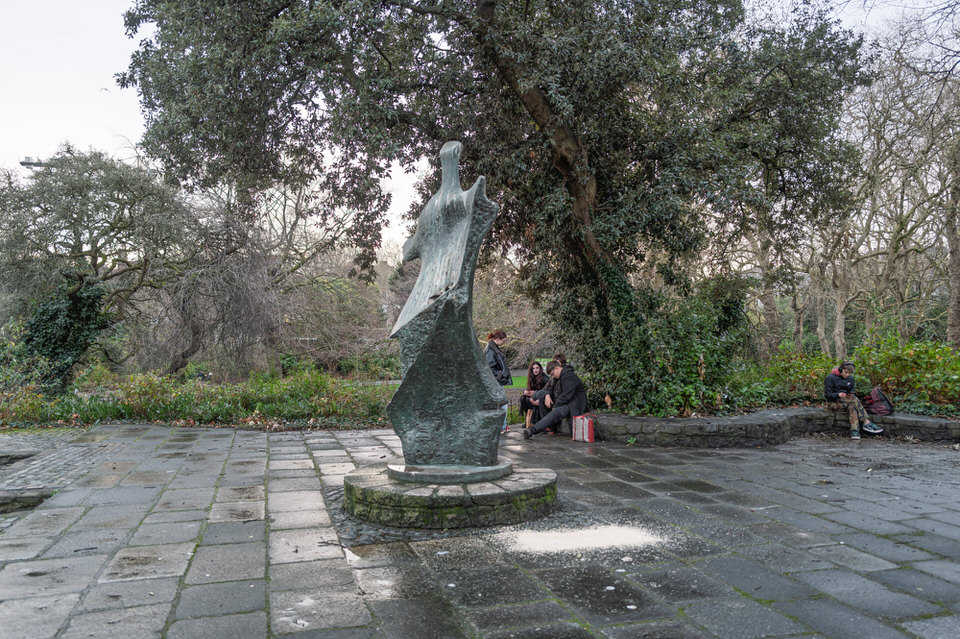
Henry Moore Sculpture In St Stephen’s Green

The "Moore Statue" in St. Stephen's Green is actually the abstract bronze sculpture "Knife Edge" by Henry Moore, a memorial to Irish poet W.B. Yeats, erected in 1967, featuring a distinctive cape shape in a tiered garden setting, serving as a peaceful spot for reflection and commemorating the Nobel laureate.

Photographed Using A Leica Q3

KNIFE EDGE SCULPTURE

The Yeats Memorial Garden

Erected in October 1967, the sculpture was unveiled by then-Taoiseach Jack Lynch. It was the first abstract monument in St. Stephen's Green, a park otherwise filled with traditional figurative busts.

Symbolism: While the sculpture is not a literal likeness of Yeats, Lynch noted at the unveiling that the poet—who detested "trite" or "facile" monuments—would have likely appreciated the work's modern, complex spirit.

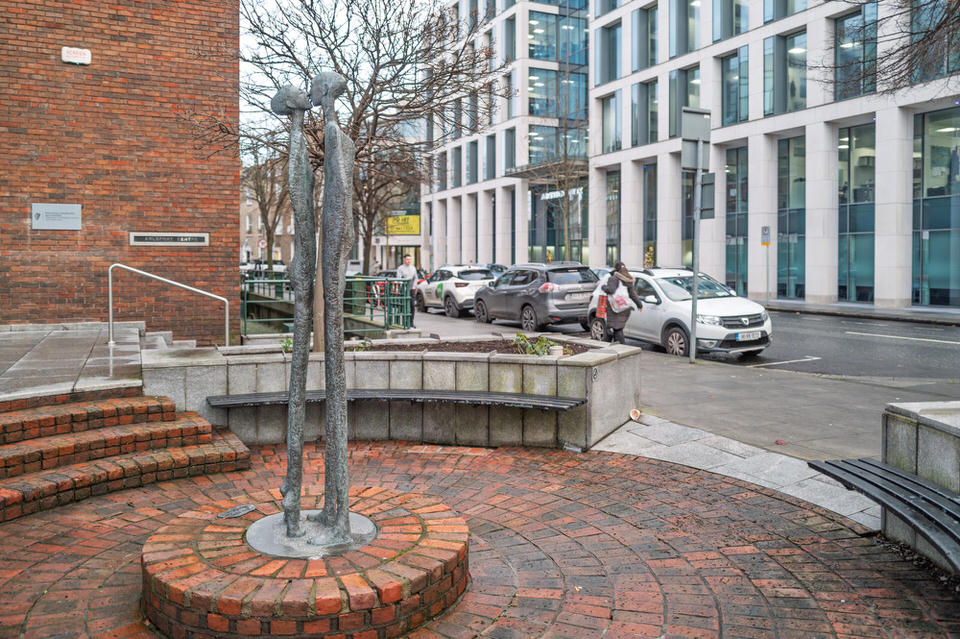
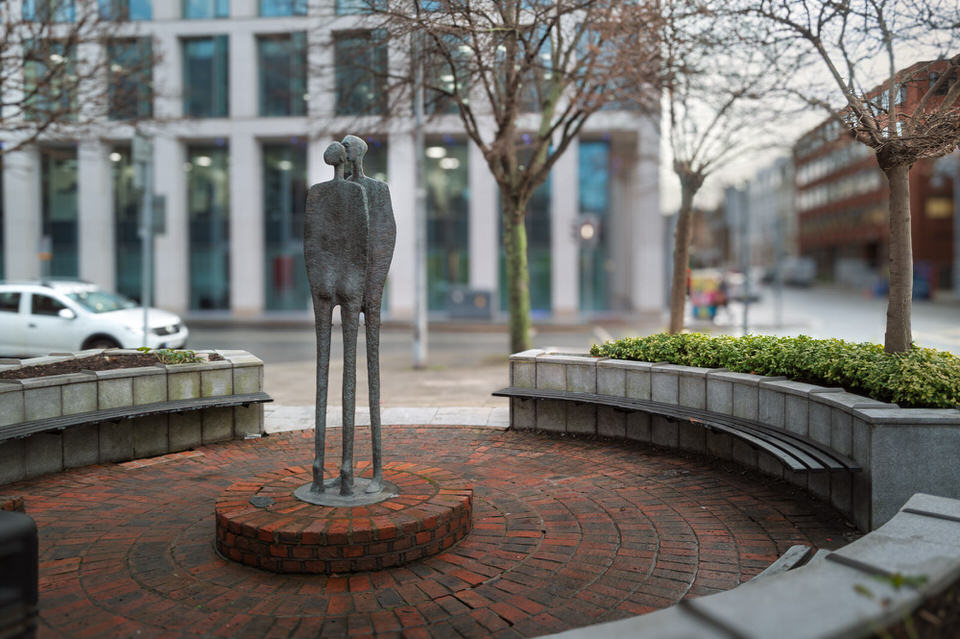
The Story Behind The Kiss Sculpture

The Kiss by Rowan Gillespie: A Guide to Dublin’s Most Romantic Sculpture Description: Discover the history and meaning behind "The Kiss," the famous bronze sculpture by Rowan Gillespie on Earlsfort Terrace. Learn about its connection to Khalil Gibran and why it captures the perfect moment of anticipation.

PHOTOGRAPHS

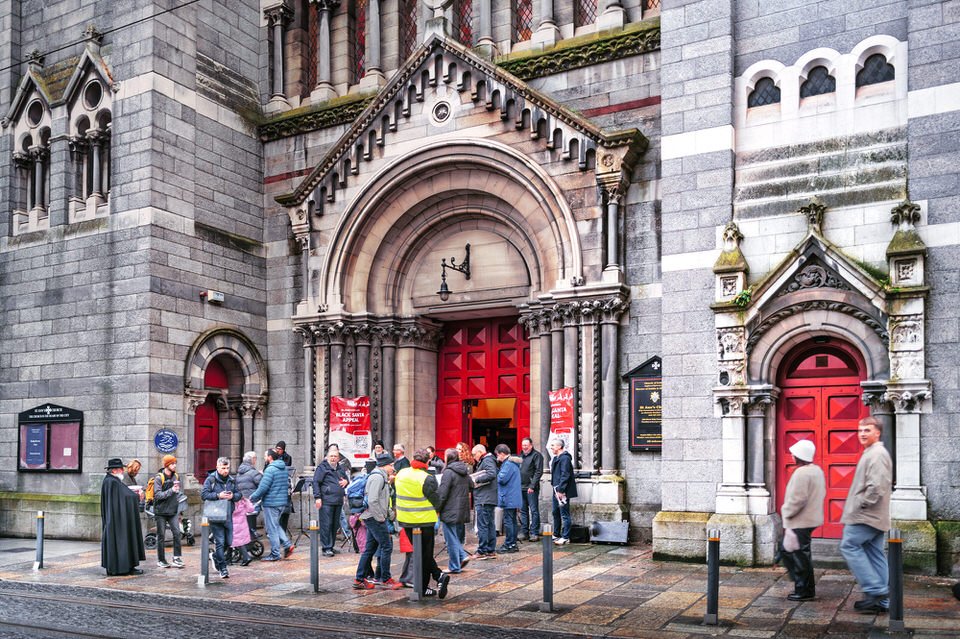
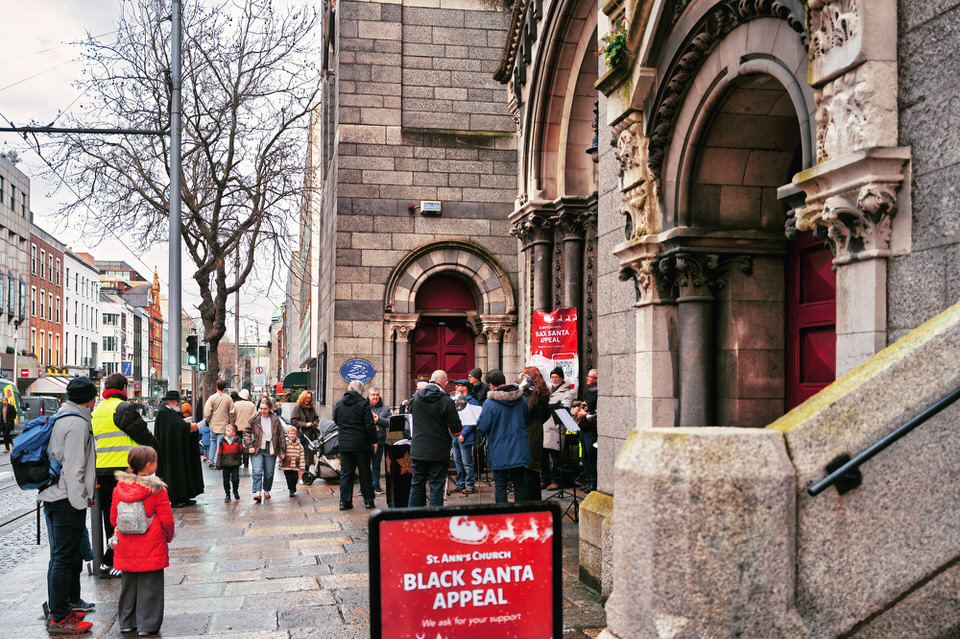
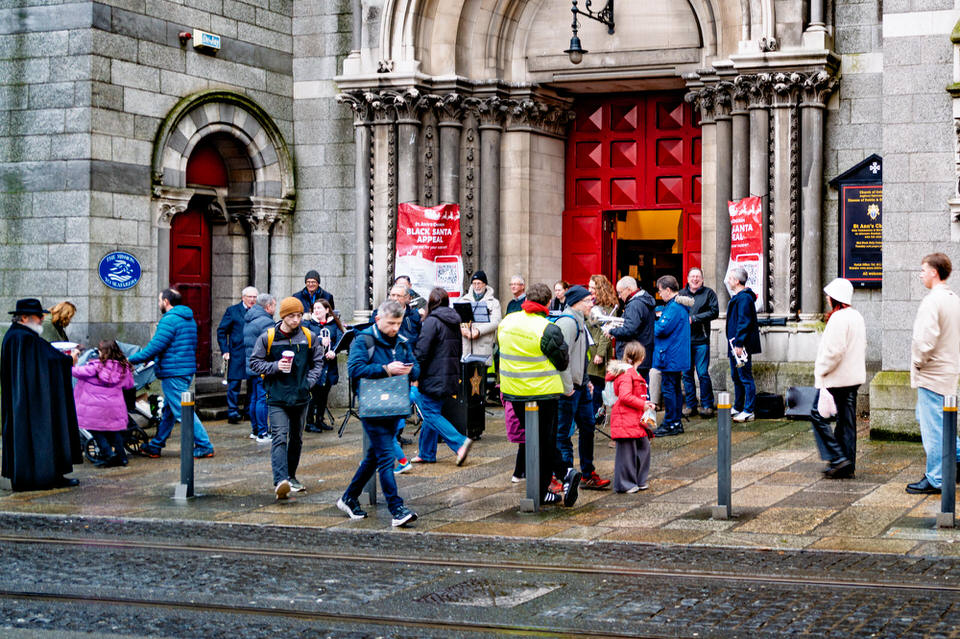
The Black Santa On Dawson Street

If you walk down Dawson Street in the frantic week leading up to Christmas, past the rattling Luas tracks and the busy cafes, you will encounter a sight that stops many visitors in their tracks. Standing on the steps of St Ann’s Church, amidst a swirl of choirs and clinking buckets, is a figure who looks a bit like Father Christmas—but dressed entirely in black.

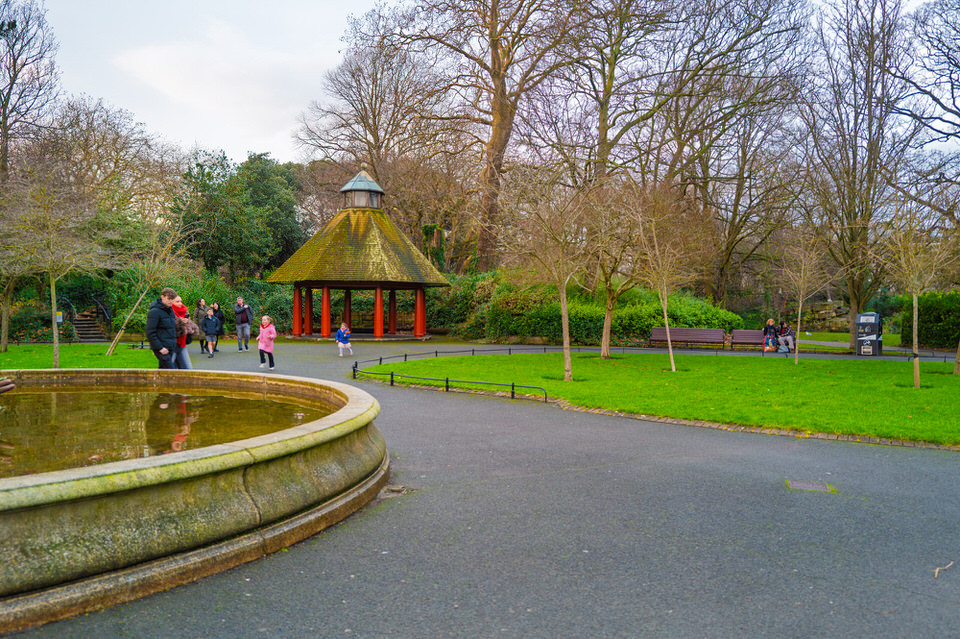
St Stephen’s Green At Christmas

Discover the history and beauty of St Stephen's Green, Dublin's premier Victorian park. Located at the top of Grafton Street, this 22-acre green space features ornamental lakes, historical monuments, and a rich legacy dating back to the 1916 Easter Rising. Explore the fusiliers' arch, the sensory garden, and the tranquil grounds gifted to the city by the Guinness family.
CHRISTMAS 2025

ST STEPHEN’S GREEN

Originally a marshy common on the edge of the city used for grazing livestock, the area was enclosed in 1663. For centuries, access was restricted to the wealthy residents who owned the surrounding Georgian townhouses. It was not until 1877, through the philanthropy of Sir Arthur Guinness (Lord Ardilaun), that the park was bought, re-landscaped, and eventually opened to the public in 1880.

THE PHOTOGRAPHS
ABOUT THE PARK

All Forms Of Street Art

Visit Our Street Art Catalogue

EXPLORE OR CATALOG OF STREET ART
PAINT-A-BOX STREET ART

PRESENTED BY THE URBAN CARTOGRAPHER

VISITING BELFAST SINCE 2011

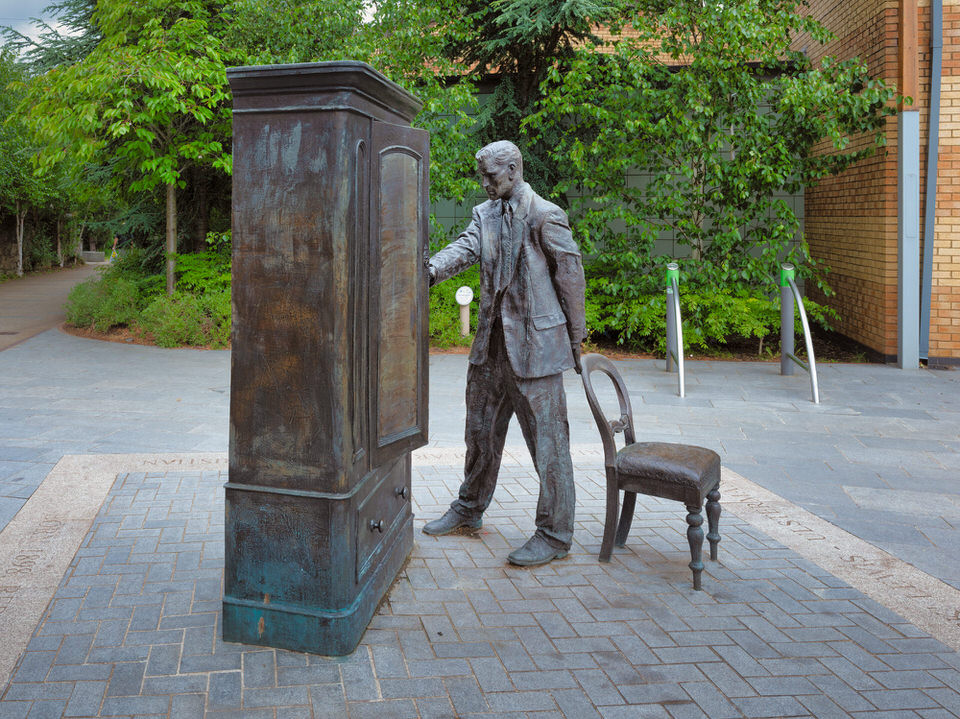
The Man And The Wardrobe Sculpture By Ross Wilson

Captured here with a Fujifilm GFX100, the sculpture stands distinct from its surroundings. While the square is populated by Maurice Harron’s striking, fantastical interpretations of the White Witch and Aslan, Wilson’s work is a study in realism and anticipation.

AT THE C.S. LEWIS SQUARE CONNSWATER

SEARCHER

Commissioned in 1998 to mark the centenary of C.S. Lewis's birth, 'The Searcher' does not depict a beast or a battle. Instead, it captures a human moment on a human scale. The figure represents Digory Kirke (the protagonist of The Magician's Nephew and later the Professor in The Lion, the Witch and the Wardrobe) standing at the threshold of the wardrobe.

In the context of the Newtownards Road—an area defined by physical barriers, peace lines, and regeneration zones—this sculpture is a powerful metaphor for a different kind of crossing. It is a study in the "threshold." Wilson captures the figure in the precise second before the door opens, inviting the viewer to step out of the grey reality of the Belfast street and into the boundless imagination of Lewis. It suggests that the magic of Narnia did not begin with a lion, but with the curiosity to open a door.
PUBLIC ART IN BELFAST

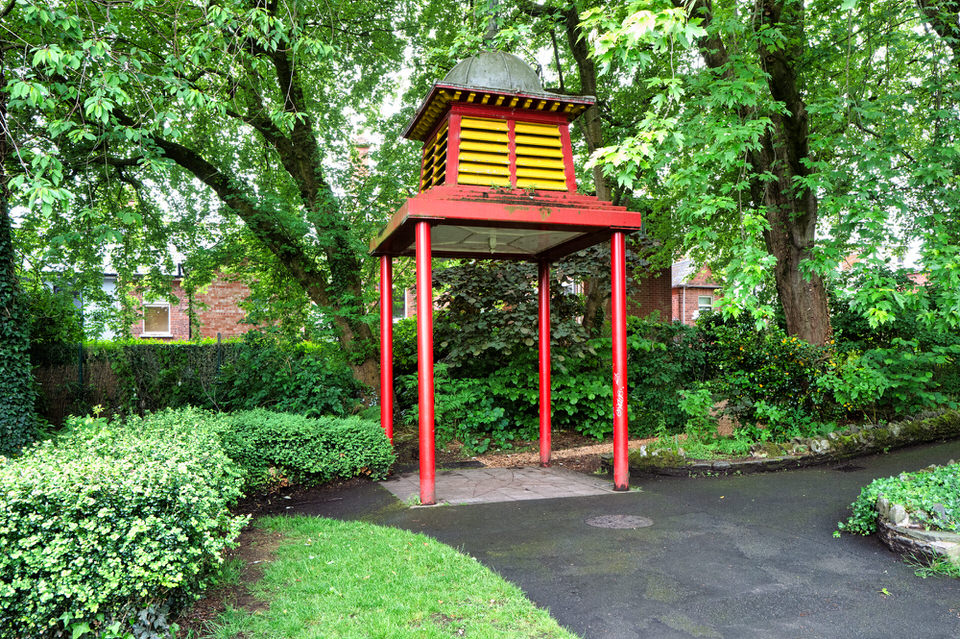
The Chinese Pagoda: A Symbol of Belfast's Global Connections

Despite its visible presence and common recognition among the public, the pagoda is notably omitted from comprehensive historical accounts and official descriptions of the Botanic Gardens' primary features. Documents from the Friends of Belfast Botanic Gardens and Belfast City Council's general overviews of the park do not list the "Chinese Pagoda" among their significant architectural or horticultural highlights.

IT IS A GIFT FROM THE PEOPLE HEFEI IN CHINA

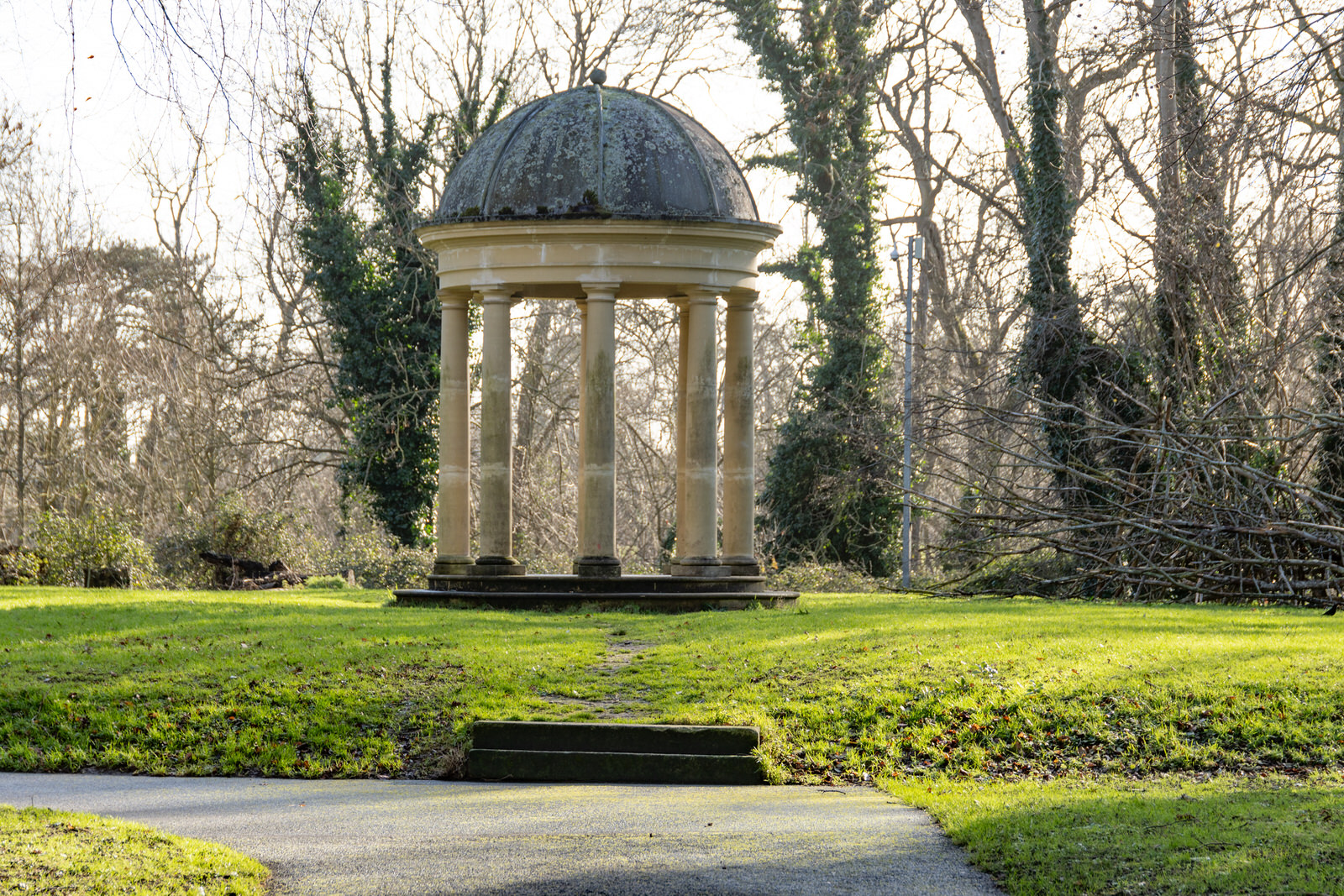
CHINESE PAGODA

Contrary to some local perceptions, the pagoda is far more than just a shelter. It was gifted to Belfast by its sister city, Hefei, China, in 1997. This generous offering was an integral part of a developing relationship that formally culminated in a historic 'Sister Cities' agreement signed in June 2005.

PHOTOGRAPHS
MORE INFORMATION
BUILDINGS OF INTEREST

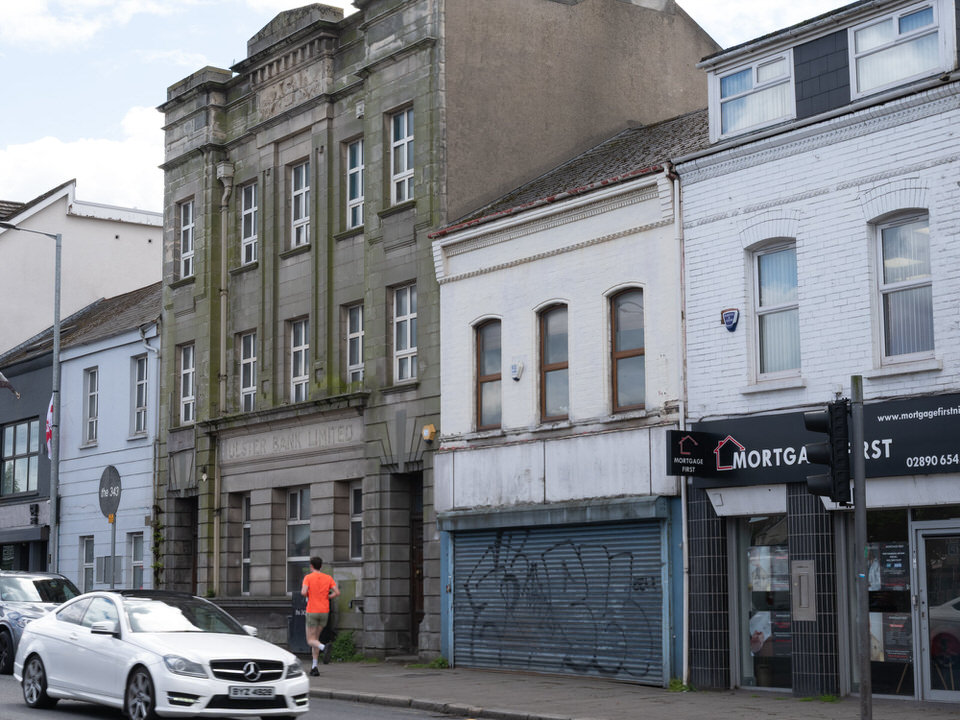
Derelict Ulster Bank Building

The former Ulster Bank building is located at 431-441 Newtownards Road, Belfast, BT4 1PG. It's a three-storey building designed in 1918 by Blackwood & Jury. The building has a Neo-Georgian style, featuring a curved ground floor with a central doorway flanked by casement windows. Above, a canted two-storey bay with casement windows is flanked by pairs of sash windows. At roof level, there's a balustrade with a central coat of arms. The building is constructed from Donegal Sandstone and polished black granite.

PHOTOGRAPHED IN MAY 2025

DERELICT BANK BUILDING

The Ulster Bank relocated from this building to Connswater Retail Park in early 1998. From March 1998 to March 2013, the building was leased to Ferris, Craig & Moore (FCM Partnership). It was offered for sale in 2013 and sold in October of the same year. The Orange Order occupied the building's offices temporarily between December 2013 and June 2015 during refurbishment works at Schomberg House. The building was B2 listed in April 2016. In February 2021, a planning application was submitted to convert the upper floors into seven apartments.

April 2011 Visit To Belfast - My First Since The 1960s

I was surprised to discover that I used the Sony VG10E camcorder to photograph this building when I first visited and photographed the built environment in Belfast back in 2011,

PHOTOGRAPHED IN 28 APRIL 2011

OCEAN BUILDINGS

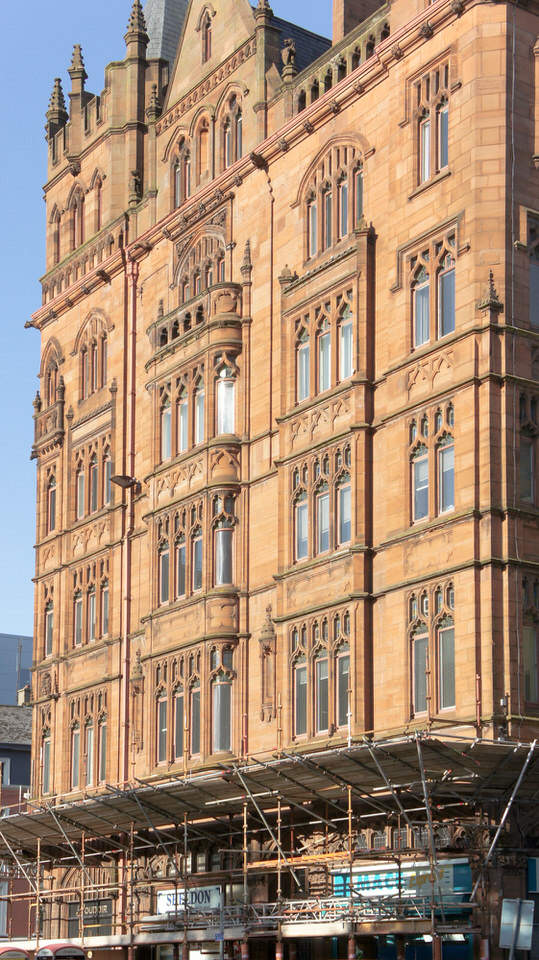
Mystery Solved: The Red Sandstone Landmark of Donegall Square

I am finally dusting off this photograph from the archives. I actually took this shot back in 2011 during a trip to Belfast, but it has sat unpublished on my hard drive for over a decade for one frustrating reason: I couldn't identify the building.
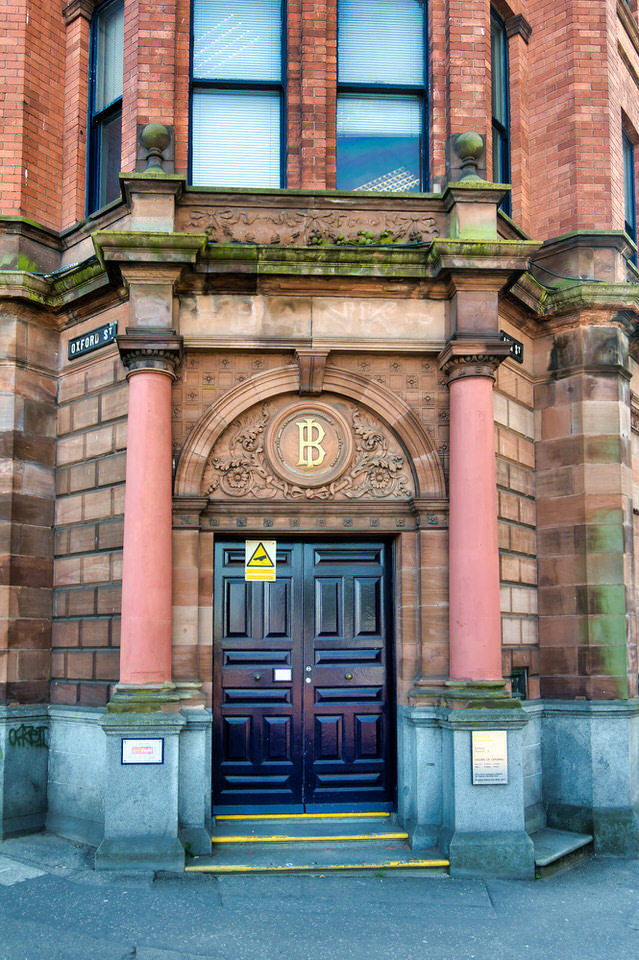
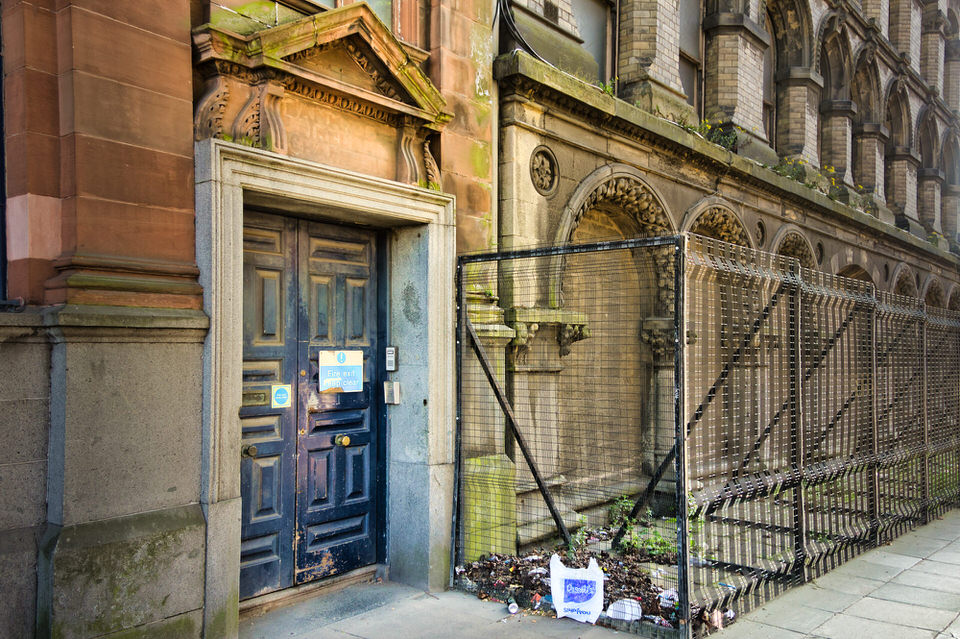
For years, I was convinced I had taken it on Oxford Street, near the Law Courts. I searched high and low on maps of that area but could never match the distinct architecture. It was a cold case in my photo collection until today, when I finally spotted the vital clue hiding in plain sight behind the scaffolding: the sign for "Sheldon."

It turns out my memory was slightly off by a few streets. This isn't Oxford Street; it is the magnificent Ocean Buildings (also known as Pearl Assurance House) located at 1-3 Donegall Square East, right on the corner of Chichester Street.

A Victorian Masterpiece Now that I know what it is, the history makes the building even more impressive. Completed around 1902, it was designed by the renowned Belfast architects Young & Mackenzie. It was originally built as the headquarters for the Ocean Accident & Guarantee Corporation, which explains the nautical themes hidden in the stone carvings—if you look closely at the masonry on this building, you can find mermaids and lighthouses, which were the corporation's trademark.

The building is a stunning example of the High Victorian style with strong Gothic and Tudor influences. The striking colour comes from Ballochmoyle red sandstone imported from Scotland, which makes it stand out vividly against the grey Belfast sky.

Frozen in Time In this photograph from 2011, the ground floor is heavily obscured by scaffolding and hoardings. At the time, the building was undergoing significant restoration work to preserve that beautiful red sandstone facade. The "Sheldon" sign visible in the shot belongs to Sheldon Galleries, a framers and art gallery that occupied the ground floor unit for many years, which ultimately helped me unlock the location.

It feels good to finally give this image a name and a place in my portfolio. It is a reminder that even arguably the most distinct buildings can hide from you if you are looking on the wrong street!

Laganview House On Ann Street In Belfast Photographed April 2011

During this visit I used a Sony NEX-5 and a Sony VG10E camcorder

WHERE ANN STREET MEETS OXFORD STREET

LAGANVIEW HOUSE BELFAST

I photographed this back in April 2011 and at the time I was unable to find any information relating the the history of the building.
The building shown in my photograph is Laganview House (93-95 Ann Street), located right at the corner where Ann Street meets Oxford Street and the Queen’s Bridge (overlooking the river).
1. The Building Housing WED2B: Laganview House

Identity: This building is the former Bank of Ireland (Queen's Bridge Branch).

History: It was built between 1899 and 1900 and designed by the architects Millar & Symes in a red-brick Victorian style.

Usage: For most of its life, the ground floor was a bank serving the busy river and market traffic. The upper floors were rented as offices to various tenants, including grain merchants, insurance firms, and at one point, the Boys' Brigade headquarters.

Modern Era: In later years, it was occupied by the Northern Ireland Housing Executive (NIHE). It sat empty for a short period around 2013-2015 before being purchased and refurbished by Angus Properties in 2017, eventually becoming the bridal store WED2B on the ground floor.

Riddle’s Warehouse On Ann Street As It Was In April 2011

The "once attractive" derelict building next door (87-91 Ann Street) is Riddel’s Warehouse. It is one of the most significant industrial heritage buildings in Belfast.

I HOPE TO PHOTOGRAPH THIS IN GREATER DETAIL

APRIL 2011 VISIT TO BELFAST
BUILDINGS OF INTEREST


The Wider Problem: Why so many derelict buildings?

I have been asked to explain how owners can "afford to sit" on these properties and why there are so many. In Belfast, this is driven by a "perfect storm" of three factors:

A. The "Rates Loophole" for Listed Buildings

In Northern Ireland, if a building is "Listed" (protected for its history, like Riddel's Warehouse), the owner does not have to pay rates (property tax) while it stands empty. The Consequence: There is no financial penalty for leaving a historic building to rot. A developer can buy a historic site and leave it empty for 10 or 20 years without it costing them a penny in annual taxes. This encourages "land banking"—buying a building and waiting for the land value to go up.

B. Land Banking & Speculation

Many derelict buildings are owned by large investment firms or developers who are not interested in the building itself, but in the land. They often wait for the market to peak, or for government grants to become available, before they act. A prime example near Ann Street is the "Tribeca" project (around North Street), where a developer bought huge swathes of the city, evicted tenants, and then stalled construction for years, leaving streets looking abandoned.

C. The Cost of Restoration vs. New Build

Restoring a Victorian building to modern safety standards (fire regulations, accessibility) is often more expensive than knocking it down and building a generic glass box.However, because these buildings are "Listed," they cannot be knocked down. This leaves them in limbo: too expensive to fix, illegal to demolish, and free to leave empty.

Summary of Ownership & Employees

Employees: In the case of Riddel's, the staff were not simply fired; the business moved to a safer location outside the city centre to continue trading. This is common; retail staff are often made redundant or transferred when high street shops close.

Owners: The owners are rarely individuals anymore. They are usually pension funds, property investment groups (often based in London or overseas), or preservation trusts (like Hearth) struggling to find funding


History: Built in 1867 by the architect Thomas Jackson, it was a warehouse for John Riddel & Co., a major ironmongery and hardware business.

Interior: While the outside is covered in decades of grime, the interior is stunning. It features a five-storey glass-roofed atrium with galleries supported by cast-iron columns. It is often described as a "sleeping giant."

Why it became derelict: The building didn't close because of bankruptcy; it closed because of the Troubles. In 1973, the bombing campaign made it too dangerous to operate a business in the city centre. Riddel's moved out, and the building was acquired by the Police Authority (PSNI).

The "Security Buffer": Because it is located right next to Musgrave Street Police Station, the police used the building as a "security buffer" to protect the station from blasts. It was essentially "mothballed" for 40 years, used only for storage and lost property. This is why it has sat silent for so long.

Current Status: It is no longer owned by the police. It was acquired by the Hearth Historic Buildings Trust, a charity dedicated to saving risk-status buildings. They are currently fundraising and working to restore it into a cultural arts centre, but the restoration costs are massive (millions of pounds), which explains the slow progress.

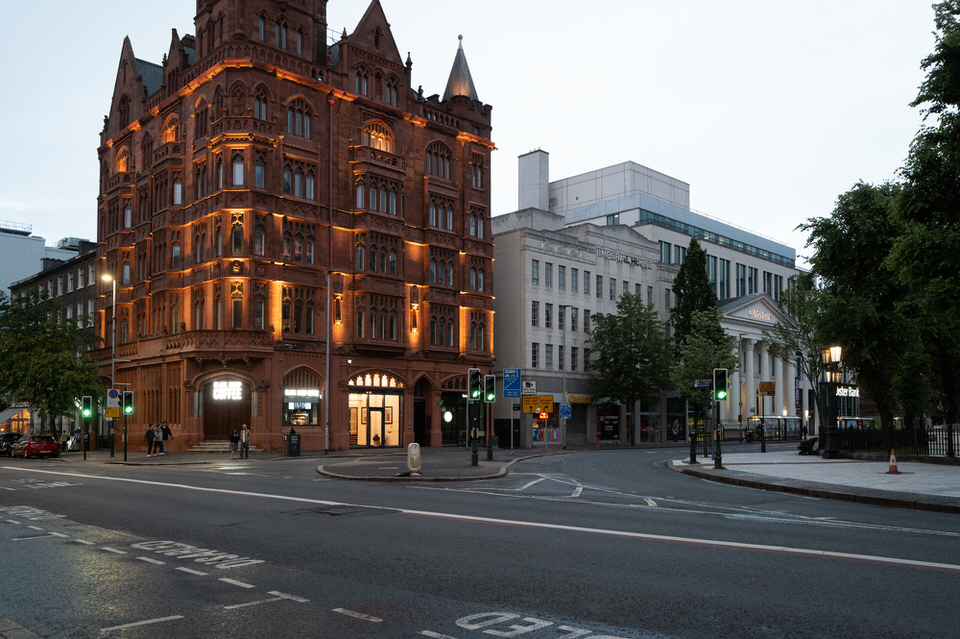
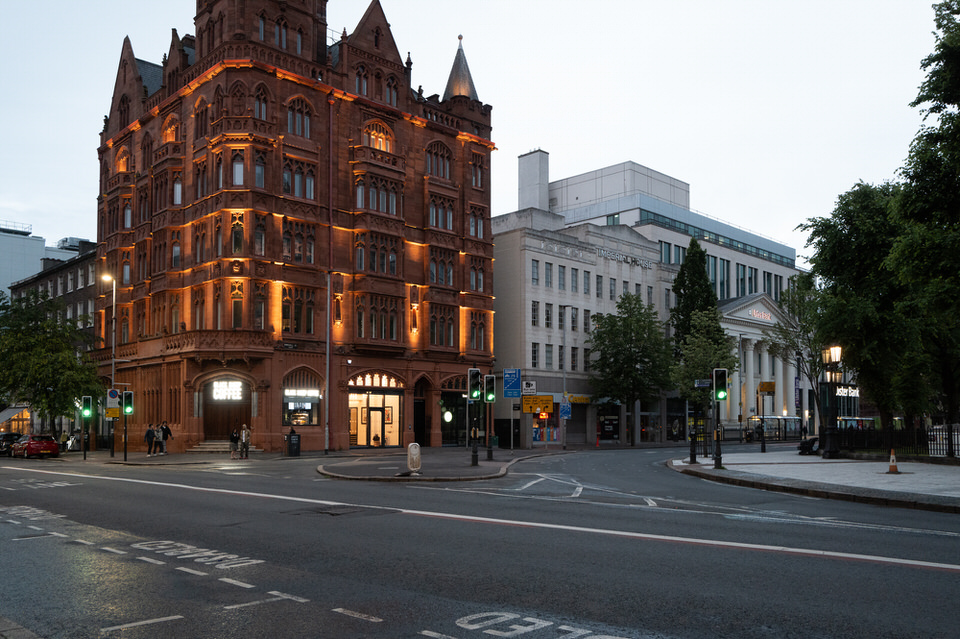
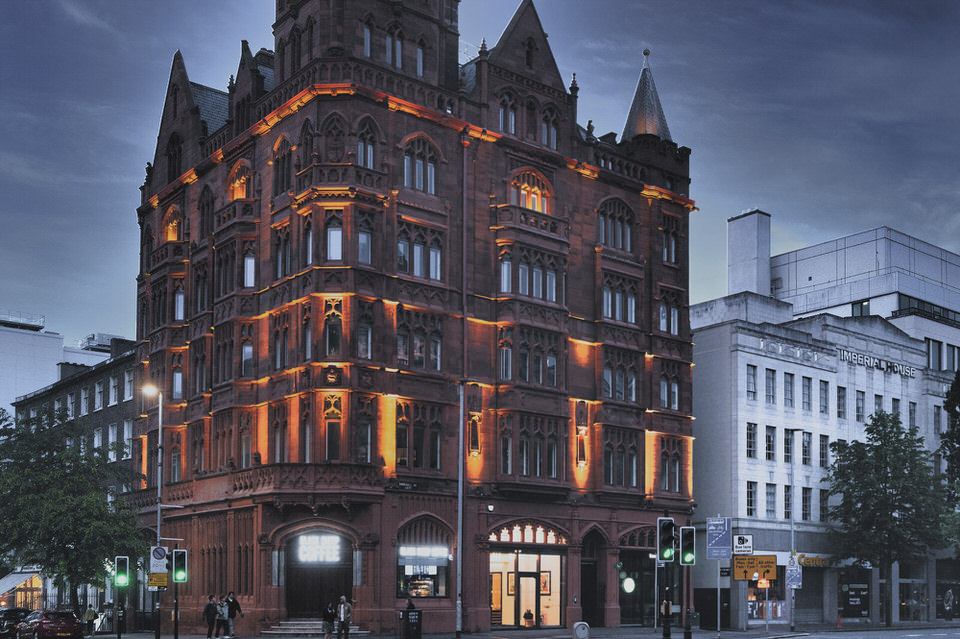
A Blue Hour Photograph Of Pearl Assurance House - May 2025

The façade is a masterclass in texture, featuring intricate stone carvings, projecting oriel windows that add depth, and a prominent corner turret with a conical roof that anchors the intersection. The modern uplighting captured in this night shot beautifully accentuates the verticality of the design, casting dramatic shadows that highlight the craftsmanship of a bygone era. Today, the ground floor breathes new life into the square, hosting "Black Sheep Coffee," blending contemporary city culture with historic grandeur.

II PHOTOGRAPHED THIS IN 2011 AND AGAIN IN 2025

ALSO KNOWN AS OCEAN HOUSE

Pearl Assurance House: A Cold Case Solved in Red Sandstone

For over a decade, this magnificent structure remained a "cold case" in my archives. I first photographed it back in May 2011 using a Sony VG10E—an early mirrorless camcorder that I was using for stills at the time. However, under the mistaken belief that the building was located on Oxford Street, I hit a dead end trying to uncover its history. I searched maps of that area extensively, but I could never match the distinct architecture to the location. Consequently, the image sat unpublished on my hard drive—a beautiful but anonymous mystery.

The breakthrough finally came just a few days ago, hiding in plain sight behind some scaffolding in that original 2011 photo: a sign for "Sheldon." The name sparked a memory of the Sheldon Galleries, which I had walked past during a recent trip to Belfast in May 2025.

It turns out I had unwittingly photographed the same building again during that recent trip, this time at night. I hadn't planned to publish the 2025 image initially; the session had been a trial by fire with my new flagship Leica Q3, and I felt the results showed my struggle with the camera's steep learning curve. However, once I identified the location as Ocean Buildings (historically Pearl Assurance House) on Donegall Square East, I realized the two images belonged together. It is satisfying to finally unite the 2011 find with this 2025 update, showcasing both the enduring grandeur of the building and the evolution of my photography journey.

Architectural Notes

The building itself is a stunning exemplar of the High Victorian style, showcasing strong Gothic and Tudor Revival influences. Its most striking feature is the warm, Ballochmoyle red sandstone imported from Scotland, which creates a vivid, fiery contrast against the cool tones of the typical grey Belfast sky and the pale stone of the adjacent Imperial House.

The façade is a masterclass in texture, featuring intricate stone carvings, projecting oriel windows that add depth, and a prominent corner turret with a conical roof that anchors the intersection. The modern uplighting captured in this night shot beautifully accentuates the verticality of the design, casting dramatic shadows that highlight the craftsmanship of a bygone era. Today, the ground floor breathes new life into the square, hosting "Black Sheep Coffee," blending contemporary city culture with historic grandeur.

Technical Details & The Learning Curve

Gear Evolution:

2011: Sony NEX-VG10E (APS-C Sensor). A novelty setup using a camcorder for stills.

2025: Leica Q3 (60MP Full-Frame Sensor). A flagship tool that demands precision.

The "Trial by Fire" Lesson: During the May 2025 shoot, I was still operating with my old mindset: keeping the ISO locked low (100–400) to ensure the cleanest possible file. With a 60-megapixel sensor, this forced my shutter speeds too slow, resulting in a struggle against camera shake. High-resolution sensors are unforgiving; any micro-jitter becomes visible blur.

My New Workflow (The Solution): Since that trip, I have completely flipped my approach for handheld night photography:

Priority on Shutter: I now aim for a shutter speed of around 1/150 sec to eliminate micro-jitter.

Auto ISO: I let the ISO float and let the camera decide the sensitivity.

The Philosophy: I realized that modern noise reduction software is incredible, but motion blur is permanent. It is easy to adjust for noise in post-production, but a blurred image is unusable.

Waiting For Godo

Pending

YES WE DID HAVE PROBLEMS

HERE WE DISCUSS VARIOUS PROBLEMS

The Capel Street Rain And Mist Test And Why My X100 VI Failed


3 Surprising Quirks of the Fujifilm X100VI I Learned the Hard Way

Introduction: The Honeymoon and The Reality Check

The Fujifilm X100VI is, without a doubt, one of the most sought-after cameras on the planet. Its blend of style, performance, and compact size has created a massive following, and for good reason. It’s a joy to use. But the honeymoon phase ends abruptly when you discover its hidden limitations under pressure. My own reality check came during a shoot that can only be described as a disaster—a frustrating experience that revealed three surprising truths about this camera that every owner needs to know before heading out into the real world.


--------------------------------------------------------------------------------

1. Its "Weather Resistance" Comes with a Major Catch

One of the key selling points of the X100VI is its weather resistance. It’s a feature that suggests you can shoot with confidence when the weather turns. After my own gear failed in the field, I started digging into why, and I discovered a massive catch. What I didn't realize is that this "weather resistance" isn't active out of the box.

To actually seal the camera, you must first purchase two separate accessories: the AR-X100 adapter ring and a compatible 49mm protection filter. You have to perform a specific procedure: unscrew the decorative ring on the front of the lens, attach the adapter, and then screw the filter onto that adapter. Only this exact combination creates the necessary barrier to protect the camera's moving front lens element from dust and moisture. Without it, your camera is completely vulnerable.

2. Its Own Conversion Lenses Can Create a Moisture Trap

I learned that first lesson the hard way while shooting on Dublin’s Capel Street in November. It wasn't pouring rain; it was something far worse for a camera—a pervasive, wetting Irish mist that hung in the air. I had the excellent WCL-X100 wide-angle converter attached, and I felt secure. I was wrong. The moment you attach one of Fujifilm's own conversion lenses, you completely break the weather seal you worked to create.

This is a critical design flaw. The WCL attaches directly to the camera's lens threads but lacks the necessary rubber gasket to form a watertight barrier. To make matters worse, its large, bulbous front element is incredibly exposed, acting almost like a rain catcher. In that fine mist, capillary action drew moisture right into the gap between the camera's master lens and the back of the conversion lens, creating an internal fog chamber.

The majority of the images from that session were unusable, ruined by unremovable internal fogging that didn't clear until the camera sat in a dry room for hours.

The experience stands in stark contrast to shooting with a truly integrated system like the Leica Q3. Its IP52-rated body is sealed as a single unit, but the real difference is the glass. The Leica's Summilux lens has aggressive hydrophobic coatings (AquaDura) that cause water to bead up and roll off instantly. Furthermore, its lens element is deeply recessed inside its square hood, providing a natural physical barrier. The X100VI's modularity, while versatile, introduces a significant vulnerability in wet weather.

3. It Can Have a "Panic Attack" from a Simple Squeeze

Nothing wakes you up faster on a crisp morning shoot than your brand-new camera refusing to work. On one such morning, I framed up my first shot, flicked the on-switch, and instead of the EVF springing to life, I was greeted by a bright yellow warning message. My heart sank.

* A bright yellow "Please use genuine battery" warning.
* A "Temperature Problem" alert, immediately before shutting down.

I was using the genuine Fuji battery. I popped it out and put it back in. Same message. I grabbed my bag and tried three other fully charged, genuine batteries. Every single one threw the same error. Then, just as I was about to give up, the camera flashed the "Temperature Problem" alert and shut down. I was standing in near-freezing weather; it was physically impossible for it to be overheating.

On a hunch, I unscrewed the WCL-X100 conversion lens I had attached. I flipped the power switch, and the camera booted up perfectly. The cause of this "false positive" is a mechanical hiccup. Tightening an accessory can cause microscopic flex in the camera's chassis, which momentarily unseats the battery pins. This creates a voltage fluctuation, and the camera's processor gets confused by the unstable power signals. It panics, misinterpreting the bad data as both a non-genuine battery and a critical temperature fault.

If this ever happens, do not worry. Simply unscrew the lens, or just open the battery door and firmly reseat the battery to resolve the issue.


--------------------------------------------------------------------------------


Conclusion: A Brilliant, Imperfect Camera

The Fujifilm X100VI is a phenomenal camera, and my affection for it remains. It delivers beautiful results in a package that is a pleasure to carry and shoot with. However, its compact, modular design introduces specific trade-offs and vulnerabilities that aren't advertised on the box. Understanding that its weather sealing has conditions, that its own lenses can undermine that sealing, and that its electronics can be sensitive to simple mechanical pressure is key to using it successfully in all conditions.

Now that you know its hidden weaknesses, does it change how you see the camera, or does it just make you a more prepared owner?

Report: William Murphy Monday 01 December 2025

Problems With Generative AI - The Art Of Prompting

WHAT I GOT

Exhibit A: The "Vandalism"

I typed in a prompt that felt natural to me: "A street artist painting a mural of an Irish red setter."

If you watch the clip below, you’ll see the problem immediately. Instead of a beautiful creative process, I got a video of an artist aggressively spraying red paint over a mural of a dog. It looked less like art and more like vandalism.

So, what went wrong?

The AI fell victim to something called Semantic Bleed. This is when the AI takes the properties of one object and accidentally applies them to another.

It heard "Red": I used the word "Red" to describe the dog breed. The AI, however, decided that the paint in the can should also be red.

It heard "Painting": To a human, "painting a mural" implies creating an image. To an AI, "painting" can simply mean coating a surface.

It lost the "Mural": The AI struggled to distinguish between a 3D dog and a 2D painting. It rendered a realistic-looking dog, and then had the artist paint on top of it.

Street_Artist_Paints_Irish_Setter_Mural.mp4

BELOW IS WHAT I WANTED

The Fix: Thinking Like a Director


To fix this, I had to stop describing the concept and start describing the physical reality. I had to treat the prompt like stage directions for a film crew.

Here is the "Subject-Action-Context" framework I used to correct the shot:

Clarify the Medium: I needed to explicitly tell the AI that the dog is a 2D static image on a brick wall, not a living creature.

Change the Action: I swapped the word "painting" (which is ambiguous) for "spraying a fine mist of varnish." This removes the color red from the action entirely, forcing the AI to keep the redness on the dog's fur, not in the spray can.

Define the Space: I specified that the artist is standing beside the wall, creating a clear separation between the creator and the subject.

Exhibit B: The Masterpiece

Here is the revised, "Director's Cut" prompt:

"Cinematic medium shot. A detailed brick wall in an urban alleyway features a hyper-realistic 2D painting of an Irish Setter. A street artist stands beside the wall, holding a spray can. The artist is carefully spraying a fine mist of varnish onto the brick texture of the wall to finish the mural. The dog is a static painted image on the bricks. High-quality video, 4k, artistic creative process."

The difference between the two videos isn't the AI model; it's the translation layer.

The art of prompting isn't just about using fancy adjectives. It is about understanding that the AI takes you literally. If you aren't specific about the relationship between your subject (the dog) and the action (the painting), the AI will connect the dots in the most chaotic way possible.

Next time you are generating a scene, don't just tell the AI what you want to feel. Tell it exactly what the camera sees.


Street_Artist_Finishes_Mural.mp4

A Random Example Of An AI Generated Video

Prompt entered by accident: "I want to create a victional"


Fictional_Video_Creation.mp4

A Young Lady Using My New Fujifilm X100 V1

Urban_Cartographer_Video_Generated.mp4

INTRODUCING THE FUJI TCL-X100 II
HELP US TEST THE SCROLLING POST SECTION
HOWTH VILLAGE AS IT WAS IN NOVEMBER 2025
HELP TEST SITELY GENERATED PHOTO GALLERY

ADVERTISEMENT

ADVERTISMENT FOR SONY A7IV

Presenting Two Of Our Cameras

DISCUSSING OUR CAMERAS

FOR YOU TO EXPLORE

THE DECEMBER 2025 MENU

Exploring The Village Of Howth

ABOUT THE VILLAGE OF HOWTH


More Than Just a Pretty View

Mention Howth, and a familiar picture comes to mind: a picturesque fishing village, a short train ride from Dublin, renowned for its dramatic cliff walks and fresh seafood. Visitors arrive in their droves, drawn by the promise of bracing sea air and panoramic views across Dublin Bay.

ABOUT THE VILLAGE OF HOWTH PHOTOGRAPHS

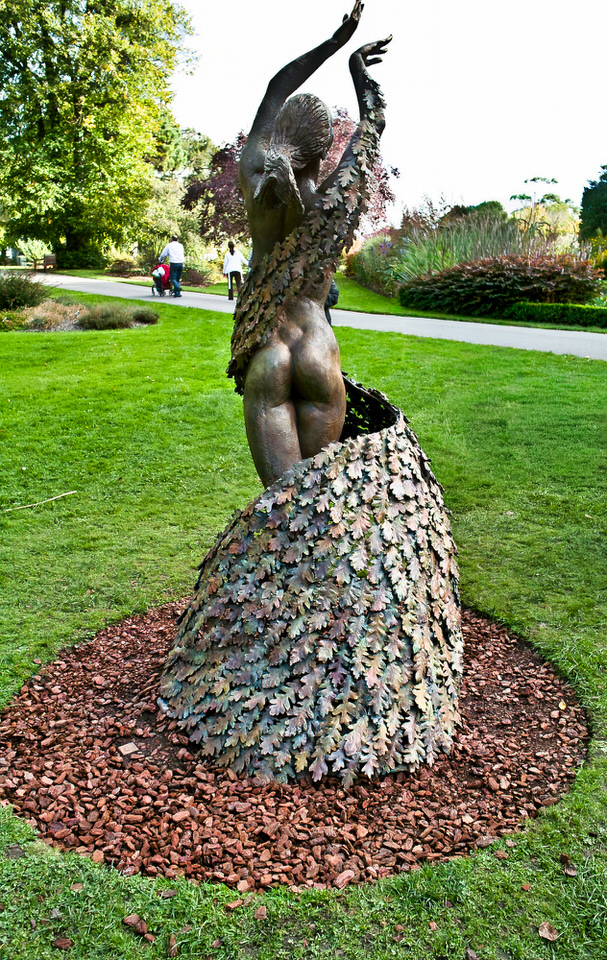
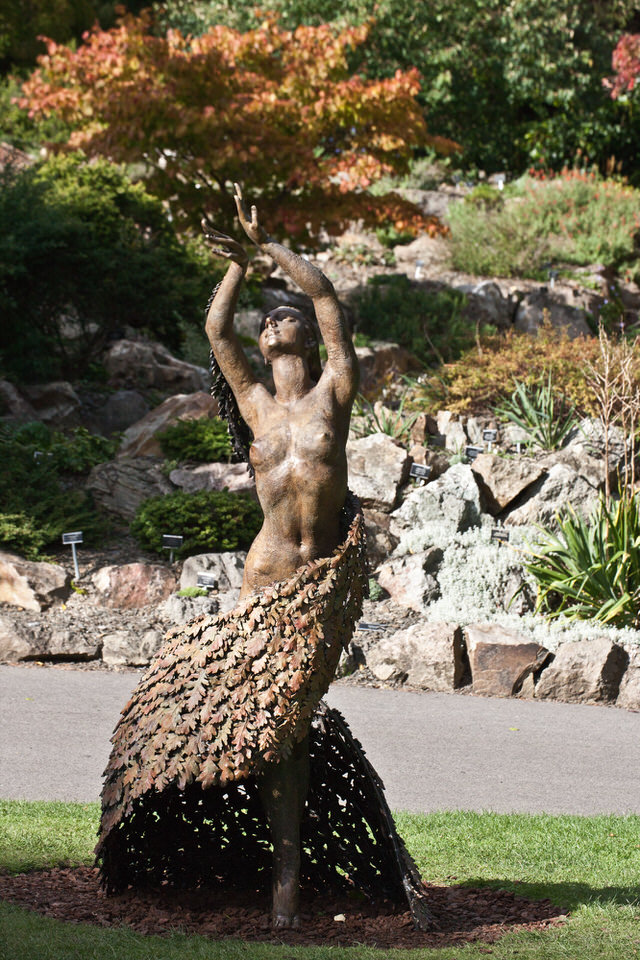
Mother Earth Dancing - A Sculpture By Betty Newman Maguire


Betty Newman-Maguire was born in Kells, Co. Meath in 1952. She is a practising artist who graduated with a First Class Hons B.A. Degree in Sculpture from the National College of Art and Design, Dublin in 1988 and was awarded a Master of Fine Art from the University of Ulster, Belfast in 1998. She has exhibited widely and is the recipient of many awards, public commissions and residencies in Ireland, France, Germany and America. Newman-Maguire has mounted 16 solo exhibitions in Ireland, Germany and America. Her work is in numerous private and public collections worldwide.

Newman-Maguire has lectured at Frobel Teacher training College, Sion Hill, Dublin, Dunlaoghaire Institute of Art and Design, Dublin, visiting lecturer to the National college of Art and Design and at the University of Ulster, Belfast. She also lectured on the M.A. for Art Therapy at Queens University, Belfast. She is currently arts coordinator/lecturer at Beaufort College, co. Meath. She was appointed to An Bord of the National College of Art and Design in 2003 and was a member of the Board of the Sculptor’s Society of Ireland. She lives and works from her studios at Castlekernan, Carnaross, Kells, Co. Meath.

Her public sculptures range in material from steel, wood, stone, bronze and earth. The scale of her public work includes a 35 foot long Viking Ship, a 4foot steel Cormorant and an installation using 101 felled trees. All her public sculptures are site specific and are made in response to the environment.

In her private work she delights in experimenting with materials and uses, glass, wood, ceramics, bricks, fibre, photography, text, video and the more traditional materials of stone and bronze. She has collaborated with musicians and performance artists to further develop themes within her work. For Newman-Maguire it is extremely important to marry materials concept and place.

MORE PHOTOGRAPHS
SCULPTURE BY BETTY NEWMAN MAGUIRE

Breaking the Habit Loop - How a Change in Hotels Changed the Way I See Ireland


For the past fifteen years, my approach to documenting the built environment of Ireland has been methodical, disciplined, and—I recently realised—comfortably predictable.

Each year, I visit every city and many towns across the island. My goal has always been to capture a continuous timeline of change: what has been built, what has decayed, what has been repurposed. To maintain consistency in a chaotic schedule, I developed habits. I tended to stay in the same hotels, park in the same spots, and walk the same "desire lines" to the key sites I needed to document.

I had developed a highly efficient routine for capturing the what of Irish architecture.

Then came 2023. Due to a variety of logistical reasons, my usual haunts were unavailable. For the first time in over a decade, I was forced to book hotels I had never used before in towns I knew intimately.

At first, this was a minor inconvenience. I still had to visit the same specific locations to update my archive. But as I walked from these new temporary bases—approaching familiar main streets from unfamiliar side alleys, traversing different neighborhoods, and seeing landmarks at different times of day—I realised my perspective was radically shifting.

By disrupting my physical route, I disrupted my cognitive map of these places.

From Vocabulary to Grammar

The most profound realisation occurred when I visited Mullingar for the first time. Despite never having set foot in the town, I navigated it with uncanny ease. I instinctively knew where the library would be relative to the Garda station. I correctly guessed the location of the Marian grotto near a junction.

I briefly worried I was suffering from déjà vu, but the reality was far more interesting: I was experiencing structural recognition.

For fifteen years, I had been expertly documenting the "vocabulary" of Irish towns—the individual buildings, shopfronts, and civic structures. But by stepping off my beaten track, I suddenly began to read the "grammar."

I realised that many Irish towns, particularly those developed in the 19th and mid-20th centuries, operate on a shared blueprint. There are predictable "civic clusters" where administrative power (courts, council buildings, police) resides. There is a sacred geometry to where religious statues are placed to guard thresholds and junctions.

My old habits had kept me focused on the facades along the main thoroughfares. The new routes forced me into the interstitial spaces, revealing the connecting tissue that holds the town together.

The New Approach: Documenting the "Why"

This accidental discovery has reinvigorated my fifteen-year project. It has moved my focus from merely documenting change to trying to understand structure.

So, what does this mean for the photographs you will see here in the future?

My future trips will be more intentional about breaking old patterns. I am moving from passive observation to active interrogation of the streetscape.

Seeking the Blueprint: You will see more photographs that attempt to capture the relationship between buildings, rather than just individual portraits of structures. I want to document those "civic clusters" to show how these towns were organized.

The Uncurated View: By changing my vantage points, I will be sharing more of the "backstage" of our towns—the service lanes, the rear extensions, and the peripheral zones that tell a wider story than the polished high street.

Testing the Theory: When visiting larger cities, where modern development has often "overwritten" that original town blueprint, I will be looking for the seams and the scars—the places where the old order clashes with new urban planning.

It is strange to think that simply booking a different hotel room could alter fifteen years of photographic methodology, but it has taught me a valuable lesson: sometimes, to see what is right in front of you, you first have to stand somewhere else.

Dublin City Centre At Night

PHOTOGRAPHED USING A FUJIFILM X100 VI

AFTER DARK

DUBLIN CITY CENTRE AFTER DARK

Christmas seems to arrive earlier every year, yet somehow it always manages to catch me by surprise. I attended my first party of the 2025 festive season just this past Friday. Looking ahead, I plan to spend a week in Belfast exploring their take on the festivities, before settling in Dún Laoghaire and Dalkey for Christmas itself.

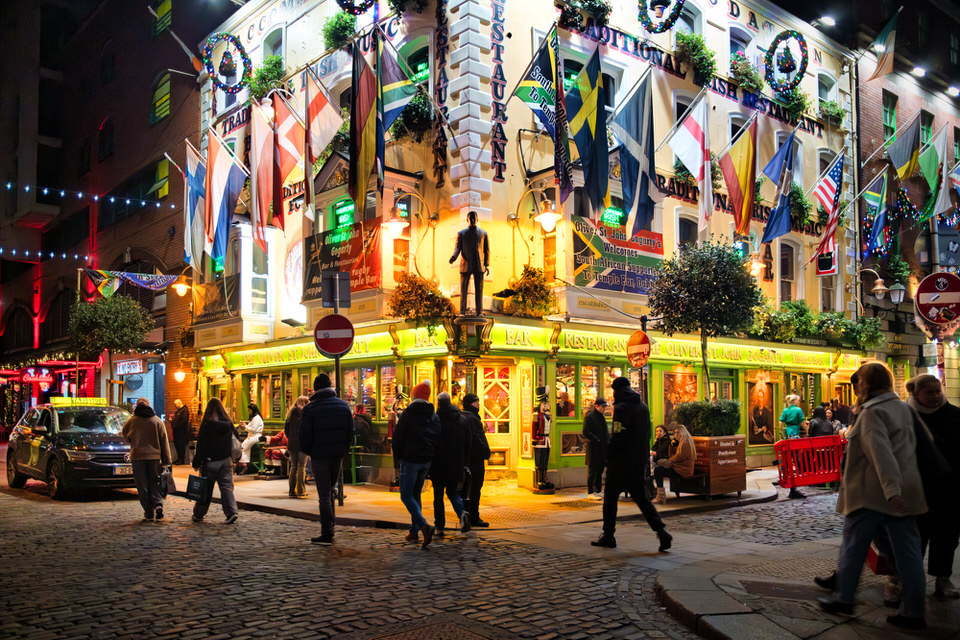
Today, following a late lunch at Eatokyo on Wellington Quay, I decided to test my Fujifilm X100VI, which I have fitted with the TCL-X100 II teleconverter. I wandered the immediate area, shooting spontaneously to see how the equipment handled the fading light. While the results naturally did not rival the Leica Q3, the setup performed better than some of my older Sony bodies and, in these conditions, handled far better than the GFX100RF.

ABOUT THE AREA

The Temple Bar At Night

TEMPLE BAR IS AN AREA OF DUBLIN

THE TEMPLE BAR PUB

When Dubliners speak of Temple Bar, they are referring to a designated district on the south bank of the River Liffey. Think of it as Dublin’s answer to London’s Covent Garden or Soho, but with more fiddles and Guinness.

PHOTOGRAPHS
INFORMATION

At the Urban Cartographer we recently got a Fujifilm X100 VI and the WCL-X100 II lens attachment so I decided to see how well the combination worked in low light so once again I visited Temple Bar.

Ryders Row Triangle - Urban Depression

URBAN DEPRESSION AND DECAY

RYDER’S ROW TRIANGLE

This September, I spent three days photographing this distressed urban triangle to test three distinct systems: a Leica Q3, a Fujifilm GFX100 series, and a Sony A1 II (paired with the 35mm F1.4 GM). The exercise was conclusive: the Sony combination clearly outperformed the Leica Q3, which struggled in the mixed lighting of the inner city.

Today, I returned with a Fujifilm X100VI fitted with a WCL-X100 II wide conversion lens. The results were visibly different—grittier, perhaps more attuned to the subject matter.

For decades, this area mirrored the commercial retreat of Dublin’s north inner city. As retail shifted to suburban centers and online platforms, the traditional high street hollowed out. The result was widespread dilapidation, fostering a negative feedback loop: derelict buildings and graffiti attracted anti-social behaviour, which in turn deterred investment.

The Capel Street Rain And Mist Test And Why My X100 VI Failed

THE FUJIFILM X100 VI FAILED THE RAIN TEST

CAPEL STREET ON A WET DAY

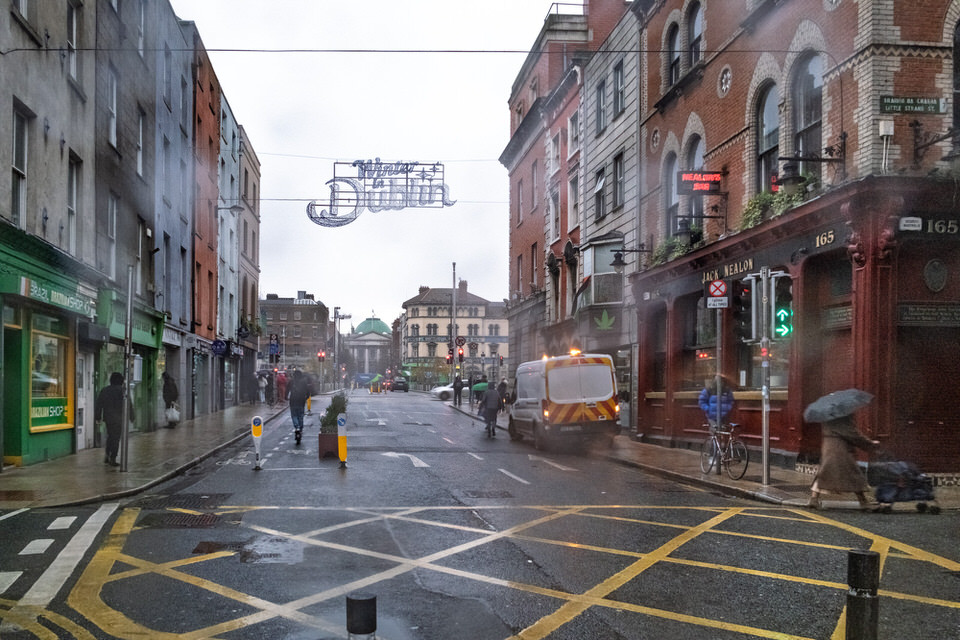
There is a specific kind of atmosphere on Dublin’s Capel Street in November that begs to be photographed. It’s moody, the lights reflect beautifully off the damp pavement, and the city feels alive.

To capture this, I recently took out my Fujifilm setup: the new X100VI paired with the WCL-X100 wide conversion lens. I love the 28mm equivalent field of view for street work—it forces you to get close and immerse yourself in the scene. I was excited to see how the new 40MP sensor handled the complex textures of the street.

The shoot, however, was a disaster.

IIt wasn't torrential rain; it was something worse for a camera. It was a wetting, pervasive Irish mist that hung in the air. Within twenty minutes, I noticed my images were looking soft, almost dreamlike, but not in a good way.

Dublin Banned Cars From Its "Coolest Street." Here’s What Nobody Expected

Introduction: The Dream of the People-First City

Cities around the world share a common dream: to reclaim their streets from the automobile. The vision is alluring—transforming noisy, polluted traffic arteries into vibrant, walkable public spaces where communities can thrive, businesses can flourish, and people can simply enjoy being in their city. It is a move towards a more human-centric urban life, prioritising pedestrians over parking spots and fresh air over fumes.

In Dublin, this dream became a real-world experiment. Capel Street, a bustling thoroughfare recently named one of the "coolest" in the world, was pedestrianised to make way for people. On the surface, it is a success story, and for many, it has been a resounding improvement. Yet, as time passes, the transition has revealed that pedestrianisation doesn’t simply solve urban problems; often, it replaces them with new, more complex ones.

So, what really happens when the cars disappear?

The experience on Capel Street shows that the results are messy and challenging. Removing one major problem—the car—doesn't create a utopia; it uncovers a new set of issues. Here are four surprising takeaways from Dublin's grand experiment.

1. It’s "Car-Free," Not "Traffic-Free"

The most immediate outcome of banning cars was that it did not automatically create a sanctuary for pedestrians. The project removed the danger and noise of automobiles, but a power vacuum quickly emerged. A new form of traffic rushed in to fill the void, dominated by high-speed electric bikes and scooters.

What was intended as a safe space for ambling and socialising has, for many, become a gauntlet of near-misses. The roar of engines has been replaced by the silent menace of scooters zig-zagging at 30kph+, often operated by riders with little regard for the rules. This forces pedestrians back onto the narrow, original footpaths they were meant to be freed from. The lesson here is critical: a pedestrian zone must be managed to ensure the fastest and most aggressive users do not dominate the space.

"In reality, since Capel Street became CAR-free, it has become much more difficult to walk down it. Please make Capel Street actually TRAFFIC-free."

2. A Change in Atmosphere: The Rise of Anti-Social Behaviour

While the street was designed to be welcoming, the social reality has proven complicated. As the initial excitement of the traffic-free trial faded, a creeping sense of unease began to settle in for some regular visitors. Without the constant flow of regulated traffic, the street has arguably become more vulnerable to anti-social behaviour.

Issues such as aggressive begging have become more prominent, creating an uncomfortable environment for those simply trying to walk to work or enjoy a meal. The perception of safety is fragile; when users feel targeted or annoyed by constant approaches, they vote with their feet. The loss of popular dining spots, such as Eatokyo in early 2025, further alters the street's character, potentially leaving a vacuum that is filled by loitering rather than leisure.

3. A New Ecosystem: The Seagull Takeover

Changing a street as central as Capel Street doesn't just alter human behaviour; it creates an entirely new urban ecosystem. The problem of traffic fumes was swapped for a different kind of pollution. The boom in outdoor dining led to a massive increase in commercial food waste, attracting an unlikely new group of residents: hordes of aggressive seagulls.

Locals report significant issues with gulls ripping open rubbish bags and strewing waste across the newly reclaimed public spaces. This creates visual clutter and hygiene concerns for the very diners the project was meant to attract. It is a fascinating example of the cascading effects of urban intervention: planners focused on the primary variable (cars), but the secondary effects on waste management and wildlife have created a major quality-of-life issue.

"The seagulls are destroying every bag on the street and making it filthy... the noise pollution is making it unbearable to live on Capel Street."

4. The Ghost of the Road Remains

Even without a single car in sight, Capel Street still feels like a road. The physical infrastructure—the black tarmac, the raised kerbs, and the temporary fencing—sends a clear subconscious signal: this is a space for vehicles, and pedestrians belong on the sidelines.

Consequently, many people instinctively "stick to the footpaths," defeating the purpose of opening up the entire width of the street. This psychological inertia is a testament to how deeply road design is ingrained in our behaviour. Residents have repeatedly called for the street to be fundamentally redesigned—levelling the kerbs and paving the surface—to feel like a true pedestrian plaza, similar to Grafton Street.

"Right now, it just feels like a car-led street that's been temporarily closed. Make it a destination, and businesses will thrive."

Conclusion: The Messy Reality of the Urban Dream

The Capel Street experiment is neither a simple failure nor an unqualified success. It is an invaluable case study in the complex realities of urban transformation. The consensus remains that moving away from cars is positive, but that single act is not a panacea.

The dream of the people-first city is worthy, but achieving it requires a holistic approach. It demands that we plan for the unpredictable interactions between walkers and e-scooters, for the environmental ripple effects on waste, and for the social atmosphere that emerges when the traffic stops. As Dublin continues to embrace the car-free dream, the challenge is no longer just banning cars, but designing for the messy, complex, and wonderful presence of people.

VISIT HOME PAGE
Photo of Sebastian Lindstrom

Documenting Ireland's Built Environment

The Urban Cartographer

The Urban Cartographer operates under a mission of comprehensive scope: to map the urban organism by capturing and synthesising an overwhelming volume of detail. We are not interested in the singular landmark, but the collective truth that emerges from a million data points. Our mission is driven by a powerful technical infrastructure dedicated to systematic capture, categorisation, and cross-referencing. By leveraging advanced tooling (M-series processing, AI research aids, geo-tagging), we seek to reveal the underlying patterns, infrastructure, and structural narratives of the city that remain invisible to the casual observer.

Fuji X100Vi

William Murphy on Thursday, 13th November

Sony A1 II Camera

Sony A1 MK2

William Murphy on Wednesday, 13th August

OUR CAMERAS

Award Winning

“The Urban Cartographer Is Interested In Enjoying His Hobby Rather Than Awards”