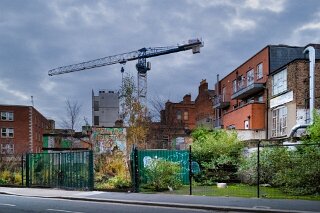
AN EXAMPLE OF URBAN DEPRESSION AND DECAY
THE RYDERS ROW TRIANGLE PHOTOGRAPHED 29 NOVEMBER 2025 [DECAY - REGENERATION - HERITAGE]
The Ryder’s Row Triangle: Decay, Regeneration, and Heritage
Date: 30 November 2025 Location: Ryder’s Row / Capel Street / Parnell Street, Dublin 1
Preamble: The Photographic Stress Test
This September, I spent three days photographing this distressed urban triangle to test three distinct systems: a Leica Q3, a Fujifilm GFX100 series, and a Sony A1 II (paired with the 35mm F1.4 GM). The exercise was conclusive: the Sony combination clearly outperformed the Leica Q3, which struggled in the mixed lighting of the inner city.
Today, I returned with a Fujifilm X100VI fitted with a WCL-X100 II wide conversion lens. The results were visibly different—grittier, perhaps more attuned to the subject matter.
Context: The Policy of Decay
The "Ryder’s Row Triangle"—intersecting Ryder’s Row, Capel Street, and Parnell Street—serves as a vivid case study of the friction between urban decay, strategic regeneration, and heritage preservation.
For decades, this area mirrored the commercial retreat of Dublin’s north inner city. As retail shifted to suburban centers and online platforms, the traditional high street hollowed out. The result was widespread dilapidation, fostering a negative feedback loop: derelict buildings and graffiti attracted anti-social behaviour, which in turn deterred investment.
This blight is not unique to the triangle. By July 2024, Dublin City Council (DCC) had 131 properties on its derelict sites register, with over €10.11 million in unpaid levies owed. In response, the area was designated a Strategic Development Regeneration Area (SDRA), a policy mandate prioritising high-density residential development and urban greening to reverse the decline.
Case Study 1: The Bicycle Yard and the "Zombie" Park
The primary symbol of this struggle was the former O'Brien and Sons bicycle yard (Nos. 13–15 Ryder’s Row and 218–222 Parnell Street). Derelict and unyielding to voluntary acquisition, the site was eventually claimed by DCC via a Compulsory Purchase Order (CPO) vested on 14 November 2022.
Following demolition, the site was landscaped with trees, granite kerbing, and benches. To the public, this looked like a new "pocket park." However, the gates were open for barely two weeks before being locked, leaving the space inaccessible.
This closure highlights a critical misunderstanding of "interim use." The site is not legally a park; it is a residential development site in stasis.
The "Placeholder" Problem: The landscaping is an "interim public realm enhancement"—a temporary aesthetic fix to prevent the land from looking like a waste ground while waiting for a developer.
The Lockout: The decision to lock the gates is driven by liability and safety. Upon its brief opening, the site immediately attracted anti-social behaviour. Furthermore, as the land is vested in the Council for housing rather than amenity, keeping it open imposes public liability risks that the Council is often unwilling to manage for a temporary site.
Case Study 2: The Heritage "Tetris"
While the bicycle yard is stalled by process, the adjacent sites are stalled by complexity. A substantial hotel is proposed for the block encompassing Nos. 3–6 Parnell Street and Nos. 58–59 Capel Street. This project illustrates the extreme difficulty of building in historic Dublin.
The developer must navigate a minefield of protections:
No. 3 Parnell Street: A Protected Structure (RPS Ref. 6422) requiring conservation supervision.
Nos. 58 & 59 Capel Street: "Early Buildings" (c. 1756) requiring façade retention.
Proximity: The site abuts the curtilage of 57 Capel Street and faces the "Dutch Billy" at 66 Capel Street—a rare c. 1716 pre-Georgian house.
These designations severely limit height and massing, forcing developers into an expensive game of architectural "Tetris" to make the site commercially viable without violating conservation laws.
Conclusion
As of late 2025, the Ryder's Row Triangle remains a paradox. The acquisition of the bicycle yard and the vesting of further derelict sites (such as 77 Parnell Street, vested in May 2024) prove that the legal machinery is working. However, the locked gates of the "park" and the slow pace of the hotel construction demonstrate that while the legal hurdles may be cleared, the practical regeneration is still years away.
Add to the Conversation
Here are three high-value points to add depth:
The "Vesting" Update: I mentioned Nos. 77 and 78 Parnell Street being derelict. It is worth noting that No. 77 Parnell Street was successfully vested by DCC on 10 May 2024 (Ref: vesting-order-77-parnell-street). This means the Council now owns it, just like the bicycle yard. Expect it to follow the same path: hoarding up, eventual demolition, and likely another long pause before construction.
The "Hostile Green" Phenomenon: The Ryder’s Row park is a classic example of "Hostile Green" architecture. It looks like an amenity from Google Earth, satisfying "greening" quotas for the SDRA, but on the ground, it acts as a fortress. It raises the question: Is a locked park better than a derelict building?
The Hotel Permission: The hotel project (Ref 3281/20) was granted permission, but the conditions attached regarding the brickwork and timber sash windows at 59 Capel Street are incredibly strict. This often scares off financing, as the "restoration" costs can outweigh the profit from the new hotel rooms.
The Ryder’s Row Triangle: Decay, Regeneration, and Heritage
Date: 30 November 2025 Location: Ryder’s Row / Capel Street / Parnell Street, Dublin 1
Preamble: The Photographic Stress Test
This September, I spent three days photographing this distressed urban triangle to test three distinct systems: a Leica Q3, a Fujifilm GFX100 series, and a Sony A1 II (paired with the 35mm F1.4 GM). The exercise was conclusive: the Sony combination clearly outperformed the Leica Q3, which struggled in the mixed lighting of the inner city.
Today, I returned with a Fujifilm X100VI fitted with a WCL-X100 II wide conversion lens. The results were visibly different—grittier, perhaps more attuned to the subject matter.
Context: The Policy of Decay
The "Ryder’s Row Triangle"—intersecting Ryder’s Row, Capel Street, and Parnell Street—serves as a vivid case study of the friction between urban decay, strategic regeneration, and heritage preservation.
For decades, this area mirrored the commercial retreat of Dublin’s north inner city. As retail shifted to suburban centers and online platforms, the traditional high street hollowed out. The result was widespread dilapidation, fostering a negative feedback loop: derelict buildings and graffiti attracted anti-social behaviour, which in turn deterred investment.
This blight is not unique to the triangle. By July 2024, Dublin City Council (DCC) had 131 properties on its derelict sites register, with over €10.11 million in unpaid levies owed. In response, the area was designated a Strategic Development Regeneration Area (SDRA), a policy mandate prioritising high-density residential development and urban greening to reverse the decline.
Case Study 1: The Bicycle Yard and the "Zombie" Park
The primary symbol of this struggle was the former O'Brien and Sons bicycle yard (Nos. 13–15 Ryder’s Row and 218–222 Parnell Street). Derelict and unyielding to voluntary acquisition, the site was eventually claimed by DCC via a Compulsory Purchase Order (CPO) vested on 14 November 2022.
Following demolition, the site was landscaped with trees, granite kerbing, and benches. To the public, this looked like a new "pocket park." However, the gates were open for barely two weeks before being locked, leaving the space inaccessible.
This closure highlights a critical misunderstanding of "interim use." The site is not legally a park; it is a residential development site in stasis.
The "Placeholder" Problem: The landscaping is an "interim public realm enhancement"—a temporary aesthetic fix to prevent the land from looking like a waste ground while waiting for a developer.
The Lockout: The decision to lock the gates is driven by liability and safety. Upon its brief opening, the site immediately attracted anti-social behaviour. Furthermore, as the land is vested in the Council for housing rather than amenity, keeping it open imposes public liability risks that the Council is often unwilling to manage for a temporary site.
Case Study 2: The Heritage "Tetris"
While the bicycle yard is stalled by process, the adjacent sites are stalled by complexity. A substantial hotel is proposed for the block encompassing Nos. 3–6 Parnell Street and Nos. 58–59 Capel Street. This project illustrates the extreme difficulty of building in historic Dublin.
The developer must navigate a minefield of protections:
No. 3 Parnell Street: A Protected Structure (RPS Ref. 6422) requiring conservation supervision.
Nos. 58 & 59 Capel Street: "Early Buildings" (c. 1756) requiring façade retention.
Proximity: The site abuts the curtilage of 57 Capel Street and faces the "Dutch Billy" at 66 Capel Street—a rare c. 1716 pre-Georgian house.
These designations severely limit height and massing, forcing developers into an expensive game of architectural "Tetris" to make the site commercially viable without violating conservation laws.
Conclusion
As of late 2025, the Ryder's Row Triangle remains a paradox. The acquisition of the bicycle yard and the vesting of further derelict sites (such as 77 Parnell Street, vested in May 2024) prove that the legal machinery is working. However, the locked gates of the "park" and the slow pace of the hotel construction demonstrate that while the legal hurdles may be cleared, the practical regeneration is still years away.
Add to the Conversation
Here are three high-value points to add depth:
The "Vesting" Update: I mentioned Nos. 77 and 78 Parnell Street being derelict. It is worth noting that No. 77 Parnell Street was successfully vested by DCC on 10 May 2024 (Ref: vesting-order-77-parnell-street). This means the Council now owns it, just like the bicycle yard. Expect it to follow the same path: hoarding up, eventual demolition, and likely another long pause before construction.
The "Hostile Green" Phenomenon: The Ryder’s Row park is a classic example of "Hostile Green" architecture. It looks like an amenity from Google Earth, satisfying "greening" quotas for the SDRA, but on the ground, it acts as a fortress. It raises the question: Is a locked park better than a derelict building?
The Hotel Permission: The hotel project (Ref 3281/20) was granted permission, but the conditions attached regarding the brickwork and timber sash windows at 59 Capel Street are incredibly strict. This often scares off financing, as the "restoration" costs can outweigh the profit from the new hotel rooms.
ABOUT THE RYDER'S ROW TRIANGLE