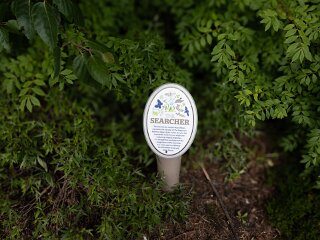
THE SEARCHER BY ROSS WILSON AT C.S. LEWIS SQUARE
THE SEARCHER BY ROSS WILSON AT C.S. LEWIS SQUARE [I USED A FUJIFILM GFX100RF]
The Quiet Threshold: Ross Wilson’s ‘The Searcher’ at Holywood Arches
Walking the Newtownards Road, the transition from the industrial grit of the streetscape to the open expanse of C.S. Lewis Square is immediate. At the Holywood Arches—the historic junction where the Newtownards and Holywood roads diverge—the urban texture softens. While the square is now dominated by the dramatic, larger-than-life Narnian figures commissioned for the Greenway’s opening, there is one piece of art that predates them and offers a far quieter, more introspective presence.
That piece is 'The Searcher', a bronze work by the Northern Irish artist Ross Wilson.
Captured here with a Fujifilm GFX100, the sculpture stands distinct from its surroundings. While the square is populated by Maurice Harron’s striking, fantastical interpretations of the White Witch and Aslan, Wilson’s work is a study in realism and anticipation.
The Man and the Wardrobe
Commissioned in 1998 to mark the centenary of C.S. Lewis's birth, 'The Searcher' does not depict a beast or a battle. Instead, it captures a human moment on a human scale. The figure represents Digory Kirke (the protagonist of The Magician's Nephew and later the Professor in The Lion, the Witch and the Wardrobe) standing at the threshold of the wardrobe.
In the context of the Newtownards Road—an area defined by physical barriers, peace lines, and regeneration zones—this sculpture is a powerful metaphor for a different kind of crossing. It is a study in the "threshold." Wilson captures the figure in the precise second before the door opens, inviting the viewer to step out of the grey reality of the Belfast street and into the boundless imagination of Lewis. It suggests that the magic of Narnia did not begin with a lion, but with the curiosity to open a door.
A Study in Detail: The Hidden Narrative
For the photographer or the keen observer of the built environment, Wilson’s sculpture rewards close inspection. Unlike the other statues in the square which are designed to be viewed from a distance, 'The Searcher' is intimate. It demands that you walk around it.
1. The Verso of the Wardrobe While the "front" (Digory stepping in) is the standard composition, the back of the sculpture offers a rich narrative layer.
The Lion’s Watch: Moulded subtly into the bronze on the rear of the wardrobe is the head of a lion, symbolising Aslan’s omnipresence even before the door is opened.
The Letter: There is a full letter inscribed into the rear panel. It is a reproduction of correspondence from C.S. Lewis to a young girl named Anne Jenkins in 1961, in which he explains the Christian allegory behind his stories. The text provides a fantastic textural element for macro photography.
2. The Inscription of Faith At the feet of the figure, etched into the bronze base, is the inscription: "Born 1898, Reborn 1931". This references Lewis’s conversion to Christianity (an event he famously described as being "surprised by joy"). It grounds the fantastical elements of the square in the personal, biographical history of the man who walked these streets.
3. The Apple Tree Handle A close zoom on the wardrobe handle reveals intricate casting work, often interpreted as referencing the wood of the magical apple tree from The Magician's Nephew, from which the wardrobe was crafted.
Conclusion
In an area of East Belfast often defined by its grand industrial past or its rapid modern regeneration, 'The Searcher' remains a constant. It is a piece of public art that does not shout; it waits. It stands at the Holywood Arches not just as a tribute to an author, but as an invitation to look deeper at the world around us.
The Quiet Threshold: Ross Wilson’s ‘The Searcher’ at Holywood Arches
Walking the Newtownards Road, the transition from the industrial grit of the streetscape to the open expanse of C.S. Lewis Square is immediate. At the Holywood Arches—the historic junction where the Newtownards and Holywood roads diverge—the urban texture softens. While the square is now dominated by the dramatic, larger-than-life Narnian figures commissioned for the Greenway’s opening, there is one piece of art that predates them and offers a far quieter, more introspective presence.
That piece is 'The Searcher', a bronze work by the Northern Irish artist Ross Wilson.
Captured here with a Fujifilm GFX100, the sculpture stands distinct from its surroundings. While the square is populated by Maurice Harron’s striking, fantastical interpretations of the White Witch and Aslan, Wilson’s work is a study in realism and anticipation.
The Man and the Wardrobe
Commissioned in 1998 to mark the centenary of C.S. Lewis's birth, 'The Searcher' does not depict a beast or a battle. Instead, it captures a human moment on a human scale. The figure represents Digory Kirke (the protagonist of The Magician's Nephew and later the Professor in The Lion, the Witch and the Wardrobe) standing at the threshold of the wardrobe.
In the context of the Newtownards Road—an area defined by physical barriers, peace lines, and regeneration zones—this sculpture is a powerful metaphor for a different kind of crossing. It is a study in the "threshold." Wilson captures the figure in the precise second before the door opens, inviting the viewer to step out of the grey reality of the Belfast street and into the boundless imagination of Lewis. It suggests that the magic of Narnia did not begin with a lion, but with the curiosity to open a door.
A Study in Detail: The Hidden Narrative
For the photographer or the keen observer of the built environment, Wilson’s sculpture rewards close inspection. Unlike the other statues in the square which are designed to be viewed from a distance, 'The Searcher' is intimate. It demands that you walk around it.
1. The Verso of the Wardrobe While the "front" (Digory stepping in) is the standard composition, the back of the sculpture offers a rich narrative layer.
The Lion’s Watch: Moulded subtly into the bronze on the rear of the wardrobe is the head of a lion, symbolising Aslan’s omnipresence even before the door is opened.
The Letter: There is a full letter inscribed into the rear panel. It is a reproduction of correspondence from C.S. Lewis to a young girl named Anne Jenkins in 1961, in which he explains the Christian allegory behind his stories. The text provides a fantastic textural element for macro photography.
2. The Inscription of Faith At the feet of the figure, etched into the bronze base, is the inscription: "Born 1898, Reborn 1931". This references Lewis’s conversion to Christianity (an event he famously described as being "surprised by joy"). It grounds the fantastical elements of the square in the personal, biographical history of the man who walked these streets.
3. The Apple Tree Handle A close zoom on the wardrobe handle reveals intricate casting work, often interpreted as referencing the wood of the magical apple tree from The Magician's Nephew, from which the wardrobe was crafted.
Conclusion
In an area of East Belfast often defined by its grand industrial past or its rapid modern regeneration, 'The Searcher' remains a constant. It is a piece of public art that does not shout; it waits. It stands at the Holywood Arches not just as a tribute to an author, but as an invitation to look deeper at the world around us.
MAN AND WARDROBE