The City's Secret Stories: 5 Surprising Discoveries Hidden in Plain Sight
We move through our cities on autopilot, walking the same routes, passing the same buildings, our eyes often focused on a destination or a screen. It’s easy to believe we know our streets, but in reality, we often miss the layers of history, humor, and humanity etched into the walls and sidewalks around us. We are surrounded by stories hidden in plain sight, waiting for someone to stop and look just a little closer.
This is the reward of meticulously documenting the built environment. By treating the city as a living archive, you begin to uncover unexpected narratives—poignant, surprising, and deeply human. What follows are five discoveries found etched into the streets of Ireland, each revealing that even the most ordinary-seeming details can tell an extraordinary story.
A Dublin Cottage Grew a Moustache for Movember
On my second day out with a new Fujifilm X100VI camera, I stumbled upon a gem on Upper Grangegorman in Dublin, not far from the famous "Hungry Tree." What makes this charming red-brick cottage remarkable is its spectacular, and entirely accidental, participation in Movember.
An ambitious climbing plant has worked its way across the facade, growing perfectly over the two front windows and above the bright blue door. The result is a dense, bushy canopy that gives the building the unmistakable appearance of a giant, verdant moustache. The discovery in November makes the scene all the more perfect, and the camera’s phenomenal color rendering—the deep greens against the warm red brick—gave the scene a magical, slightly unusual feel.
But this is more than just a quirky photo opportunity. Much like the moustaches grown for the Movember Foundation, the cottage acts as a "delightful trigger." It's a charming visual that starts a conversation, reminding us of the serious men's health issues—from cancer to mental health—that the global movement works to address. It's a house that, with more enthusiasm than most, wears its support on its face.
A Faded Piece of Graffiti Revealed a City's Hidden Crisis
This year, I spent a week at the Moxy Hotel on Camden Quay in Cork. I chose it partly because it replaced a derelict building on a site I had previously documented, thoughtfully restoring some historical elements. This act of urban renewal prompted me to look through my back catalogue, and there I found it: a 2014 photograph of a wall on Pine Street that no longer exists, preserving a simple, hand-painted piece of graffiti that reads:
"This Is Nan She Has E.D.S A Rare Disease"
The message sparked an investigation. Was "Nan" a given name, or was this a plea for a beloved grandmother, as is common in Ireland? Was it a genuine, desperate appeal for help? The evidence suggests the graffiti was an authentic reflection of a real-life struggle, placed on a wall known as a hub for street art to reach a specific audience.
This single photograph of ephemeral art is now a unique piece of archival evidence. It preserves a human story that would have otherwise been completely lost when the building was redeveloped. It stands as a poignant reflection of a documented crisis, a public plea frozen in time, reminding us that city walls can hold the most personal and urgent of messages.
A Letterbox to Nowhere Tells a Story of Urban Change
Also near Dublin's "Hungry Tree" at Kings Inns, a peculiar sight remains on a redeveloped wall: a lone, bronze letterbox. There is no door, no hallway, and no home behind it. It simply faces the street as a "silent, metallic smile," waiting for a postman who will never arrive.
The observation captures the poetry of urban memory and loss. It is an object stripped of its function but not its meaning, a remnant of a life that has vanished.
It is the Cheshire Cat's grin. The door was gone, the hallway was gone, the life that waited inside for the clatter of the flap was gone. But the grin remained.
This letterbox to nowhere serves as a powerful metaphor for the echoes of the past that persist in our modern cityscapes. It is a "bronze echo," a small, quiet monument to the people and the homes that were once there.
A Vandalized Statue Reveals a Community's Resilience
Public art is not static; it has a life cycle of its own. I first photographed the "Freedom's Dawn" sculpture, also known as "The Pikeman," in the town of Midleton in 2016. When I visited again in 2019, I couldn't find it and decided I must have been confused or remembered the wrong location. Later, I discovered the truth: the statue had been removed for repair after a lamentable act of vandalism. The bronze scroll held in its hand—an integral part of its narrative representing the ideals of the United Irishmen—had been stolen.
The damage was significant enough that the entire statue had to be taken away. For a time, it vanished from its public square.
However, the story didn't end there. The statue was eventually restored and reinstalled, but this time on a plinth, making it harder for vandals to reach. This personal experience of its disappearance and rediscovery provided a surprising look into the life of public art. It is not just about creation but also about vulnerability, repair, and a community's determination to preserve the symbols that matter to them.
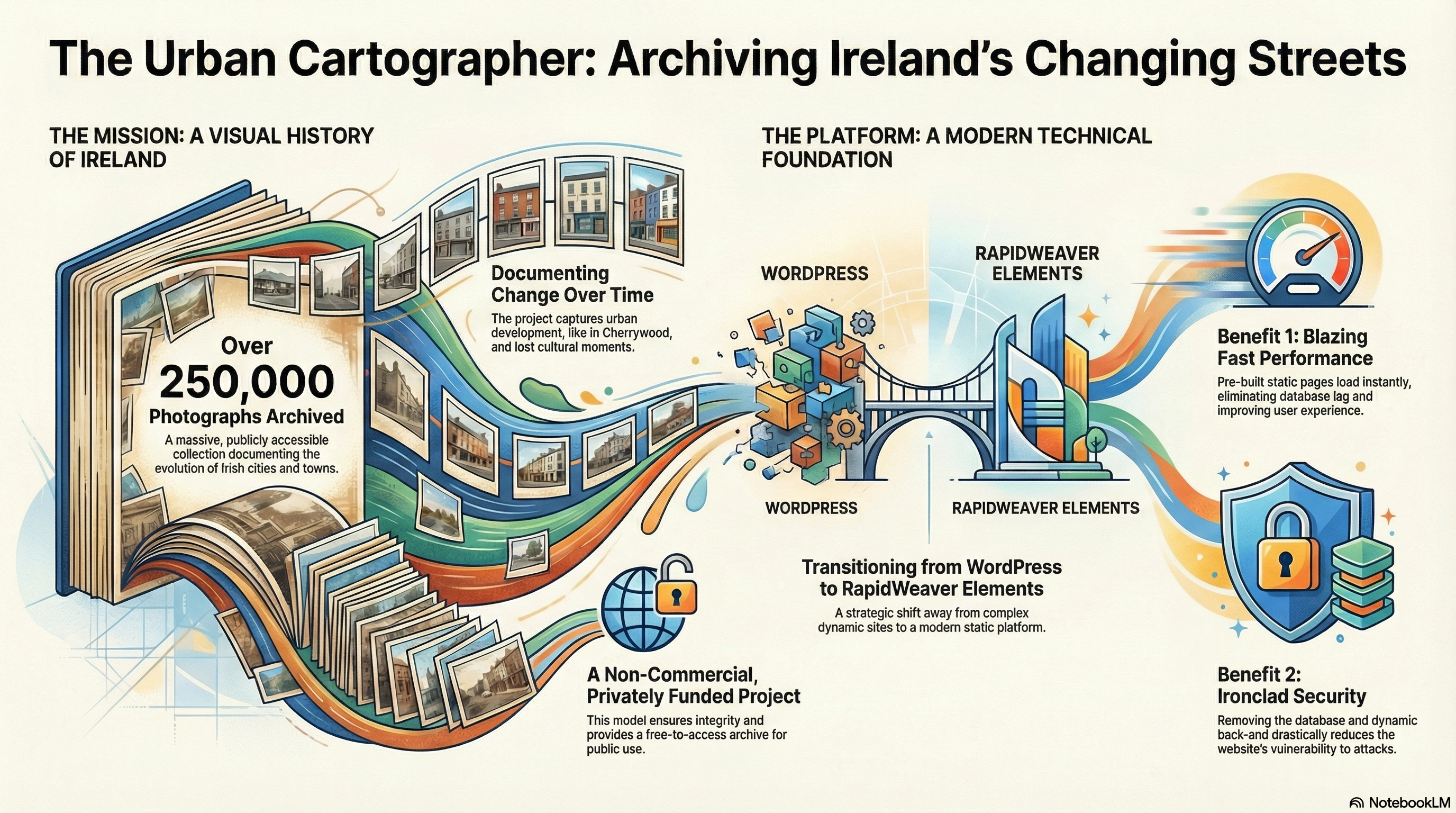
The Counter-Intuitive Truth: Why a 'Static' Website is Faster and Safer
Sometimes, the most surprising discoveries aren't on the street, but in the tools we use to document them. A project dedicated to archiving the urban environment is, counter-intuitively, moving away from a powerful and familiar platform like WordPress.
The transition is to a tool that creates "static sites." In simple terms, a "dynamic" site like one built on WordPress must query a database and assemble a webpage from different pieces every time a visitor clicks. This process can introduce lag. A "static" site, by contrast, is a collection of pre-built, optimized HTML files that are delivered instantly. There are no database queries and no on-the-fly assembly.
The core benefits are "blazing fast performance" and "ironclad security." With no database to compromise, the "attack surface" for malicious threats is significantly reduced. It’s a surprising lesson in technology: the most advanced and efficient solution isn't always the most complex or familiar one.
Conclusion: Keep Looking Closer
From a moustachioed cottage to a letterbox without a door, these stories affirm that our cities are living archives. They are filled with unexpected tales of humor, struggle, memory, and resilience, all waiting in the details we so often overlook.
These discoveries are the reward for slowing down and paying attention. They are a reminder that the world around us is rich with narrative, if only we take the time to look a little closer.
What hidden stories are waiting to be discovered on your own street?