HRE CAME SWEENEY
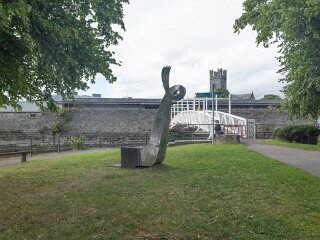
BARE TO THE WORLD HERE CAME SWEENEY [SCULPTURE BY ROWAN GILLESPIE AT THE HUNT MUSEUM 14 JULY 2025]
This was my first time to use the Fuji GFX100RF and the RAW files are huge requiring a lot of computer resources.
I photographed this a number of times but never published the photographs because I could not find any information relating to the sculpture. The problem was that I had not realised that the plaque was associated with the sculpture, I thought that it was unrelated. I am now re checking my catalogues
The phrase "BARE TO THE WORLD HERE CAME SWEENEY" refers to a sculpture by the Irish artist Rowan Gillespie. This work, associated with the Hunt Museum, draws its inspiration directly from the medieval Irish legend Buile Suibhne (The Frenzy of Sweeney).
📖 The Legend of Sweeney
The "Sweeney" (or Suibhne Geilt) mentioned is a mythological Irish king from Ulster. According to the 12th-century text, Sweeney insulted Saint Ronan and, as punishment, was cursed by the saint during the Battle of Mag Rath (Moira).
The curse drove him insane. In his madness, he believed he had grown feathers and fled the battle, abandoning his kingdom and his humanity. He spent the rest of his life as an outcast, leaping and perching in trees like a bird, living "bare to the world" in the wilderness. During his exile, he composed poetry detailing his profound suffering, his alienation from humankind, and his intimate connection with nature.
🗣️ Analysing the Phrase
Rowan Gillespie is renowned for his bronze figurative sculptures that capture deep psychological states, such as the Famine Memorial in Dublin. His depiction of Sweeney, often shown as a gaunt, bird-like, and anguished figure, visualises this legend.
The inscription "BARE TO THE WORLD HERE CAME SWEENEY" encapsulates the core of the myth:
"Bare to the world": This signifies Sweeney's total vulnerability. He is stripped of his kingship, his sanity, his clothing, and all the protections of civilisation. He is exposed entirely to the elements, his isolation, and his own tormented mind.
"Here came Sweeney": This line acts as an announcement of his arrival, not as a king, but as this new, wild, cursed creature—an embodiment of trauma and profound separation from the human world.
The sculpture and its text work together to present a powerful image of madness, isolation, and the loss of identity.
This was my first time to use the Fuji GFX100RF and the RAW files are huge requiring a lot of computer resources.
I photographed this a number of times but never published the photographs because I could not find any information relating to the sculpture. The problem was that I had not realised that the plaque was associated with the sculpture, I thought that it was unrelated. I am now re checking my catalogues
The phrase "BARE TO THE WORLD HERE CAME SWEENEY" refers to a sculpture by the Irish artist Rowan Gillespie. This work, associated with the Hunt Museum, draws its inspiration directly from the medieval Irish legend Buile Suibhne (The Frenzy of Sweeney).
📖 The Legend of Sweeney
The "Sweeney" (or Suibhne Geilt) mentioned is a mythological Irish king from Ulster. According to the 12th-century text, Sweeney insulted Saint Ronan and, as punishment, was cursed by the saint during the Battle of Mag Rath (Moira).
The curse drove him insane. In his madness, he believed he had grown feathers and fled the battle, abandoning his kingdom and his humanity. He spent the rest of his life as an outcast, leaping and perching in trees like a bird, living "bare to the world" in the wilderness. During his exile, he composed poetry detailing his profound suffering, his alienation from humankind, and his intimate connection with nature.
🗣️ Analysing the Phrase
Rowan Gillespie is renowned for his bronze figurative sculptures that capture deep psychological states, such as the Famine Memorial in Dublin. His depiction of Sweeney, often shown as a gaunt, bird-like, and anguished figure, visualises this legend.
The inscription "BARE TO THE WORLD HERE CAME SWEENEY" encapsulates the core of the myth:
"Bare to the world": This signifies Sweeney's total vulnerability. He is stripped of his kingship, his sanity, his clothing, and all the protections of civilisation. He is exposed entirely to the elements, his isolation, and his own tormented mind.
"Here came Sweeney": This line acts as an announcement of his arrival, not as a king, but as this new, wild, cursed creature—an embodiment of trauma and profound separation from the human world.
The sculpture and its text work together to present a powerful image of madness, isolation, and the loss of identity.