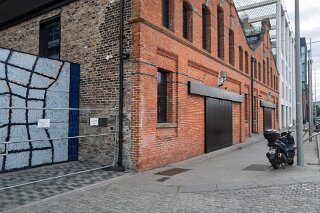
THE TROPICAL FRUIT WAREHOUSE IS NOW THE OpenAI EUROPEAN HEADQUARTERS - PHOTOGRAPHED 30 JULY 2026
A Docklands Landmark Redefined
Standing along Sir John Rogerson’s Quay, the former Tropical Fruit Company building represents one of the most prominent examples of architectural adaptive reuse in Dublin’s South Docklands. Known today as the Tropical Fruit Warehouse, the site bridges three centuries of urban history—evolving from a 19th-century commercial shipping hub to a pivotal piece of Irish popular culture infrastructure, and ultimately into a flagship location for global artificial intelligence development.
Victorian Origins and the River Gods
Originally constructed in the 1890s for the Dublin Tropical Fruit Company, the warehouse is anchored by twin-gabled yellow and red-brick facades fronting directly onto the River Liffey. Beyond its classic brickwork and restored timber roof trusses, the building holds a remarkable link to Dublin’s civic heritage.
Set into the brick gables above the historic loading bays are two carved granite keystones representing the river gods Atlantic and Anna Livia. Designed by Edward Smyth, these keystones were originally commissioned for James Gandon’s Carlisle Bridge, constructed between 1791 and 1794. When Carlisle Bridge was widened and flattened in 1880 to create O’Connell Bridge, the oversized keystones were salvaged and later incorporated into the quay facade, anchoring a piece of 18th-century stone carving within a late Victorian industrial structure.
The U2 Connection: Storage, Archives, and Management
While the surrounding Docklands area gained musical renown through Hanover Quay and Windmill Lane Studios, the Tropical Fruit Warehouse played an essential operational role in the story of U2.
Following its industrial lifecycle as a fruit import hub, the building was taken over as the band’s headquarters in 1982. It served as a secure archive and primary storage facility for the group's growing collection of stage equipment, awards, and historical items. In 1990, the building underwent a sensitive internal conversion designed by architects Beardmore Yauner Byrne and Felim Dunne, becoming the long-standing management offices for Paul McGuinness and Principle Management. For nearly two decades, the administrative decisions behind one of the world's largest touring acts were made within its historic brick walls.
Cantilevered Glass, IPUT, and the Friction of "POPS"
In recent years, the site underwent a dramatic redevelopment led by property firm IPUT Real Estate and designed by architects Henry J Lyons. The scheme meticulously restored the original 1890s masonry streetscape while cantilevering a modern six-storey, twin-skin glass office structure directly over the historic warehouse footprint, creating approximately 88,000 square feet of high-specification office space.
However, for those documenting and navigating the built environment, the development is equally notable for how its surrounding public footprint is managed. IPUT has earned a distinct reputation across the Docklands for its aggressive management of Privately Owned Public Space (POPS). While these pedestrian plazas and public realms are touted in planning permissions as open civic amenities, the reality on the ground often involves tight security oversight, strict limitations on lingering, and an immediate pushback against street photography or public assembly.
This friction was highlighted by planning disputes surrounding the site's ground-floor space. Originally designated under planning conditions to include a publicly accessible café and animation along the pedestrian realm, attempts were made to convert the area into a private, staff-only facility. The move drew significant pushback, underscoring a recurring motif in Docklands developments: the steady clawback of promised public amenities into corporate enclaves. This ongoing tension between private corporate stewardship and genuine public access remains one of the defining operational realities of Dublin’s modern urban landscape.
OpenAI’s European Headquarters
Despite these urban frictions, the commercial pull of the location remains immense. The building is entering its next chapter following the announcement that OpenAI has secured a long-term lease for the entire warehouse complex as its new European Union headquarters. Moving into the space previously let to TikTok, OpenAI plans to expand its Dublin operations significantly across engineering, legal, privacy, and research divisions.
The Tropical Fruit Warehouse remains a standout testament to how Dublin’s historic industrial fabric can be preserved and integrated with modern architecture—even as the boundaries between private corporate territory and public civic space continue to blur along the riverfront.
Standing along Sir John Rogerson’s Quay, the former Tropical Fruit Company building represents one of the most prominent examples of architectural adaptive reuse in Dublin’s South Docklands. Known today as the Tropical Fruit Warehouse, the site bridges three centuries of urban history—evolving from a 19th-century commercial shipping hub to a pivotal piece of Irish popular culture infrastructure, and ultimately into a flagship location for global artificial intelligence development.
Victorian Origins and the River Gods
Originally constructed in the 1890s for the Dublin Tropical Fruit Company, the warehouse is anchored by twin-gabled yellow and red-brick facades fronting directly onto the River Liffey. Beyond its classic brickwork and restored timber roof trusses, the building holds a remarkable link to Dublin’s civic heritage.
Set into the brick gables above the historic loading bays are two carved granite keystones representing the river gods Atlantic and Anna Livia. Designed by Edward Smyth, these keystones were originally commissioned for James Gandon’s Carlisle Bridge, constructed between 1791 and 1794. When Carlisle Bridge was widened and flattened in 1880 to create O’Connell Bridge, the oversized keystones were salvaged and later incorporated into the quay facade, anchoring a piece of 18th-century stone carving within a late Victorian industrial structure.
The U2 Connection: Storage, Archives, and Management
While the surrounding Docklands area gained musical renown through Hanover Quay and Windmill Lane Studios, the Tropical Fruit Warehouse played an essential operational role in the story of U2.
Following its industrial lifecycle as a fruit import hub, the building was taken over as the band’s headquarters in 1982. It served as a secure archive and primary storage facility for the group's growing collection of stage equipment, awards, and historical items. In 1990, the building underwent a sensitive internal conversion designed by architects Beardmore Yauner Byrne and Felim Dunne, becoming the long-standing management offices for Paul McGuinness and Principle Management. For nearly two decades, the administrative decisions behind one of the world's largest touring acts were made within its historic brick walls.
Cantilevered Glass, IPUT, and the Friction of "POPS"
In recent years, the site underwent a dramatic redevelopment led by property firm IPUT Real Estate and designed by architects Henry J Lyons. The scheme meticulously restored the original 1890s masonry streetscape while cantilevering a modern six-storey, twin-skin glass office structure directly over the historic warehouse footprint, creating approximately 88,000 square feet of high-specification office space.
However, for those documenting and navigating the built environment, the development is equally notable for how its surrounding public footprint is managed. IPUT has earned a distinct reputation across the Docklands for its aggressive management of Privately Owned Public Space (POPS). While these pedestrian plazas and public realms are touted in planning permissions as open civic amenities, the reality on the ground often involves tight security oversight, strict limitations on lingering, and an immediate pushback against street photography or public assembly.
This friction was highlighted by planning disputes surrounding the site's ground-floor space. Originally designated under planning conditions to include a publicly accessible café and animation along the pedestrian realm, attempts were made to convert the area into a private, staff-only facility. The move drew significant pushback, underscoring a recurring motif in Docklands developments: the steady clawback of promised public amenities into corporate enclaves. This ongoing tension between private corporate stewardship and genuine public access remains one of the defining operational realities of Dublin’s modern urban landscape.
OpenAI’s European Headquarters
Despite these urban frictions, the commercial pull of the location remains immense. The building is entering its next chapter following the announcement that OpenAI has secured a long-term lease for the entire warehouse complex as its new European Union headquarters. Moving into the space previously let to TikTok, OpenAI plans to expand its Dublin operations significantly across engineering, legal, privacy, and research divisions.
The Tropical Fruit Warehouse remains a standout testament to how Dublin’s historic industrial fabric can be preserved and integrated with modern architecture—even as the boundaries between private corporate territory and public civic space continue to blur along the riverfront.