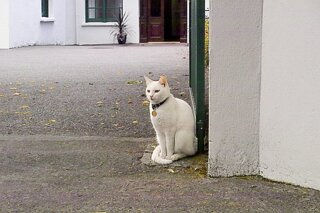
THIS MY FIRST VISIT TO CORK AS A STREET PHOTOGRAPHED WAS A DISASTER
Back in August 2005 I was unable to book a room in Cork City so I ended up stating in Rushbrooke and the accommodation did not live up to expectations and it rained every minute of every day and my new DSLR failed - it was a Sigma SD14 which I discuss below. I did not revisit the city until 2011
The Sigma SD14 is one of digital photography’s great cautionary tales: a camera built around a revolutionary sensor concept that was utterly undermined by hostile ergonomics, sluggish processing, and catastrophic power management.
On paper, the promise was tantalising. In the field—especially under heavy Irish cloud cover—it was an exercise in pure friction.
The Foveon Promise vs. The Engineering Reality
Pure, Per-Pixel Colour Fidelity: Promised true chromatic separation without colour interpolation, but in practice was strictly limited to bright daylight at base ISO.
No Anti-Aliasing Filter Needed: Delivered exceptional edge acuity across architectural details and masonry, yet demanded near-perfect shooting conditions to avoid severe image degradation.
Three-Layer Silicon Depth: Stacked full RGB photodiodes vertically at every pixel location, generating massive raw data streams that overwhelmed the camera’s internal processing buffer.
True Chromatic Separation: Suffered from extreme electronic cross-talk between silicon layers at elevated sensitivities, resulting in muddy shadow noise and severe colour shift.
Why the SD14 Failed in the Field
The ISO 100 Glass Ceiling: Because red wavelengths had to penetrate the upper blue and green silicon layers to reach the bottom diodes, the signal-to-noise ratio collapsed in poor light. While sensitivities up to ISO 800 or 1600 were offered, anything beyond ISO 100 yielded aggressive chroma blotching, desaturation, and severe yellow-magenta banding. Handheld street work under overcast skies was starved of light from the start.
Crippling Battery Drain: The camera's power architecture was notoriously inefficient. Processing the dense three-layer raw files placed an immense continuous load on the lithium-ion battery. In cold, damp environments, voltage sagged rapidly, leading to sudden shutdowns, stalled buffers, and battery depletion after just a handful of exposures.
The Proprietary File Bottleneck (X3F to DNG): Sigma’s proprietary .X3F raw format required Sigma Photo Pro—a glacial, unstable utility. Converting files to linear .DNG was an unavoidable intermediate step to make the images workable within standard processing software, adding a tedious layer of friction before a single frame could be reviewed.
August 2005: The Cork and Rushbrooke Washout
Taking a camera with such acute operational limitations into the damp climate of County Cork turned an ambitious solo street photography excursion into a battle against hardware failures:
The Rushbrooke Compromise: Being forced out of Cork city centre to base operations across the river in Rushbrooke added unnecessary travel friction to an already challenging itinerary.
The Relentless Rain: Without usable sensitivity above ISO 100, the constant drizzle and gloomy skies demanded slow shutter speeds that made sharp, handheld capture exceptionally difficult.
The Abysmal Yield: Fighting dying batteries, sluggish buffer clearing, and poor light resulted in fewer than 25 usable frames across two full days of walking the streets.
The Sigma SD14 is one of digital photography’s great cautionary tales: a camera built around a revolutionary sensor concept that was utterly undermined by hostile ergonomics, sluggish processing, and catastrophic power management.
On paper, the promise was tantalising. In the field—especially under heavy Irish cloud cover—it was an exercise in pure friction.
The Foveon Promise vs. The Engineering Reality
Pure, Per-Pixel Colour Fidelity: Promised true chromatic separation without colour interpolation, but in practice was strictly limited to bright daylight at base ISO.
No Anti-Aliasing Filter Needed: Delivered exceptional edge acuity across architectural details and masonry, yet demanded near-perfect shooting conditions to avoid severe image degradation.
Three-Layer Silicon Depth: Stacked full RGB photodiodes vertically at every pixel location, generating massive raw data streams that overwhelmed the camera’s internal processing buffer.
True Chromatic Separation: Suffered from extreme electronic cross-talk between silicon layers at elevated sensitivities, resulting in muddy shadow noise and severe colour shift.
Why the SD14 Failed in the Field
The ISO 100 Glass Ceiling: Because red wavelengths had to penetrate the upper blue and green silicon layers to reach the bottom diodes, the signal-to-noise ratio collapsed in poor light. While sensitivities up to ISO 800 or 1600 were offered, anything beyond ISO 100 yielded aggressive chroma blotching, desaturation, and severe yellow-magenta banding. Handheld street work under overcast skies was starved of light from the start.
Crippling Battery Drain: The camera's power architecture was notoriously inefficient. Processing the dense three-layer raw files placed an immense continuous load on the lithium-ion battery. In cold, damp environments, voltage sagged rapidly, leading to sudden shutdowns, stalled buffers, and battery depletion after just a handful of exposures.
The Proprietary File Bottleneck (X3F to DNG): Sigma’s proprietary .X3F raw format required Sigma Photo Pro—a glacial, unstable utility. Converting files to linear .DNG was an unavoidable intermediate step to make the images workable within standard processing software, adding a tedious layer of friction before a single frame could be reviewed.
August 2005: The Cork and Rushbrooke Washout
Taking a camera with such acute operational limitations into the damp climate of County Cork turned an ambitious solo street photography excursion into a battle against hardware failures:
The Rushbrooke Compromise: Being forced out of Cork city centre to base operations across the river in Rushbrooke added unnecessary travel friction to an already challenging itinerary.
The Relentless Rain: Without usable sensitivity above ISO 100, the constant drizzle and gloomy skies demanded slow shutter speeds that made sharp, handheld capture exceptionally difficult.
The Abysmal Yield: Fighting dying batteries, sluggish buffer clearing, and poor light resulted in fewer than 25 usable frames across two full days of walking the streets.
MY SIGMA SD14 FAILED