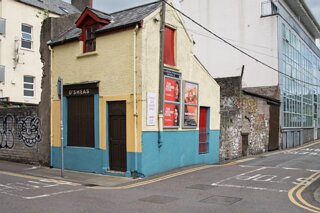
PHOTOGRAPHED DURING MY MAY 2022 VISIT TO CORK CITY
SAWMILL STREET AND LANE IN CORK AND THE O'SHEA BUILDING [HISTORY AND CURRENT STATUS]
Situated within Cork’s historic South Parish, Sawmill Street and its offshoot Sawmill Lane form an urban artery that traces the area's shift from industrial waterfronts to modern education and residential spaces.
History of Sawmill Street and Sawmill Lane
Industrial Foundations: During the 18th and 19th centuries, the South Parish developed into a hive of processing, manufacturing, and commerce. True to its name, the street emerged alongside local timber yards, sawmills, and yards that handled imported lumber and domestic hardwoods. Surrounding enterprises included corn mills, bacon curers, malthouses, and builders' suppliers—notably Brooks-Haughton, which operated timber storage and yards on the street well into the 20th century.
Institutional and Social Legacy: Alongside industry, the street became home to key religious and philanthropic foundations. The trustees of nearby St John's Episcopalian Church (opened in 1840 on Douglas Street) established an L-shaped building on Sawmill Street in the mid-19th century as a female refuge, penitentiary, and institutional laundry.
Buckingham House: The refuge later became Buckingham House Free School, a home and educational institution for destitute Protestant children that operated there until 1958, when remaining residents relocated to Sunday's Well.
Sawmill Lane: Branching from the main corridor, Sawmill Lane served primarily as a utilitarian access point and service laneway, providing mews access, carriage turnouts, and rear delivery passages for adjacent workshops and artisans' dwellings.
Evolution into an Educational Hub
In 1958, the City of Cork Vocational Education Committee (VEC) purchased the Buckingham House site for £13,100.
The Technical Institutes: In 1961, the site opened as the School of Building and Junior Technical Institute. Two years later, in 1963, a School of Furniture opened in the adjacent former rectory. Over the following decades, the institute expanded to house trades, craft design, and vocational technology.
St John’s Central College: The institution eventually consolidated and rebranded as St John's Central College, growing into one of the largest and most varied further education colleges in Munster. In 2003–2004, substantial campus redevelopment took place: older institutional walls and 1960s annexes were replaced with modern, purpose-built educational facilities extending over the former laundry and timber yard footprints.
Douglas Street Campus
Cork College of FET: Under the restructuring by the Cork Education and Training Board (CETB), all further education providers in the region were integrated under the single umbrella brand of Cork College of FET. Today, St John's Central College serves as the primary component of the Cork College of FET – Douglas Street Campus. Its Sawmill Street entrance remains a primary operational access point, housing state-of-the-art facilities for veterinary nursing, photographic studies, fine art, jewellery making, software development, canine care, and media technology.
The distinctive, painted corner building with the "O'SHEAS" fascia board stands at the junction of Sawmill Street and Rutland Street (facing towards South Terrace) in the South Parish.
While it looks at first glance like a disused corner pub or sweet shop, it has a notable local commercial and family history tied to Cork's domestic fuel trade.
History and Origins Of The Business
The O'Shea Family Home & Office: The cottage-scale building was the ancestral family home and birthplace of Patrick O'Shea, owner of O'Shea's Coal Merchants (traditionally based at 2–10 Rutland Street). The family lived on the upper floors while the ground floor served as an order and administrative office for the coal business.
The Coal Yard Link: Directly adjoining and behind the building sits the roughly 0.08-hectare O'Sheas coal yard, which has operated in the South Parish for generations. A signboard on the side wall directed customers around the corner to the coal depot and orders desk.
Architectural Character: It is an idiosyncratic vernacular building—two storeys with an asymmetrical pitched roof, dormer detailing, a modest shopfront entrance on the canted corner, and rendered exterior walls painted in vibrant cream and blue.
Local Affection and the Miniature Replica
The structure became a celebrated piece of South Parish folklore in late 2020:
Al Dalton, founder of the Cork creative agency Notes to Cork (based nearby on Douglas Street), frequently passed the building while maintaining poster display boards mounted on its Rutland Street wall.
Charmed by its unique proportions and cheerful colours, Dalton commissioned artist and carpenter Davy Dummigan to build an exact, handcrafted scale model of the building as part of a Christmas window installation.
After the local postman spotted the miniature model and informed the family, Dalton gifted the replica to 82-year-old Patrick O'Shea in January 2021, drawing widespread coverage across Cork media celebrating the city's surviving small family institutions.
The Building As It Is Today
The ground floor and domestic rooms have remained unoccupied for daily living in recent years as business practices evolved, though the building remains in the ownership of the O'Shea family alongside the adjacent yard. The external flank wall continues to serve as an authorised billboard and poster location for local arts and community events. Cork City Council’s South Parish Area Action Plan has noted the corner plot and coal yard footprint as a key historic site with potential for sensitive, mixed-use urban regeneration whenever the family chooses to redevelop the parcel.
Current Status Of Sawmill Street And Lane
Today, Sawmill Street is a quiet yet active urban street balancing institutional educational footprints with South Parish domestic life. Modern student foot traffic from Cork College of FET mingles with long-standing terraced residential housing, creative workspaces, and small local commercial premises. Sawmill Lane remains a character-rich laneway retaining traditional boundary walls, stone masonry fragments, and residential mews plots.
Situated within Cork’s historic South Parish, Sawmill Street and its offshoot Sawmill Lane form an urban artery that traces the area's shift from industrial waterfronts to modern education and residential spaces.
History of Sawmill Street and Sawmill Lane
Industrial Foundations: During the 18th and 19th centuries, the South Parish developed into a hive of processing, manufacturing, and commerce. True to its name, the street emerged alongside local timber yards, sawmills, and yards that handled imported lumber and domestic hardwoods. Surrounding enterprises included corn mills, bacon curers, malthouses, and builders' suppliers—notably Brooks-Haughton, which operated timber storage and yards on the street well into the 20th century.
Institutional and Social Legacy: Alongside industry, the street became home to key religious and philanthropic foundations. The trustees of nearby St John's Episcopalian Church (opened in 1840 on Douglas Street) established an L-shaped building on Sawmill Street in the mid-19th century as a female refuge, penitentiary, and institutional laundry.
Buckingham House: The refuge later became Buckingham House Free School, a home and educational institution for destitute Protestant children that operated there until 1958, when remaining residents relocated to Sunday's Well.
Sawmill Lane: Branching from the main corridor, Sawmill Lane served primarily as a utilitarian access point and service laneway, providing mews access, carriage turnouts, and rear delivery passages for adjacent workshops and artisans' dwellings.
Evolution into an Educational Hub
In 1958, the City of Cork Vocational Education Committee (VEC) purchased the Buckingham House site for £13,100.
The Technical Institutes: In 1961, the site opened as the School of Building and Junior Technical Institute. Two years later, in 1963, a School of Furniture opened in the adjacent former rectory. Over the following decades, the institute expanded to house trades, craft design, and vocational technology.
St John’s Central College: The institution eventually consolidated and rebranded as St John's Central College, growing into one of the largest and most varied further education colleges in Munster. In 2003–2004, substantial campus redevelopment took place: older institutional walls and 1960s annexes were replaced with modern, purpose-built educational facilities extending over the former laundry and timber yard footprints.
Douglas Street Campus
Cork College of FET: Under the restructuring by the Cork Education and Training Board (CETB), all further education providers in the region were integrated under the single umbrella brand of Cork College of FET. Today, St John's Central College serves as the primary component of the Cork College of FET – Douglas Street Campus. Its Sawmill Street entrance remains a primary operational access point, housing state-of-the-art facilities for veterinary nursing, photographic studies, fine art, jewellery making, software development, canine care, and media technology.
The distinctive, painted corner building with the "O'SHEAS" fascia board stands at the junction of Sawmill Street and Rutland Street (facing towards South Terrace) in the South Parish.
While it looks at first glance like a disused corner pub or sweet shop, it has a notable local commercial and family history tied to Cork's domestic fuel trade.
History and Origins Of The Business
The O'Shea Family Home & Office: The cottage-scale building was the ancestral family home and birthplace of Patrick O'Shea, owner of O'Shea's Coal Merchants (traditionally based at 2–10 Rutland Street). The family lived on the upper floors while the ground floor served as an order and administrative office for the coal business.
The Coal Yard Link: Directly adjoining and behind the building sits the roughly 0.08-hectare O'Sheas coal yard, which has operated in the South Parish for generations. A signboard on the side wall directed customers around the corner to the coal depot and orders desk.
Architectural Character: It is an idiosyncratic vernacular building—two storeys with an asymmetrical pitched roof, dormer detailing, a modest shopfront entrance on the canted corner, and rendered exterior walls painted in vibrant cream and blue.
Local Affection and the Miniature Replica
The structure became a celebrated piece of South Parish folklore in late 2020:
Al Dalton, founder of the Cork creative agency Notes to Cork (based nearby on Douglas Street), frequently passed the building while maintaining poster display boards mounted on its Rutland Street wall.
Charmed by its unique proportions and cheerful colours, Dalton commissioned artist and carpenter Davy Dummigan to build an exact, handcrafted scale model of the building as part of a Christmas window installation.
After the local postman spotted the miniature model and informed the family, Dalton gifted the replica to 82-year-old Patrick O'Shea in January 2021, drawing widespread coverage across Cork media celebrating the city's surviving small family institutions.
The Building As It Is Today
The ground floor and domestic rooms have remained unoccupied for daily living in recent years as business practices evolved, though the building remains in the ownership of the O'Shea family alongside the adjacent yard. The external flank wall continues to serve as an authorised billboard and poster location for local arts and community events. Cork City Council’s South Parish Area Action Plan has noted the corner plot and coal yard footprint as a key historic site with potential for sensitive, mixed-use urban regeneration whenever the family chooses to redevelop the parcel.
Current Status Of Sawmill Street And Lane
Today, Sawmill Street is a quiet yet active urban street balancing institutional educational footprints with South Parish domestic life. Modern student foot traffic from Cork College of FET mingles with long-standing terraced residential housing, creative workspaces, and small local commercial premises. Sawmill Lane remains a character-rich laneway retaining traditional boundary walls, stone masonry fragments, and residential mews plots.
SAWMILL STREET AND LANE