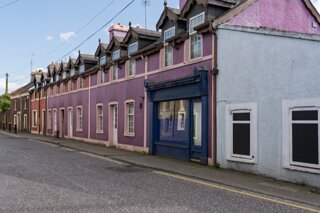
McDERMOTT STREET IN MIDLETON
McDERMOTT STREET IN MIDLETON COUNTY CORK [MIDLETON NOT MIDDLETON]
I Normally visit Cork every in May or June but in 2025 I delayed until my Sony A1 II arrive but eventually as my dealer gave me a Sony A7RV on loan as my FE 28-70 F2 lens had already arrived I decided in September to travel to Cork and based myself at the Moxy Hotel which was a very good choice. On arriving at my hotel I received a text message indicating that the Sony A1 has arrived and was awaiting collection. As a matter of interest it is expected that the Sony A7RVI will be announced in May.
Shadows and Shifting Colours: The Duality of McDermott Street, Midleton
McDermott Street in Midleton, East Cork, is a short stretch of road that tells a long story. To the casual observer, it is a convenient cut-through from the Main Street towards the River Owenacurra. To a photographer, however, it is a study in contrast: a place where vibrant, modern restoration sits directly across from the salt-stained decay of a past era.
The street is named after Seán Mac Diarmada (Sean McDermott), a revolutionary leader and signatory of the 1916 Proclamation. While many Irish streets were renamed in the post-independence era to honour national heroes, McDermott Street carries a weight that feels uniquely tied to the town's industrial and environmental struggles.
A Legacy of Industry and Inundation
Historically, this area was the pulse of Midleton’s working class. Its proximity to the river made it ideal for the industries that defined the town—most notably the woollen mills and the world-famous Midleton Distillery. The street provided housing for the artisans and labourers who powered these massive operations.
However, its greatest asset—the River Owenacurra—has also been its greatest threat. McDermott Street is one of the lowest points in the town, acting as a natural bowl during heavy rainfall. Most recently, during Storm Babet in October 2023, the street was submerged under several feet of water. This persistent cycle of flooding has shaped the architecture you see today, dictating which buildings thrive and which fall into silence.
The Purple Terrace: Artisan Resilience
One of the most striking subjects for any photographer on the street is the row of houses often referred to as the Distillery Cottages. The vibrant purple facade of No. 2, accented by its deep blue shop front, provides a sharp pop of colour against the often-grey Irish sky.
These are classic late 19th-century artisan dwellings. Note the distinctive gabled dormer windows that break the roofline—a hallmark of the era’s "model housing" for industrial workers. While many such terraces across Ireland have been lost to modernisation, this row has been meticulously maintained. The bold colour palette isn't just an aesthetic choice; it’s a statement of resilience in a part of town that has been "dried out" more times than most residents care to count.
The Meeting Place: A Casualty of the Tide
Directly contrasting the vibrant terrace is the derelict block housing the former "Meeting Place" pub and restaurant. Once a focal point for local social life, it now stands as a haunting example of urban decay.
The building’s architecture is older than its weathered stucco suggests, with thick stone masonry dating back to the early 1800s. The peeling paint and boarded-up windows are the physical scars of the river’s recurring presence. When a building of this age is flooded, the porous lime-and-stone walls can take years to fully dry, often making insurance and commercial renovation prohibitively expensive. In the background of this dereliction, the spire of St. John the Baptist Church serves as a silent witness to the street's slow transformation from a commercial hub to a quiet, weathered corridor.
Midleton Not Middleton
It is a common mistake to assume the town is named "Middleton" because of its location, but the spelling Midleton (with a single 'd') is a specific evolution of its history and the "Hiberno-English" way place names were recorded.
The name translates to "Middle Town", but its origins are a blend of Norman-French, English, and Irish influences.
1. The Cistercian Connection
Long before it was a town, the area was known as Chore Abbey (from the Irish Mainistir na Corann, meaning "Monastery of the Weir"). When the town was officially established as a "New Town" in the 17th century, it was positioned halfway between the established settlements of Cork City and Youghal. This "middle" position gave rise to its name.
2. The Brodrick Family and the Royal Charter
The specific spelling was formalised in 1670 when King Charles II granted a royal charter to Sir St. John Brodrick. The charter officially incorporated the area as the "Borough and Town of Midleton."
In the 17th century, English spelling was not as strictly standardised as it is today. When the Brodricks were granted the title Viscounts Midleton in 1717, the single-'d' spelling became the legal and aristocratic standard. Because the town's growth was entirely dictated by the Brodrick estate, their preferred spelling became the permanent one.
3. Avoiding Confusion
While "Middleton" is one of the most common place names in England (there are dozens of them), "Midleton" is unique to County Cork. This distinct spelling helps distinguish the Irish town from its many namesakes across the UK and the United States.
I Normally visit Cork every in May or June but in 2025 I delayed until my Sony A1 II arrive but eventually as my dealer gave me a Sony A7RV on loan as my FE 28-70 F2 lens had already arrived I decided in September to travel to Cork and based myself at the Moxy Hotel which was a very good choice. On arriving at my hotel I received a text message indicating that the Sony A1 has arrived and was awaiting collection. As a matter of interest it is expected that the Sony A7RVI will be announced in May.
Shadows and Shifting Colours: The Duality of McDermott Street, Midleton
McDermott Street in Midleton, East Cork, is a short stretch of road that tells a long story. To the casual observer, it is a convenient cut-through from the Main Street towards the River Owenacurra. To a photographer, however, it is a study in contrast: a place where vibrant, modern restoration sits directly across from the salt-stained decay of a past era.
The street is named after Seán Mac Diarmada (Sean McDermott), a revolutionary leader and signatory of the 1916 Proclamation. While many Irish streets were renamed in the post-independence era to honour national heroes, McDermott Street carries a weight that feels uniquely tied to the town's industrial and environmental struggles.
A Legacy of Industry and Inundation
Historically, this area was the pulse of Midleton’s working class. Its proximity to the river made it ideal for the industries that defined the town—most notably the woollen mills and the world-famous Midleton Distillery. The street provided housing for the artisans and labourers who powered these massive operations.
However, its greatest asset—the River Owenacurra—has also been its greatest threat. McDermott Street is one of the lowest points in the town, acting as a natural bowl during heavy rainfall. Most recently, during Storm Babet in October 2023, the street was submerged under several feet of water. This persistent cycle of flooding has shaped the architecture you see today, dictating which buildings thrive and which fall into silence.
The Purple Terrace: Artisan Resilience
One of the most striking subjects for any photographer on the street is the row of houses often referred to as the Distillery Cottages. The vibrant purple facade of No. 2, accented by its deep blue shop front, provides a sharp pop of colour against the often-grey Irish sky.
These are classic late 19th-century artisan dwellings. Note the distinctive gabled dormer windows that break the roofline—a hallmark of the era’s "model housing" for industrial workers. While many such terraces across Ireland have been lost to modernisation, this row has been meticulously maintained. The bold colour palette isn't just an aesthetic choice; it’s a statement of resilience in a part of town that has been "dried out" more times than most residents care to count.
The Meeting Place: A Casualty of the Tide
Directly contrasting the vibrant terrace is the derelict block housing the former "Meeting Place" pub and restaurant. Once a focal point for local social life, it now stands as a haunting example of urban decay.
The building’s architecture is older than its weathered stucco suggests, with thick stone masonry dating back to the early 1800s. The peeling paint and boarded-up windows are the physical scars of the river’s recurring presence. When a building of this age is flooded, the porous lime-and-stone walls can take years to fully dry, often making insurance and commercial renovation prohibitively expensive. In the background of this dereliction, the spire of St. John the Baptist Church serves as a silent witness to the street's slow transformation from a commercial hub to a quiet, weathered corridor.
Midleton Not Middleton
It is a common mistake to assume the town is named "Middleton" because of its location, but the spelling Midleton (with a single 'd') is a specific evolution of its history and the "Hiberno-English" way place names were recorded.
The name translates to "Middle Town", but its origins are a blend of Norman-French, English, and Irish influences.
1. The Cistercian Connection
Long before it was a town, the area was known as Chore Abbey (from the Irish Mainistir na Corann, meaning "Monastery of the Weir"). When the town was officially established as a "New Town" in the 17th century, it was positioned halfway between the established settlements of Cork City and Youghal. This "middle" position gave rise to its name.
2. The Brodrick Family and the Royal Charter
The specific spelling was formalised in 1670 when King Charles II granted a royal charter to Sir St. John Brodrick. The charter officially incorporated the area as the "Borough and Town of Midleton."
In the 17th century, English spelling was not as strictly standardised as it is today. When the Brodricks were granted the title Viscounts Midleton in 1717, the single-'d' spelling became the legal and aristocratic standard. Because the town's growth was entirely dictated by the Brodrick estate, their preferred spelling became the permanent one.
3. Avoiding Confusion
While "Middleton" is one of the most common place names in England (there are dozens of them), "Midleton" is unique to County Cork. This distinct spelling helps distinguish the Irish town from its many namesakes across the UK and the United States.
McDERMOTT STREET