AN UNEXPECTED PROBLEM
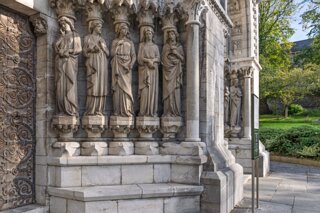
MY SEPTEMBER 2025 VISIT TO ST FIN BARRES CATHEDRAL IN CORK [AND AN UNEXPECTED PROBLEM]
I have already discussed the Cathedral in great detail elsewhere so I am going off subject to some extent because of a problem that I encountered when using my Sony A7RV.
Towards the end of 2024 I ordered and fully paid for a Sony A1 II which I hoped to use for my city visits in 2025. By March 2025 I was beginning to realise that I would not have the camera in time for my April visit to Cork so I delayed the visit to September - and guess what the camera had still not arrived. My dealer then offered me a Sony A7RV on loan so when I visited Cork I had a new Leica Q3 which proved to be unreliable and the Sony which was a joy to use but the weather was terrible. While I was in Cork the A1 II arrived at my apartment in Dublin. I mention the Sony because it attracted a lot of attention during my week in Cork and in many ways that can be a problem.
The Street Photographer’s Dilemma: Navigating the Uninvited Subject
For a street photographer committed to documenting the built environment and the authentic, unposed rhythms of the city, the camera acts as both a passport and a lightning rod. True street photography relies on candid reality. The moment a passerby notices the lens and demands to be photographed, the illusion of the observer breaks. Navigating these uninvited interactions requires quick thinking, psychological reading, and occasionally, a fast exit.
The Comedy of Literal Compliance: The Waterford Hill
An encounter in Waterford several years ago illustrates the lengths a photographer will go to protect artistic autonomy—and how a creative excuse can backfire into comedy.
When two young women insistently demanded a photograph, the desire to decline without causing offence led to a quick fabrication. The explanation offered was highly technical: the lens currently mounted was strictly for nature photography, meaning a distance of at least 200 metres was required before the camera could even focus.
Astonishingly, the physics of this fictional lens went unquestioned. The pair simply agreed, walked 200 metres down the hill, and stopped to wait for the shutter to click. Caught in a self-made trap, the only option was to take the distant shot. Satisfied, they turned and continued on their way, leaving behind a completely bewildered photographer outsmarted by sheer determination.
The Darker Side: The Payment Trap
Unfortunately, not all interactions are so lighthearted. A far more cynical challenge involves individuals who become aggressively confrontational if a request to photograph them is refused.
This hostility often stems from a specific street hustle: the individuals attempt to force a photographer into taking their picture with the sole intention of aggressively demanding payment the moment the shutter clicks. By refusing to engage in the first place, the ruse is disrupted, and the easy payday is denied. The resulting anger is pure intimidation, turning a creative pursuit into a high-stress exercise in boundary management.
My September 2025 Visit to St Fin Barre’s Cathedral
The unpredictable and volatile nature of public spaces reached a bizarre peak during a visit to the grounds of St Fin Barre’s Cathedral in Cork.
The afternoon began with absolute tranquility. The grounds were entirely deserted—a rare opportunity to capture the soaring Gothic Revival architecture without a single soul in frame. Then, around a corner, the stillness shattered. Two young women were suddenly encountered, actively taking topless selfies against the backdrop of the historic church.
[Photographer] ---> Stumbles into ---> [Two Women taking Topless Selfies]
(Potential Conflict)
[Groundsman] ---> Intervenes ---> "Closing early for maintenance!"
The instinctual warning signs were immediate: this could escalate into a massive problem. In the modern cultural climate, the sudden appearance of a man with a professional camera near individuals in a state of undress is a powder keg. A misunderstanding, a panic, or a defensive reaction could easily result in shouting, accusations, or the involvement of the Gardaí.
Just as the tension began to build, a remarkably professional rescue arrived. A cathedral groundsman appeared on the scene. Performing a masterclass in tactical blindness, he completely ignored the women and walked straight over to deliver a polite but firm notice: the grounds were closing early due to urgent emergency maintenance.
The eviction was gladly accepted. Gear was packed, and a swift exit was made, leaving the sensitive situation behind. The incident served as a stark reminder of how quickly an environment can shift from completely vacant to highly problematic, and how valuable a skilled, observant groundsman can be in defusing a crisis before it even begins.
Deciphering the "Why?" Query
Beyond requests for portraits, anyone operating a professional camera in public will inevitably face the standard interrogation: "Why are you photographing that?"
Reading the true intent behind this question in a split second is difficult. Most often, the inquiry comes from a place of genuine local curiosity; a resident is simply fascinated by what an artist sees in a mundane wall or a crumbling archway. However, the question can also come from a defensive property owner or an aggressive individual looking for a confrontation.
["Why are you shooting that?"]
[Genuinely Curious]
- Loves local history
- Yields great conversation
[The Confrontational]
- Seeks an argument
- Neutralised by "The Boss"
An excellent antidote to this awkwardness was passed along by a veteran British tabloid photographer. When asked why he was taking a picture, his standard, bulletproof response was simple:
"The boss told me to."
Deploying this tactic a few days later yielded spectacular results. When a suspicious gentleman demanded to know the purpose of the photography, the "boss" excuse was offered.
The gentleman stopped, nodded, and replied: "Mate, tell me about bosses—they are all stupid."
The brilliance of this shield lies in the immediate shift of dynamics. Bureaucracy is the ultimate conversation killer. By deflecting responsibility to an unseen employer, the photographer ceases to be an enigmatic outsider or a suspicious intruder. Instead, the interaction becomes a shared moment of working-class solidarity. It disarms suspicion, ends the debate, and turns a potential confrontation into a sympathetic complaint about corporate management.
I have already discussed the Cathedral in great detail elsewhere so I am going off subject to some extent because of a problem that I encountered when using my Sony A7RV.
Towards the end of 2024 I ordered and fully paid for a Sony A1 II which I hoped to use for my city visits in 2025. By March 2025 I was beginning to realise that I would not have the camera in time for my April visit to Cork so I delayed the visit to September - and guess what the camera had still not arrived. My dealer then offered me a Sony A7RV on loan so when I visited Cork I had a new Leica Q3 which proved to be unreliable and the Sony which was a joy to use but the weather was terrible. While I was in Cork the A1 II arrived at my apartment in Dublin. I mention the Sony because it attracted a lot of attention during my week in Cork and in many ways that can be a problem.
The Street Photographer’s Dilemma: Navigating the Uninvited Subject
For a street photographer committed to documenting the built environment and the authentic, unposed rhythms of the city, the camera acts as both a passport and a lightning rod. True street photography relies on candid reality. The moment a passerby notices the lens and demands to be photographed, the illusion of the observer breaks. Navigating these uninvited interactions requires quick thinking, psychological reading, and occasionally, a fast exit.
The Comedy of Literal Compliance: The Waterford Hill
An encounter in Waterford several years ago illustrates the lengths a photographer will go to protect artistic autonomy—and how a creative excuse can backfire into comedy.
When two young women insistently demanded a photograph, the desire to decline without causing offence led to a quick fabrication. The explanation offered was highly technical: the lens currently mounted was strictly for nature photography, meaning a distance of at least 200 metres was required before the camera could even focus.
Astonishingly, the physics of this fictional lens went unquestioned. The pair simply agreed, walked 200 metres down the hill, and stopped to wait for the shutter to click. Caught in a self-made trap, the only option was to take the distant shot. Satisfied, they turned and continued on their way, leaving behind a completely bewildered photographer outsmarted by sheer determination.
The Darker Side: The Payment Trap
Unfortunately, not all interactions are so lighthearted. A far more cynical challenge involves individuals who become aggressively confrontational if a request to photograph them is refused.
This hostility often stems from a specific street hustle: the individuals attempt to force a photographer into taking their picture with the sole intention of aggressively demanding payment the moment the shutter clicks. By refusing to engage in the first place, the ruse is disrupted, and the easy payday is denied. The resulting anger is pure intimidation, turning a creative pursuit into a high-stress exercise in boundary management.
My September 2025 Visit to St Fin Barre’s Cathedral
The unpredictable and volatile nature of public spaces reached a bizarre peak during a visit to the grounds of St Fin Barre’s Cathedral in Cork.
The afternoon began with absolute tranquility. The grounds were entirely deserted—a rare opportunity to capture the soaring Gothic Revival architecture without a single soul in frame. Then, around a corner, the stillness shattered. Two young women were suddenly encountered, actively taking topless selfies against the backdrop of the historic church.
[Photographer] ---> Stumbles into ---> [Two Women taking Topless Selfies]
(Potential Conflict)
[Groundsman] ---> Intervenes ---> "Closing early for maintenance!"
The instinctual warning signs were immediate: this could escalate into a massive problem. In the modern cultural climate, the sudden appearance of a man with a professional camera near individuals in a state of undress is a powder keg. A misunderstanding, a panic, or a defensive reaction could easily result in shouting, accusations, or the involvement of the Gardaí.
Just as the tension began to build, a remarkably professional rescue arrived. A cathedral groundsman appeared on the scene. Performing a masterclass in tactical blindness, he completely ignored the women and walked straight over to deliver a polite but firm notice: the grounds were closing early due to urgent emergency maintenance.
The eviction was gladly accepted. Gear was packed, and a swift exit was made, leaving the sensitive situation behind. The incident served as a stark reminder of how quickly an environment can shift from completely vacant to highly problematic, and how valuable a skilled, observant groundsman can be in defusing a crisis before it even begins.
Deciphering the "Why?" Query
Beyond requests for portraits, anyone operating a professional camera in public will inevitably face the standard interrogation: "Why are you photographing that?"
Reading the true intent behind this question in a split second is difficult. Most often, the inquiry comes from a place of genuine local curiosity; a resident is simply fascinated by what an artist sees in a mundane wall or a crumbling archway. However, the question can also come from a defensive property owner or an aggressive individual looking for a confrontation.
["Why are you shooting that?"]
[Genuinely Curious]
- Loves local history
- Yields great conversation
[The Confrontational]
- Seeks an argument
- Neutralised by "The Boss"
An excellent antidote to this awkwardness was passed along by a veteran British tabloid photographer. When asked why he was taking a picture, his standard, bulletproof response was simple:
"The boss told me to."
Deploying this tactic a few days later yielded spectacular results. When a suspicious gentleman demanded to know the purpose of the photography, the "boss" excuse was offered.
The gentleman stopped, nodded, and replied: "Mate, tell me about bosses—they are all stupid."
The brilliance of this shield lies in the immediate shift of dynamics. Bureaucracy is the ultimate conversation killer. By deflecting responsibility to an unseen employer, the photographer ceases to be an enigmatic outsider or a suspicious intruder. Instead, the interaction becomes a shared moment of working-class solidarity. It disarms suspicion, ends the debate, and turns a potential confrontation into a sympathetic complaint about corporate management.
THE PROBLEM