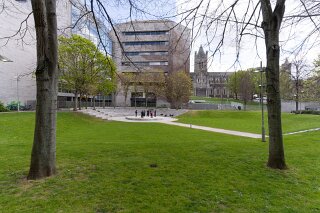
THE BEGINNING OF THE END FOR WOOD QUAY
WOOD QUAY CIVIC OFFICES AND THE MISSING BRONZE COW [ENJOYING THE SUN 13 APRIL 2026]
The disappearance of the bronze cow from Wood Quay is part of a much larger, and somewhat controversial, shift in Dublin’s administrative landscape. As of April 2026, the "Enjoying the Sun" sculpture and the very buildings it sat beside are at the centre of a massive redevelopment plan.
The Mystery of the Bronze Cow
Ag Crú na Gréine (“Enjoying the Sun”), the life-sized bronze cow by Jackie McKenna, has had a nomadic few years. Originally commissioned in 2003 for Wolfe Tone Park, it was moved to the Wood Quay Civic Offices in 2017 during the park's redevelopment.
While it became a fixture of the "bunker" landscape at Wood Quay, recent reports indicate that the sculpture has been removed or placed into storage. This is directly linked to Dublin City Council’s (DCC) imminent departure from the Wood Quay site. Given the site is slated for total demolition and redevelopment, public art is being decommissioned or moved to prevent damage during the transition.
The Relocation to Kevin Street
In a move that has surprised many Dubliners, DCC has officially signed a contract (as of March/April 2026) to relocate its headquarters from Wood Quay to the Old Kevin Street College site (specifically the Camden Yard development).
The Purchase: DCC purchased the site, a "stalled" development project formerly owned by DIT, for approximately €90 million.
The Cost: The total project, including finishing the office blocks and building public housing, is estimated to exceed €670 million.
The Reason: DCC Chief Executive Richard Shakespeare stated that retrofitting the current Wood Quay offices to meet 2030 climate standards would cost an astronomical €400 million. Buying a modern, energy-efficient site (aiming for an A3 BER rating) was deemed more "cost-effective" than repairing the existing "bunkers."
A Brief History of Wood Quay
Wood Quay is perhaps the most historically charged plot of land in Dublin. Its history is a tug-of-war between progress and preservation:
Viking Origins: Excavations in the 1970s revealed it was the heart of Viking Dublin, dating back to 841 AD. Archaeologists found remarkably preserved wooden houses, pathways, and thousands of artefacts.
The Great Protest: When the Corporation (now DCC) announced plans to build offices there in the late 60s, it sparked a national outcry. In 1978, 20,000 people marched to "Save Wood Quay."
"Operation Sitric": Activists, including prominent writers and politicians, occupied the site in 1979 to stop the bulldozers.
The "Bunkers": Despite the protests and a High Court ruling declaring it a National Monument, the government allowed the development to proceed. The four granite blocks (often derided as "the bunkers") were completed in stages between 1986 and 1994.
What Happens Next?
The Wood Quay site is not being sold to a private developer; instead, DCC intends to demolish the current Civic Offices to build over 500 public homes.
While the "Bronze Cow" might seem like a small detail in a €600 million relocation, its absence marks the end of an era for Wood Quay as the city's administrative hub. Whether she returns to a rejuvenated Wolfe Tone Park or finds a new home at the Kevin Street campus remains to be seen.
The housing plans for the Wood Quay site are ambitious, but as of April 2026, they are also the subject of intense debate regarding cost, heritage, and transparency.
Here are the specific details of what Dublin City Council (DCC) intends to do once they "unlock" the land:
1. The Numbers: Scale and Type
The primary objective of vacating the current "bunkers" is to transform the site from an administrative hub into a residential one.
Capacity: DCC management has stated the site will accommodate in excess of 500 public homes.
Tenure: The focus is explicitly on social and affordable housing, aiming to bring life back to the city centre after business hours.
The Kevin Street Link: As part of the same master project, the new site at Camden Yard (Kevin Street) will also deliver up to 300 public homes alongside the new offices, bringing the total residential yield of the relocation plan to roughly 800 units.
2. Demolition vs. Repurposing
One of the most controversial aspects of the plan is the fate of the existing buildings (designed by Sam Stephenson).
The Verdict: Current management claims that the buildings are "not fit for purpose" for modern housing. They intend to completely demolish the four granite blocks.
The Cost Argument: DCC argues that retrofitting the existing structures for climate compliance and residential use would be more expensive than starting from scratch (citing a potential €500 million price tag for retrofitting alone).
The Criticism: Critics and some architects argue that the "embodied carbon" in the current structures is being ignored, and that the buildings could—and should—be repurposed rather than levelled.
3. The Archaeological "Minefield"
Because the site sits directly atop the Viking heart of Dublin, any new construction is fraught with complexity.
Risk: While the "bunkers" were built on massive concrete rafts that destroyed much of the archaeology in the 70s and 80s, the land between and beneath them still holds significant historical potential.
Regulation: New housing will require a rigorous (and expensive) archaeological excavation phase before any foundations can be poured. This is expected to add years to the development timeline.
4. Timeline and Current Status
The Handover: DCC has only just signed the contract for the Kevin Street site (March 2026).
The Vacancy: It will take several years to complete the Kevin Street offices and relocate thousands of staff.
The Projection: Demolition of the Wood Quay bunkers is not expected to begin until the late 2020s, with the first homes likely not ready until the early 2030s.
Key Takeaway for the "Bronze Cow"
With the buildings slated for eventual demolition, the Ag Crú na Gréine sculpture is effectively in "exile." Given that the Wood Quay site will become a construction zone for the better part of the next decade, her return to Wolfe Tone Park or a move to the new Camden Yard campus seems more likely than her staying at a site that is about to be turned into a massive housing development.
The disappearance of the bronze cow from Wood Quay is part of a much larger, and somewhat controversial, shift in Dublin’s administrative landscape. As of April 2026, the "Enjoying the Sun" sculpture and the very buildings it sat beside are at the centre of a massive redevelopment plan.
The Mystery of the Bronze Cow
Ag Crú na Gréine (“Enjoying the Sun”), the life-sized bronze cow by Jackie McKenna, has had a nomadic few years. Originally commissioned in 2003 for Wolfe Tone Park, it was moved to the Wood Quay Civic Offices in 2017 during the park's redevelopment.
While it became a fixture of the "bunker" landscape at Wood Quay, recent reports indicate that the sculpture has been removed or placed into storage. This is directly linked to Dublin City Council’s (DCC) imminent departure from the Wood Quay site. Given the site is slated for total demolition and redevelopment, public art is being decommissioned or moved to prevent damage during the transition.
The Relocation to Kevin Street
In a move that has surprised many Dubliners, DCC has officially signed a contract (as of March/April 2026) to relocate its headquarters from Wood Quay to the Old Kevin Street College site (specifically the Camden Yard development).
The Purchase: DCC purchased the site, a "stalled" development project formerly owned by DIT, for approximately €90 million.
The Cost: The total project, including finishing the office blocks and building public housing, is estimated to exceed €670 million.
The Reason: DCC Chief Executive Richard Shakespeare stated that retrofitting the current Wood Quay offices to meet 2030 climate standards would cost an astronomical €400 million. Buying a modern, energy-efficient site (aiming for an A3 BER rating) was deemed more "cost-effective" than repairing the existing "bunkers."
A Brief History of Wood Quay
Wood Quay is perhaps the most historically charged plot of land in Dublin. Its history is a tug-of-war between progress and preservation:
Viking Origins: Excavations in the 1970s revealed it was the heart of Viking Dublin, dating back to 841 AD. Archaeologists found remarkably preserved wooden houses, pathways, and thousands of artefacts.
The Great Protest: When the Corporation (now DCC) announced plans to build offices there in the late 60s, it sparked a national outcry. In 1978, 20,000 people marched to "Save Wood Quay."
"Operation Sitric": Activists, including prominent writers and politicians, occupied the site in 1979 to stop the bulldozers.
The "Bunkers": Despite the protests and a High Court ruling declaring it a National Monument, the government allowed the development to proceed. The four granite blocks (often derided as "the bunkers") were completed in stages between 1986 and 1994.
What Happens Next?
The Wood Quay site is not being sold to a private developer; instead, DCC intends to demolish the current Civic Offices to build over 500 public homes.
While the "Bronze Cow" might seem like a small detail in a €600 million relocation, its absence marks the end of an era for Wood Quay as the city's administrative hub. Whether she returns to a rejuvenated Wolfe Tone Park or finds a new home at the Kevin Street campus remains to be seen.
The housing plans for the Wood Quay site are ambitious, but as of April 2026, they are also the subject of intense debate regarding cost, heritage, and transparency.
Here are the specific details of what Dublin City Council (DCC) intends to do once they "unlock" the land:
1. The Numbers: Scale and Type
The primary objective of vacating the current "bunkers" is to transform the site from an administrative hub into a residential one.
Capacity: DCC management has stated the site will accommodate in excess of 500 public homes.
Tenure: The focus is explicitly on social and affordable housing, aiming to bring life back to the city centre after business hours.
The Kevin Street Link: As part of the same master project, the new site at Camden Yard (Kevin Street) will also deliver up to 300 public homes alongside the new offices, bringing the total residential yield of the relocation plan to roughly 800 units.
2. Demolition vs. Repurposing
One of the most controversial aspects of the plan is the fate of the existing buildings (designed by Sam Stephenson).
The Verdict: Current management claims that the buildings are "not fit for purpose" for modern housing. They intend to completely demolish the four granite blocks.
The Cost Argument: DCC argues that retrofitting the existing structures for climate compliance and residential use would be more expensive than starting from scratch (citing a potential €500 million price tag for retrofitting alone).
The Criticism: Critics and some architects argue that the "embodied carbon" in the current structures is being ignored, and that the buildings could—and should—be repurposed rather than levelled.
3. The Archaeological "Minefield"
Because the site sits directly atop the Viking heart of Dublin, any new construction is fraught with complexity.
Risk: While the "bunkers" were built on massive concrete rafts that destroyed much of the archaeology in the 70s and 80s, the land between and beneath them still holds significant historical potential.
Regulation: New housing will require a rigorous (and expensive) archaeological excavation phase before any foundations can be poured. This is expected to add years to the development timeline.
4. Timeline and Current Status
The Handover: DCC has only just signed the contract for the Kevin Street site (March 2026).
The Vacancy: It will take several years to complete the Kevin Street offices and relocate thousands of staff.
The Projection: Demolition of the Wood Quay bunkers is not expected to begin until the late 2020s, with the first homes likely not ready until the early 2030s.
Key Takeaway for the "Bronze Cow"
With the buildings slated for eventual demolition, the Ag Crú na Gréine sculpture is effectively in "exile." Given that the Wood Quay site will become a construction zone for the better part of the next decade, her return to Wolfe Tone Park or a move to the new Camden Yard campus seems more likely than her staying at a site that is about to be turned into a massive housing development.
THE BEGINNING OF THE END