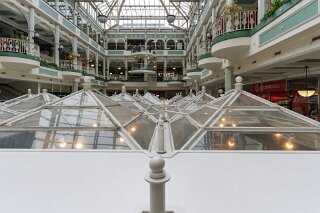
ST STEPHEN'S GREEN SHOPPING CENTRE 12 APRIL 2026
ST STEPHEN'S GREEN CENTRE [12 APRIL 2026]
St Stephen's Green Shopping Centre stands as a distinctive landmark at the terminus of Grafton Street. While its Victorian-inspired aesthetic may suggest antiquity, the building is a product of late-1980s postmodernism, serving as a rare "architectural wedding cake" in the heart of Dublin.
The History of the Site
Before the shopping centre’s inception, the site was part of the dense urban fabric surrounding St Stephen’s Green, which began its life as a marshy common in the 17th century.
Pre-1980s: The site was historically occupied by a variety of smaller buildings and commercial premises. By the mid-20th century, parts of the area had fallen into disrepair or were under-utilised.
The 1988 Opening: Designed by architect James Toomey and opened in October 1988, the centre was a flagship project for the "Dublin Millennium." It was, at the time, Ireland's largest shopping centre.
Design Philosophy: The architecture was intended to be a "crystal palace" for the modern age. Its ornate ironwork and glass facades were designed to mirror the neighbouring Gaiety Theatre and evoke the feel of a 19th-century conservatory, effectively "bringing the park indoors."
The Controversy: Redevelopment vs. Preservation
In recent years, the owners (DTDL Ltd) have sought to radically redevelop the site. A €100 million plan was proposed to demolish much of the existing structure and replace it with a modern, eight-storey mixed-use development, primarily featuring office space and a more "restrained" facade.
Planning Refusals: As of mid-2025, An Coimisiún Pleanála (formerly An Bord Pleanála) refused permission for the redevelopment. Inspectors argued the new design lacked sufficient "architectural merit" and failed to provide high-quality urban placemaking.
Revised Plans (2026): Newer iterations of the plan involve a collaboration with high-profile architects O’Donnell + Tuomey, though public and political opposition remains fierce.
Why the Public Loves It
The opposition to its demolition is notable because postmodern buildings are often the first to be targeted for "modernisation." However, Dubliners have formed a strong emotional bond with the centre for several reasons:
Whimsical Aesthetic: In a city increasingly dominated by "glass box" office developments, the shopping centre's iron scrolls, floral motifs, and giant clock offer a sense of character and "kitsch" that many find charming.
The Interior Atrium: The vast, light-filled atrium with its hanging greenery provides a unique public-feeling space that is protected from the Irish weather.
Sentimental Value: For many, the centre is synonymous with meeting points and the "Golden Mile" shopping experience of the 90s and 2000s.
Environmental Concerns: Campaigners, such as the "Save Stephen's Green" group, argue that demolishing a functional 40-year-old building to build more offices (amidst high vacancy rates) is environmentally irresponsible.
Interestingly, the public and critical reception in 1988 was far more divisive than the nostalgic "save it" sentiment we see today. It is a classic case of an architectural "ugly duckling" becoming a beloved swan simply by staying exactly the same while the world around it changed.
A "Love-Hate" Scenario
When the centre first opened, it was not universally hailed as a masterpiece. Instead, it was often viewed with a mixture of awe at its scale and skepticism toward its style.
The Critics' Scorn: High-profile critics, most notably Frank McDonald of The Irish Times, were famously unimpressed. It was McDonald who coined (or at least popularised) the derisive nicknames "The Wedding Cake" and the "Mississippi Steamboat." Critics viewed its Victorian-pastiche style as "historical fakery"—a superficial "Disney-fication" of Dublin’s architecture that lacked the authenticity of the Georgian buildings it replaced.
The "Dandelion" Grief: Much of the initial public resentment actually stemmed from what was lost. The site had previously hosted the Dandelion Market, a legendary, bohemian open-air market where U2 played early gigs and young Dubliners bought their first punk records or second-hand clothes. To many locals, the new, polished shopping centre felt like a corporate "sanitisation" of the city’s soul.
The Shift to "Beloved Landmark"
The reason it is so fiercely defended in 2026 is largely due to environmental and aesthetic fatigue:
Survival of the Different: In 1988, its "kitsch" style was seen as gaudy. Today, after decades of Dublin being filled with steel-and-glass office blocks, the centre’s ornate ironwork feels like a rare burst of personality.
The "Third Space" Success: While critics hated the "maze-like" interior designed to keep shoppers inside, the public grew to love the light-filled atrium. It became a reliable, free meeting spot for generations of teenagers and tourists—a "quasi-public" space that feels warmer than a modern mall.
Irony of Preservation: Frank McDonald, the very man who mocked its design in the 80s, became one of the key figures appealing against its demolition in recent years. His argument shifted from "this building is ugly" to "this building is a landmark of its era, and what replaces it will be much worse."
In short: it wasn't necessarily "liked" for its high-art credentials in 1988, but it was noticeable. In an era of architectural austerity, the public has decided that a "wedding cake" is much better than another "soulless cube."
St Stephen's Green Shopping Centre stands as a distinctive landmark at the terminus of Grafton Street. While its Victorian-inspired aesthetic may suggest antiquity, the building is a product of late-1980s postmodernism, serving as a rare "architectural wedding cake" in the heart of Dublin.
The History of the Site
Before the shopping centre’s inception, the site was part of the dense urban fabric surrounding St Stephen’s Green, which began its life as a marshy common in the 17th century.
Pre-1980s: The site was historically occupied by a variety of smaller buildings and commercial premises. By the mid-20th century, parts of the area had fallen into disrepair or were under-utilised.
The 1988 Opening: Designed by architect James Toomey and opened in October 1988, the centre was a flagship project for the "Dublin Millennium." It was, at the time, Ireland's largest shopping centre.
Design Philosophy: The architecture was intended to be a "crystal palace" for the modern age. Its ornate ironwork and glass facades were designed to mirror the neighbouring Gaiety Theatre and evoke the feel of a 19th-century conservatory, effectively "bringing the park indoors."
The Controversy: Redevelopment vs. Preservation
In recent years, the owners (DTDL Ltd) have sought to radically redevelop the site. A €100 million plan was proposed to demolish much of the existing structure and replace it with a modern, eight-storey mixed-use development, primarily featuring office space and a more "restrained" facade.
Planning Refusals: As of mid-2025, An Coimisiún Pleanála (formerly An Bord Pleanála) refused permission for the redevelopment. Inspectors argued the new design lacked sufficient "architectural merit" and failed to provide high-quality urban placemaking.
Revised Plans (2026): Newer iterations of the plan involve a collaboration with high-profile architects O’Donnell + Tuomey, though public and political opposition remains fierce.
Why the Public Loves It
The opposition to its demolition is notable because postmodern buildings are often the first to be targeted for "modernisation." However, Dubliners have formed a strong emotional bond with the centre for several reasons:
Whimsical Aesthetic: In a city increasingly dominated by "glass box" office developments, the shopping centre's iron scrolls, floral motifs, and giant clock offer a sense of character and "kitsch" that many find charming.
The Interior Atrium: The vast, light-filled atrium with its hanging greenery provides a unique public-feeling space that is protected from the Irish weather.
Sentimental Value: For many, the centre is synonymous with meeting points and the "Golden Mile" shopping experience of the 90s and 2000s.
Environmental Concerns: Campaigners, such as the "Save Stephen's Green" group, argue that demolishing a functional 40-year-old building to build more offices (amidst high vacancy rates) is environmentally irresponsible.
Interestingly, the public and critical reception in 1988 was far more divisive than the nostalgic "save it" sentiment we see today. It is a classic case of an architectural "ugly duckling" becoming a beloved swan simply by staying exactly the same while the world around it changed.
A "Love-Hate" Scenario
When the centre first opened, it was not universally hailed as a masterpiece. Instead, it was often viewed with a mixture of awe at its scale and skepticism toward its style.
The Critics' Scorn: High-profile critics, most notably Frank McDonald of The Irish Times, were famously unimpressed. It was McDonald who coined (or at least popularised) the derisive nicknames "The Wedding Cake" and the "Mississippi Steamboat." Critics viewed its Victorian-pastiche style as "historical fakery"—a superficial "Disney-fication" of Dublin’s architecture that lacked the authenticity of the Georgian buildings it replaced.
The "Dandelion" Grief: Much of the initial public resentment actually stemmed from what was lost. The site had previously hosted the Dandelion Market, a legendary, bohemian open-air market where U2 played early gigs and young Dubliners bought their first punk records or second-hand clothes. To many locals, the new, polished shopping centre felt like a corporate "sanitisation" of the city’s soul.
The Shift to "Beloved Landmark"
The reason it is so fiercely defended in 2026 is largely due to environmental and aesthetic fatigue:
Survival of the Different: In 1988, its "kitsch" style was seen as gaudy. Today, after decades of Dublin being filled with steel-and-glass office blocks, the centre’s ornate ironwork feels like a rare burst of personality.
The "Third Space" Success: While critics hated the "maze-like" interior designed to keep shoppers inside, the public grew to love the light-filled atrium. It became a reliable, free meeting spot for generations of teenagers and tourists—a "quasi-public" space that feels warmer than a modern mall.
Irony of Preservation: Frank McDonald, the very man who mocked its design in the 80s, became one of the key figures appealing against its demolition in recent years. His argument shifted from "this building is ugly" to "this building is a landmark of its era, and what replaces it will be much worse."
In short: it wasn't necessarily "liked" for its high-art credentials in 1988, but it was noticeable. In an era of architectural austerity, the public has decided that a "wedding cake" is much better than another "soulless cube."
THE GREEN SHOPPING CENTRE