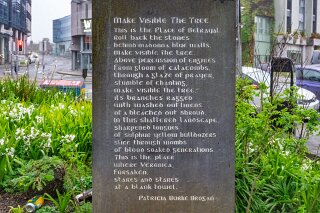
MEMORIAL IN GALWAY - PHOTOGRAPHED APRIL 2026
REMEMBERING GALWAY'S MAGDALENE HOMES [SCULPTURE BY MICK WILKINS]
The Shadows of Forster Street: Remembering Galway’s Magdalene Women
When walking through Galway, it is easy to be swept up in the vibrant busker music and medieval charm. However, tucked away near the site of the former Forster Street Laundry stands a poignant site of pilgrimage for those seeking to understand Ireland’s complex social history. This memorial—comprising a limestone bench, a bronze sculpture, and a haunting stone poem—serves as a permanent "I’m sorry" to the thousands of women whose lives were eclipsed by institutional silence.
The History of the Memorial
Unveiled on 8 March 2009 (International Women’s Day), the memorial was a collaborative effort to restore dignity to the women confined within the Magdalene system. For over a century, these women were "disappeared" from society, their forced labour hidden behind high stone walls.
The project was spearheaded by the Galway Civic Trust (Dúchas na Gaillimhe). The funding reflected a community effort toward reconciliation, with contributions coming from private donations, the Galway City Council, and the Sisters of Mercy, the religious order that had previously managed the local laundry.
The Artistry: Mick Wilkins and Patricia Burke Brogan
The memorial is a dual work of visual and literary art, designed to create a space for quiet reflection:
The Sculpture: Designed by renowned Irish sculptor Mick Wilkins, the piece consists of a simple limestone bench and a bronze sculpture. Its understated nature invites passers-by to sit and contemplate. The inscription is brief yet heavy with meaning: "In memory of the women who worked in the Magdalene Laundry."
The Poem: Beside the sculpture is a large stone plaque featuring the poem "Make Visible the Tree" by the acclaimed Galway writer Patricia Burke Brogan.
Brogan’s involvement is particularly significant. In the 1960s, she was a novice with the Sisters of Mercy at Forster Street. Witnessing the conditions of the women led her to leave the order and later write the landmark play Eclipsed, which was instrumental in breaking the national silence surrounding the laundries. Her poem calls for us to "make visible" the hidden suffering, using the metaphor of "washed out linens" and "bleached shrouds" to evoke the relentless, unpaid labour of the laundry.
The Forster Street Laundry: A Dark Legacy
The memorial stands just a short distance from the original Forster Street Magdalene Institution.
Originally established in the 19th century, the home was taken over by the Sisters of Mercy in 1870. While ostensibly "refuges," these laundries became punitive institutions where women were sent for "moral lapses"—ranging from out-of-wedlock pregnancies to simply being deemed "wayward" by the state or church.
The women at Forster Street lived under a regime of strict surveillance, prayer, and grueling manual labour, washing linens for local hospitals and hotels without wages. The Forster Street laundry was remarkably one of the last of its kind to close, only ceasing operations in 1984.
The Galway Poetry Trail
Today, the plaque is a key stop on the Galway Poetry Trail. By embedding these words into the physical landscape of the city, Galway ensures that while the laundry buildings may have been redeveloped, the lived experiences of the women who passed through those gates are never erased from the public record.
The Shadows of Forster Street: Remembering Galway’s Magdalene Women
When walking through Galway, it is easy to be swept up in the vibrant busker music and medieval charm. However, tucked away near the site of the former Forster Street Laundry stands a poignant site of pilgrimage for those seeking to understand Ireland’s complex social history. This memorial—comprising a limestone bench, a bronze sculpture, and a haunting stone poem—serves as a permanent "I’m sorry" to the thousands of women whose lives were eclipsed by institutional silence.
The History of the Memorial
Unveiled on 8 March 2009 (International Women’s Day), the memorial was a collaborative effort to restore dignity to the women confined within the Magdalene system. For over a century, these women were "disappeared" from society, their forced labour hidden behind high stone walls.
The project was spearheaded by the Galway Civic Trust (Dúchas na Gaillimhe). The funding reflected a community effort toward reconciliation, with contributions coming from private donations, the Galway City Council, and the Sisters of Mercy, the religious order that had previously managed the local laundry.
The Artistry: Mick Wilkins and Patricia Burke Brogan
The memorial is a dual work of visual and literary art, designed to create a space for quiet reflection:
The Sculpture: Designed by renowned Irish sculptor Mick Wilkins, the piece consists of a simple limestone bench and a bronze sculpture. Its understated nature invites passers-by to sit and contemplate. The inscription is brief yet heavy with meaning: "In memory of the women who worked in the Magdalene Laundry."
The Poem: Beside the sculpture is a large stone plaque featuring the poem "Make Visible the Tree" by the acclaimed Galway writer Patricia Burke Brogan.
Brogan’s involvement is particularly significant. In the 1960s, she was a novice with the Sisters of Mercy at Forster Street. Witnessing the conditions of the women led her to leave the order and later write the landmark play Eclipsed, which was instrumental in breaking the national silence surrounding the laundries. Her poem calls for us to "make visible" the hidden suffering, using the metaphor of "washed out linens" and "bleached shrouds" to evoke the relentless, unpaid labour of the laundry.
The Forster Street Laundry: A Dark Legacy
The memorial stands just a short distance from the original Forster Street Magdalene Institution.
Originally established in the 19th century, the home was taken over by the Sisters of Mercy in 1870. While ostensibly "refuges," these laundries became punitive institutions where women were sent for "moral lapses"—ranging from out-of-wedlock pregnancies to simply being deemed "wayward" by the state or church.
The women at Forster Street lived under a regime of strict surveillance, prayer, and grueling manual labour, washing linens for local hospitals and hotels without wages. The Forster Street laundry was remarkably one of the last of its kind to close, only ceasing operations in 1984.
The Galway Poetry Trail
Today, the plaque is a key stop on the Galway Poetry Trail. By embedding these words into the physical landscape of the city, Galway ensures that while the laundry buildings may have been redeveloped, the lived experiences of the women who passed through those gates are never erased from the public record.