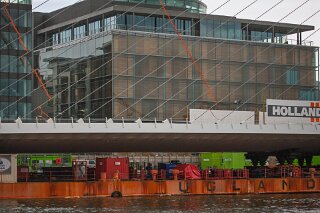
FINAL STAGES OF THE CONSTRUCTION OF THE SAMUEL BECKETT BRIDGE - PHOTOGRAPHED MAY 2009 USING A CANON 1Ds MK3
In May 2009, the Samuel Beckett Bridge reached its most dramatic and visible milestone: the delivery and installation phase. After years of off-site fabrication, the massive steel superstructure made its celebrated journey from the Netherlands to Ireland.
onstruction Status in May 2009
By early May 2009, the primary steelwork was complete. While civil engineering works—such as the construction of the reinforced concrete support pier and the quay-wall abutments—had been progressing in Dublin since 2007, the bridge itself did not yet exist on-site.
Fabrication: The 2,500-tonne superstructure had been fully assembled and painted by the Dutch firm Hollandia in Rotterdam.
On-site Readiness: In Dublin, the river pier (housed in a 20-metre square cofferdam) was prepared to receive the structure.
The Delivery Process: From Rotterdam to the Liffey
The bridge’s journey is often cited as a masterclass in maritime logistics. Rather than being transported in sections, the decision was made to ship the bridge as a single, fully-assembled unit to ensure higher quality and precision.
The Departure: On 3 May 2009, the bridge left the Hollandia wharf in Krimpen aan den IJssel.
The Voyage: It was loaded onto a specialised seagoing barge, the Terra Marique, and towed across the English Channel and around Land's End. The 628-mile journey took approximately eight days, including a brief period where the barge had to seek shelter from high winds.
Arrival in Dublin: The barge entered Dublin Bay in mid-May. Because of its height and width, temporary adjustments had to be made to the East Link Bridge (now the Tom Clarke Bridge) to allow the barge to pass through to the Docklands.
Installation and Cranes
The installation did not rely on traditional "lifting" by cranes in the way a building might. Instead, it utilised a float-in technique combined with hydraulic systems and support equipment.
Barges and Ballasting: A second barge was used in Dublin to help balance the bridge. By using the river's tidal cycle, engineers positioned the barge over the support pier at high tide. As the tide receded, the bridge was lowered precisely onto its permanent pivot.
Cranes Used: While the main structure was moved via barge, McNally’s Crane Hire provided the heavy-lifting support on the quayside for secondary components. Crawler cranes were used extensively on the banks for the civil works and to manage the heavy counterweights (steel and concrete ballast) that were added once the bridge was seated to ensure it could rotate properly.
onstruction Status in May 2009
By early May 2009, the primary steelwork was complete. While civil engineering works—such as the construction of the reinforced concrete support pier and the quay-wall abutments—had been progressing in Dublin since 2007, the bridge itself did not yet exist on-site.
Fabrication: The 2,500-tonne superstructure had been fully assembled and painted by the Dutch firm Hollandia in Rotterdam.
On-site Readiness: In Dublin, the river pier (housed in a 20-metre square cofferdam) was prepared to receive the structure.
The Delivery Process: From Rotterdam to the Liffey
The bridge’s journey is often cited as a masterclass in maritime logistics. Rather than being transported in sections, the decision was made to ship the bridge as a single, fully-assembled unit to ensure higher quality and precision.
The Departure: On 3 May 2009, the bridge left the Hollandia wharf in Krimpen aan den IJssel.
The Voyage: It was loaded onto a specialised seagoing barge, the Terra Marique, and towed across the English Channel and around Land's End. The 628-mile journey took approximately eight days, including a brief period where the barge had to seek shelter from high winds.
Arrival in Dublin: The barge entered Dublin Bay in mid-May. Because of its height and width, temporary adjustments had to be made to the East Link Bridge (now the Tom Clarke Bridge) to allow the barge to pass through to the Docklands.
Installation and Cranes
The installation did not rely on traditional "lifting" by cranes in the way a building might. Instead, it utilised a float-in technique combined with hydraulic systems and support equipment.
Barges and Ballasting: A second barge was used in Dublin to help balance the bridge. By using the river's tidal cycle, engineers positioned the barge over the support pier at high tide. As the tide receded, the bridge was lowered precisely onto its permanent pivot.
Cranes Used: While the main structure was moved via barge, McNally’s Crane Hire provided the heavy-lifting support on the quayside for secondary components. Crawler cranes were used extensively on the banks for the civil works and to manage the heavy counterweights (steel and concrete ballast) that were added once the bridge was seated to ensure it could rotate properly.
SAMUEL BECKETT BRIDGE