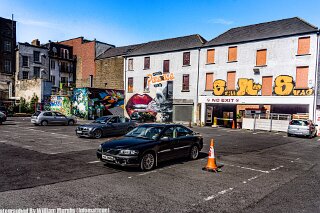
STREET ART AT TIVOLI CAR PARK IN JUNE 2013
Street Art At The Tivoli Theatre And Carpark - From Subcultural Canvas To Sanitised Realm
The Origins: Burgh Quay to Francis Street
Before its association with Francis Street in The Liberties, the original Tivoli Theatre occupied Burgh Quay on the south bank of the River Liffey. The building had originated in 1841 as the Conciliation Hall—the headquarters of Daniel O’Connell’s Repeal Association. Following O’Connell’s death, the site served as a grain store until reopening in 1897 as the Grand Lyric Hall (later the Lyric Theatre of Varieties), staging music hall acts. In 1901, it was renamed the Tivoli and operated as an early cinema and cine-variety house. It closed its doors on Burgh Quay in May 1928, subsequently purchased by the Irish Press newspaper group.
To replace the Burgh Quay institution, a brand-new venue designed by architect Vincent Kelly opened on 21 December 1934 at 135 Francis Street. It operated primarily as the Tivoli Cinema with seating for 700 until September 1964, when a serious fire forced its closure. Derelict for over two decades, the building was rescued in the mid-1980s by Anthony ‘Tony’ Byrne (a former Bohemian F.C. footballer), who invested approximately £250,000 into a comprehensive redevelopment.
Reopening in 1987 as the Tivoli Theatre, it incorporated a tiered 500-seat theatrical auditorium upstairs and a versatile ground-floor live venue. Over the next thirty years, it became an iconic cultural pillar of Dublin, hosting alternative theatre, pantomimes, and landmark early gigs by acts such as Nirvana, Rage Against the Machine, Oasis, The Cranberries, and Blur, before operating as the renowned electronic music club District 8 in its final years.
Timeline of the Tivoli Carpark as a Street Art Sanctuary
The adjoining surface car park along Francis Street developed into one of Europe’s most revered, organic open-air graffiti and street art galleries.
- Late 1990s – Early 2000s (Organic Emergence): As Dublin's graffiti subculture expanded, the recessed walls flanking the Tivoli carpark offered high visibility without direct roadside obstruction. Tony Byrne and the venue management adopted an informal, permissive attitude, allowing local writers to paint without fear of immediate municipal buffing.
- Mid-2000s (The "All City" Hub): The carpark became synonymous with Dublin’s burgeoning hip-hop and graffiti subculture, closely linked with independent institutions like the All City record/graffiti shop. Regular curated paint jams transformed the boundary walls into layered, evolving murals featuring both lettering and figurative works.
- 2008 – 2014 (International Acclaim): By the time you photographed it in June 2013, the Tivoli carpark was internationally recognised. It served as a flagship destination for writers from across Ireland, the UK, Europe, and North America (including events tied to the All City Tivoli Jam). Artists repainted panels every few months; pieces by Maser, ADOR, Shane Sutton, Subset, and dozens of international guests stood side-by-side. It was celebrated as an authentic, ever-shifting community canvas.
- 2017 – 2018 (The Demolition Threat): As the Dublin property boom accelerated, planning applications emerged to demolish the theatre and car park for commercial accommodation. A public outcry ensued, lamenting the dual erasure of an essential independent venue and the country's most famous open legal wall.
- January – April 2019 (The Demise): Despite local petitions and objections from the arts community, the venue shuttered in early 2019. By mid-2019, heavy machinery demolished the theatre and flattened the perimeter walls, ending three decades of free, organic street art on the site.
Planning, Redevelopment, and the "Pretend POPS" Contradiction
When Dublin City Council granted planning permission to demolish the complex for an aparthotel (developed by Staycity as Staycity Aparthotels Dublin Tivoli), the loss of cultural infrastructure was a contentious battleground.
To temper public criticism, the planning conditions stipulated cultural remediation:
- Photographic Archiving: The developer was legally required to document, photograph, and archive the extant murals across the car park before demolition commenced.
- Cultural / Performance Provision: The scheme was required to incorporate a dedicated community exhibition and performance space (a multi-use internal cultural hall of roughly 350 m²) to compensate for the lost theatre.
- Public Realm & Art Retention: The open-air internal courtyard ("Tivoli Place / Tivoli Square") was intended to function as a Privately Owned Public Space (POPS), providing public permeability and referencing the site’s artistic heritage.
The Reality: Privatised Heritage & Token Preservation
In practice, the delivery diverged sharply from the civic intent:
- The "Hidden Wall": While promotional materials claimed original artwork was retained "at the back of Tivoli Square", the remaining fragment of perimeter wall containing authentic street art was effectively cordoned off into a rear utility/servicing area. It is largely inaccessible to casual pedestrians and shielded behind hotel infrastructure—a sterile relic divorced from the vibrancy that created it.
- The "Pretend POPS" Phenomenon: Rather than operating as an inviting, democratic civic space, the courtyard exhibits the hallmark flaws of modern POPS: ambiguous sightlines, heavy CCTV presence, private security governance, and architectural hostility toward lingering or unapproved activity.
- The Stalled Cultural Offset: For years after opening, investigative reporting (such as exposés by the Dublin Inquirer and The Irish Times in 2023) revealed that the mandatory "cultural space" sat largely vacant or was repurposed informally for aparthotel back-of-house storage, leaving the local arts community entirely dispossessed of the promised venue.
The Commercialisation of Street Art: From Subversion to "Graffiti Deterrent"
The fate of the Tivoli encapsulates a broader paradigm shift: the co-optation of counter-cultural expression into a commodified urban amenity.
- Inoculation Against Real Graffiti:
Where street art was once a raw, uncommissioned act of reclaiming space, property owners and municipal councils have discovered that commissioning large, polished murals serves as an effective "graffiti buffer." Because unwritten subcultural codes generally discourage tagging over elaborate pieces, corporate developers hire muralists specifically to insulate their assets from raw bombing and tagging. - Sanitised Visual Placemaking:
Commercial street art is frequently leveraged to establish aesthetic credibility—an edgy, colourful backdrop used to elevate real-estate valuations and attract tourists. Developers borrow the counter-cultural capital of street art while actively dismantling the grassroots ecosystems (affordable studios, derelict spaces, legal car parks) that cultivate it. - The Loss of Creative Friction:
Once street art becomes a hired service, it must navigate client briefs, municipal committees, brand safety guidelines, and corporate liability. The resulting murals tend toward uncontroversial figurative portraits, flora, fauna, or abstract motifs. The subversive, political, and experimental spontaneity that made sites like the 2013 Tivoli Carpark vital is replaced by predictable, commissioned visual wallpaper.