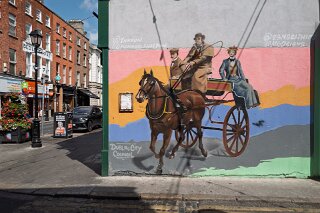
URBAN EXPRESSION ON A LANE OFF TALBOT STREET
EXAMPLES OF STREET ART 22 JULY 2026 [MALBOROUGH PLACE OFF TALBOT STREET]
Tucked away in the heart of Dublin’s North Inner City, Marlborough Place is a historic laneway connecting Talbot Street with Marlborough Street. Though modest in size, this thoroughfare carries a rich urban history—from 18th-century pleasure grounds to 20th-century entertainment culture—and today stands as a vibrant canvas for Dublin’s street art scene.
Historical Context & Gaming Heritage
During the 18th century, the broader precinct surrounding Marlborough Place was part of Marlborough Green, a fashionable leisure destination boasting bowling greens, pleasure gardens, and shelter houses for gaming and card playing.
By the mid-to-late 20th century, the laneway and its immediate surroundings became synonymous with Dublin’s working-class entertainment culture. Entrances along Marlborough Place and adjacent lanes provided access to bustling amusement arcades, most famously Barney’s Amusements. These arcades were local landmarks for generations of Dubliners, filled with penny slots, pinball machines, and early arcade games that defined the bustling nightlife and youth culture of the north inner city.
Street Art & Urban Regeneration
In recent years, Marlborough Place and neighboring alleys (such as Talbot Lane) have undergone a creative transformation under Dublin City Council's laneway renewal strategies (such as the Reimagining Dublin One initiative).
Community Murals: A prominent 50-metre community mural spans the corner of Marlborough Street and Marlborough Place, supported by local community groups and cultural partners.
Heritage & Memory: Artworks by local collectives (such as the Memory Lane project led by artists like Fionnuala Halpin and the Lucky Bag collective) explicitly pay homage to the lane’s rich past. Visual motifs depict vintage arcade games, retro neon signage from Barney’s Amusements, Georgian doorways, and Dublin literary icons such as James Joyce and Seán O’Casey.
Tucked away in the heart of Dublin’s North Inner City, Marlborough Place is a historic laneway connecting Talbot Street with Marlborough Street. Though modest in size, this thoroughfare carries a rich urban history—from 18th-century pleasure grounds to 20th-century entertainment culture—and today stands as a vibrant canvas for Dublin’s street art scene.
Historical Context & Gaming Heritage
During the 18th century, the broader precinct surrounding Marlborough Place was part of Marlborough Green, a fashionable leisure destination boasting bowling greens, pleasure gardens, and shelter houses for gaming and card playing.
By the mid-to-late 20th century, the laneway and its immediate surroundings became synonymous with Dublin’s working-class entertainment culture. Entrances along Marlborough Place and adjacent lanes provided access to bustling amusement arcades, most famously Barney’s Amusements. These arcades were local landmarks for generations of Dubliners, filled with penny slots, pinball machines, and early arcade games that defined the bustling nightlife and youth culture of the north inner city.
Street Art & Urban Regeneration
In recent years, Marlborough Place and neighboring alleys (such as Talbot Lane) have undergone a creative transformation under Dublin City Council's laneway renewal strategies (such as the Reimagining Dublin One initiative).
Community Murals: A prominent 50-metre community mural spans the corner of Marlborough Street and Marlborough Place, supported by local community groups and cultural partners.
Heritage & Memory: Artworks by local collectives (such as the Memory Lane project led by artists like Fionnuala Halpin and the Lucky Bag collective) explicitly pay homage to the lane’s rich past. Visual motifs depict vintage arcade games, retro neon signage from Barney’s Amusements, Georgian doorways, and Dublin literary icons such as James Joyce and Seán O’Casey.