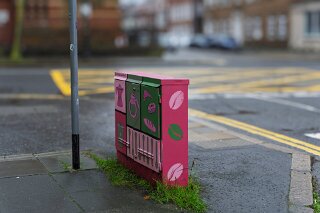
PAINT-A-BOX STREET ART IN BELFAST
While both Dublin and Belfast have embraced the transformation of utility boxes into canvases, the "Paint-A-Box" movement—formally known as Dublin Canvas and Belfast Canvas—exhibits distinct differences in visibility, scale, and artist attribution.
The Visibility Gap: Scale and Strategy
The primary reason for the higher visibility in Dublin is the sheer volume of the project. Dublin Canvas began as a trial in 2013 and has since ballooned into a massive, county-wide initiative with over 900 completed pieces. Its presence is ubiquitous, covering traffic light control boxes at almost every major junction across the four local authorities.
In contrast, Belfast Canvas is a newer and more concentrated effort. While it has successfully transformed over 130 boxes, the project has historically focused on the city centre and major arterial routes like the Linen Quarter. This makes the art feel like a series of "pockets" rather than a continuous urban gallery, leading to the perception that it is less visible than its southern counterpart.
The Challenge of Artist Identification
Identifying the artist behind a specific box can be surprisingly difficult for several reasons:
Project Branding vs. Personal Branding: In Dublin, most boxes feature a small, standardised stencil or sticker at the bottom mentioning "Dublin Canvas" and the artist's name. In Belfast, while projects like Daisy Chain Inc and Seedhead Arts coordinate these efforts, the attribution is often less uniform, sometimes omitting a clear "tag" or social media handle.
The "Mural Culture" Shadow: Belfast is world-renowned for its large-scale political and social murals. These massive gables often overshadow the smaller utility boxes, which are sometimes viewed by the public as "filler" art rather than individual commissioned works.
Weather and Wear: The North’s climate is particularly harsh on street-level paint. Without a clear digital directory or QR code on the box itself, fading and "tagging" (illegal graffiti over the art) often obscure the artist’s original signature.
Bridging the Information Gap
To find out who painted a box, one usually has to look toward the curators. In Dublin, the Dublin Canvas website maintains a comprehensive map and artist directory. In Belfast, you are more likely to find the artist through the portfolios of Daisy Chain Inc or by following the Hit the North street art festival, which often incorporates box painting into its wider programme.
The Visibility Gap: Scale and Strategy
The primary reason for the higher visibility in Dublin is the sheer volume of the project. Dublin Canvas began as a trial in 2013 and has since ballooned into a massive, county-wide initiative with over 900 completed pieces. Its presence is ubiquitous, covering traffic light control boxes at almost every major junction across the four local authorities.
In contrast, Belfast Canvas is a newer and more concentrated effort. While it has successfully transformed over 130 boxes, the project has historically focused on the city centre and major arterial routes like the Linen Quarter. This makes the art feel like a series of "pockets" rather than a continuous urban gallery, leading to the perception that it is less visible than its southern counterpart.
The Challenge of Artist Identification
Identifying the artist behind a specific box can be surprisingly difficult for several reasons:
Project Branding vs. Personal Branding: In Dublin, most boxes feature a small, standardised stencil or sticker at the bottom mentioning "Dublin Canvas" and the artist's name. In Belfast, while projects like Daisy Chain Inc and Seedhead Arts coordinate these efforts, the attribution is often less uniform, sometimes omitting a clear "tag" or social media handle.
The "Mural Culture" Shadow: Belfast is world-renowned for its large-scale political and social murals. These massive gables often overshadow the smaller utility boxes, which are sometimes viewed by the public as "filler" art rather than individual commissioned works.
Weather and Wear: The North’s climate is particularly harsh on street-level paint. Without a clear digital directory or QR code on the box itself, fading and "tagging" (illegal graffiti over the art) often obscure the artist’s original signature.
Bridging the Information Gap
To find out who painted a box, one usually has to look toward the curators. In Dublin, the Dublin Canvas website maintains a comprehensive map and artist directory. In Belfast, you are more likely to find the artist through the portfolios of Daisy Chain Inc or by following the Hit the North street art festival, which often incorporates box painting into its wider programme.
PAINT-A-BOX STREET ART