WHAT IS THE PURPOSE
Belfast’s Beautiful Dead End: The Mystery of the Ravenhill "Gateway to Nowhere"
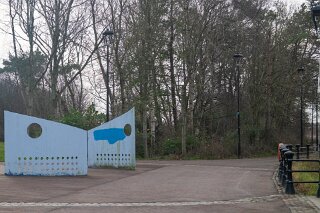
If you have ever walked the banks of the River Lagan near the Gasworks, you’ve likely spotted it: a gleaming, curved white (sometimes appearing blue) structure on the opposite bank. It looks like a piece of modern art—a maritime sculpture evoking sails or a ship’s hull, pierced with portholes that frame the river behind it.
For years, I wondered how to get to it. It sits tantalisingly close to the city centre, yet it seems cut off from the main thoroughfares. Last week, I finally tracked it down, only to discover that this beautiful structure isn't just art. It is perhaps the most stylish "Keep Out" sign in Belfast.
The Hunt for the White Sculpture: My journey began at Stranmillis, following the river north. But as the familiar towpath faded into the industrial edges of the Ormeau Embankment, the route disappeared. I found myself navigating the backstreets near the old Asian Supermarket site, eventually hitting a dead end at Ballarat Street.
The residents there knew exactly what I was looking for—and they weren't exactly thrilled about it. With a mix of helpfulness and local frustration, they pointed me toward a hidden patch of ground at Ravenhill Reach.
The "Missing Link" When I finally stood before the white structure, I realised its true purpose. It marks the abrupt end of the public path. This spot is known locally as the "Missing Link" of the Lagan Towpath network.
While the western bank (Gasworks side) offers a continuous run for cyclists and walkers, the eastern bank is severed here. The curved metal screens act as a sculptural full stop. Although you could physically walk (or even drive a small car) through the gap, the structure marks the boundary where public land ends and private property begins.
A Bridge Too Far: Looking through the structure’s "portholes," you can see the path should logically extend under the railway bridge to connect with Central Station and the city centre. Instead, the riverfront immediately ahead belongs to the private Ravenhill Reach apartment complex.
For over 20 years, there have been proposals to build a "Gasworks Bridge"—a pedestrian and cycle link that would bypass this private land and finally connect this stranded path to the rest of the city. Until then, this white gateway remains a monument to what could be: a beautiful entrance to a path that simply doesn't exist.
Questions:
1. Was I on Private Property? Technically, no—but I was standing right on the line. The paved area where the white structure sits is the very edge of the public realm. The structure itself serves as the demarcation line.
The Public Side: The area I stood on (approached from the industrial estate/Ravenhill Reach access road) is generally accessible to the public.
The Private Side: The land beyond the white curves—specifically the paved riverfront path running in front of the red-brick apartments—is private residential property.
The Confusion: The barrier is porous; you can easily walk past it. However, doing so crosses you from public amenity land into private residential curtilage, which is why the path doesn't "go" anywhere.
2. Did the residents of "Ballarat Street" lose a right of way? It is highly likely they lost informal access, which explains their annoyance.
The History: Before the 1990s redevelopment, this area was a mix of industrial land and older housing. Residents of streets like Ballarat Street likely had casual, informal routes through open yards or derelict sites to reach the riverbank for recreation.
The "Severance": When the area was regenerated into secure business parks and gated apartment complexes like Ravenhill Reach, these informal shortcuts were fenced off.
The Result: While they may not have lost a legally recorded "Public Right of Way" (which is difficult to extinguish), they lost the utility of the river. They now live just meters from the water but are physically "boxed in" by the private developments, forcing them to take long detours to reach the bank. This "severance" is a common complaint in post-industrial redevelopments.
If you have ever walked the banks of the River Lagan near the Gasworks, you’ve likely spotted it: a gleaming, curved white (sometimes appearing blue) structure on the opposite bank. It looks like a piece of modern art—a maritime sculpture evoking sails or a ship’s hull, pierced with portholes that frame the river behind it.
For years, I wondered how to get to it. It sits tantalisingly close to the city centre, yet it seems cut off from the main thoroughfares. Last week, I finally tracked it down, only to discover that this beautiful structure isn't just art. It is perhaps the most stylish "Keep Out" sign in Belfast.
The Hunt for the White Sculpture: My journey began at Stranmillis, following the river north. But as the familiar towpath faded into the industrial edges of the Ormeau Embankment, the route disappeared. I found myself navigating the backstreets near the old Asian Supermarket site, eventually hitting a dead end at Ballarat Street.
The residents there knew exactly what I was looking for—and they weren't exactly thrilled about it. With a mix of helpfulness and local frustration, they pointed me toward a hidden patch of ground at Ravenhill Reach.
The "Missing Link" When I finally stood before the white structure, I realised its true purpose. It marks the abrupt end of the public path. This spot is known locally as the "Missing Link" of the Lagan Towpath network.
While the western bank (Gasworks side) offers a continuous run for cyclists and walkers, the eastern bank is severed here. The curved metal screens act as a sculptural full stop. Although you could physically walk (or even drive a small car) through the gap, the structure marks the boundary where public land ends and private property begins.
A Bridge Too Far: Looking through the structure’s "portholes," you can see the path should logically extend under the railway bridge to connect with Central Station and the city centre. Instead, the riverfront immediately ahead belongs to the private Ravenhill Reach apartment complex.
For over 20 years, there have been proposals to build a "Gasworks Bridge"—a pedestrian and cycle link that would bypass this private land and finally connect this stranded path to the rest of the city. Until then, this white gateway remains a monument to what could be: a beautiful entrance to a path that simply doesn't exist.
Questions:
1. Was I on Private Property? Technically, no—but I was standing right on the line. The paved area where the white structure sits is the very edge of the public realm. The structure itself serves as the demarcation line.
The Public Side: The area I stood on (approached from the industrial estate/Ravenhill Reach access road) is generally accessible to the public.
The Private Side: The land beyond the white curves—specifically the paved riverfront path running in front of the red-brick apartments—is private residential property.
The Confusion: The barrier is porous; you can easily walk past it. However, doing so crosses you from public amenity land into private residential curtilage, which is why the path doesn't "go" anywhere.
2. Did the residents of "Ballarat Street" lose a right of way? It is highly likely they lost informal access, which explains their annoyance.
The History: Before the 1990s redevelopment, this area was a mix of industrial land and older housing. Residents of streets like Ballarat Street likely had casual, informal routes through open yards or derelict sites to reach the riverbank for recreation.
The "Severance": When the area was regenerated into secure business parks and gated apartment complexes like Ravenhill Reach, these informal shortcuts were fenced off.
The Result: While they may not have lost a legally recorded "Public Right of Way" (which is difficult to extinguish), they lost the utility of the river. They now live just meters from the water but are physically "boxed in" by the private developments, forcing them to take long detours to reach the bank. This "severance" is a common complaint in post-industrial redevelopments.
GATEWAY TO NOWHERE