WORLD CHAMPION BOXER FROM SAILORTOWN IN BELFAST
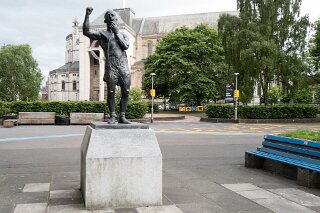
RINTY MONAGHAN WAS A CHAMPION OF THE PEOPLE [SCULPTURE BY ALAN BEATTIE HARRIOT]
The Champion of the People: A Pilgrimage to the Two Sides of Rinty Monaghan
Belfast is a city that wears its history on its sleeve, often through its murals and monuments. Yet, few figures bridge the city’s complex divides quite like John "Rinty" Monaghan. To understand the man, one must look at the two distinct poles of his legacy: the vibrant bronze energy of Cathedral Gardens and the silent, dignified masonry of the City Cemetery.
Recently, I set out to capture the spirit of the "Singing Irishman" with my Leica Q3. While my lens found the statue, I chose to leave his final resting place unphotographed. It is a personal policy of mine to avoid attracting unwelcome attention to the graves of the famous unless they are of a purely ancient, historic nature. Some silences are meant to be kept.
The Singing Champion in Cathedral Gardens
The statue, designed by Alan Beattie Herriot and unveiled in 2015, stands as a sharp, modern counterpoint to the weathered Victorian textures found elsewhere in the city. Positioned overlooking the Sailortown area where he was born, it avoids the typical, aggressive boxing stance.
Instead, Rinty is frozen in a moment of pure Belfast jubilation. One hand is raised in triumph; the other clutches a microphone. This is a nod to his legendary post-fight ritual: serenading the crowd with "When Irish Eyes Are Smiling." It was this showmanship that transformed him from a mere athlete into a genuine folk hero.
A Shared Icon in a Divided City
Rinty’s significance transcends his 1948 undisputed world flyweight title. During an era of deep sectarian division, he was a rare bridge—loved by both sides of the community.
When health issues forced his retirement in 1950, he didn't retreat into a life of secluded luxury. Instead, he remained a fixture of the city. To his neighbours, he wasn't just a world champion; he was the local taxi driver or the man at the petrol pump, always ready with a song or a story for anyone who crossed his path.
The Price of a Big Heart
Monaghan’s financial story is a poignant example of the "people’s champion." While he earned significant purses—including roughly £3,500 for his world title win—the money didn't stick.
Generosity: Monaghan was notoriously soft-hearted, frequently falling for "hard-luck" stories from neighbours and giving away his winnings to those in the docks.
The Inland Revenue: Like many of his era, poor financial advice left him vulnerable to the "taxman," who eventually claimed much of his remaining boxing wealth.
He famously spent his first major winnings on a radiogram and a three-piece suite so large it barely squeezed into the front room of his small terraced house on Little Corporation Street. He never expressed bitterness about his return to manual labour, remaining gregarious and beloved until his death in 1984.
The Grave: A Final Undefeated Stance
In the quiet of the Belfast City Cemetery, his headstone reflects a legacy of humble pride. Etched between two boxing gloves is a simple, powerful inscription: "Undefeated World Flyweight Champion."
For many, the journey between the bustling Cathedral Quarter and this quiet corner of the cemetery constitutes a modern pilgrimage. It tracks the arc of a man who rose from the poverty of the docks to the top of the world, yet proved his greatest strength by never leaving his people behind.
The Champion of the People: A Pilgrimage to the Two Sides of Rinty Monaghan
Belfast is a city that wears its history on its sleeve, often through its murals and monuments. Yet, few figures bridge the city’s complex divides quite like John "Rinty" Monaghan. To understand the man, one must look at the two distinct poles of his legacy: the vibrant bronze energy of Cathedral Gardens and the silent, dignified masonry of the City Cemetery.
Recently, I set out to capture the spirit of the "Singing Irishman" with my Leica Q3. While my lens found the statue, I chose to leave his final resting place unphotographed. It is a personal policy of mine to avoid attracting unwelcome attention to the graves of the famous unless they are of a purely ancient, historic nature. Some silences are meant to be kept.
The Singing Champion in Cathedral Gardens
The statue, designed by Alan Beattie Herriot and unveiled in 2015, stands as a sharp, modern counterpoint to the weathered Victorian textures found elsewhere in the city. Positioned overlooking the Sailortown area where he was born, it avoids the typical, aggressive boxing stance.
Instead, Rinty is frozen in a moment of pure Belfast jubilation. One hand is raised in triumph; the other clutches a microphone. This is a nod to his legendary post-fight ritual: serenading the crowd with "When Irish Eyes Are Smiling." It was this showmanship that transformed him from a mere athlete into a genuine folk hero.
A Shared Icon in a Divided City
Rinty’s significance transcends his 1948 undisputed world flyweight title. During an era of deep sectarian division, he was a rare bridge—loved by both sides of the community.
When health issues forced his retirement in 1950, he didn't retreat into a life of secluded luxury. Instead, he remained a fixture of the city. To his neighbours, he wasn't just a world champion; he was the local taxi driver or the man at the petrol pump, always ready with a song or a story for anyone who crossed his path.
The Price of a Big Heart
Monaghan’s financial story is a poignant example of the "people’s champion." While he earned significant purses—including roughly £3,500 for his world title win—the money didn't stick.
Generosity: Monaghan was notoriously soft-hearted, frequently falling for "hard-luck" stories from neighbours and giving away his winnings to those in the docks.
The Inland Revenue: Like many of his era, poor financial advice left him vulnerable to the "taxman," who eventually claimed much of his remaining boxing wealth.
He famously spent his first major winnings on a radiogram and a three-piece suite so large it barely squeezed into the front room of his small terraced house on Little Corporation Street. He never expressed bitterness about his return to manual labour, remaining gregarious and beloved until his death in 1984.
The Grave: A Final Undefeated Stance
In the quiet of the Belfast City Cemetery, his headstone reflects a legacy of humble pride. Etched between two boxing gloves is a simple, powerful inscription: "Undefeated World Flyweight Champion."
For many, the journey between the bustling Cathedral Quarter and this quiet corner of the cemetery constitutes a modern pilgrimage. It tracks the arc of a man who rose from the poverty of the docks to the top of the world, yet proved his greatest strength by never leaving his people behind.
WORLD CHAMPION