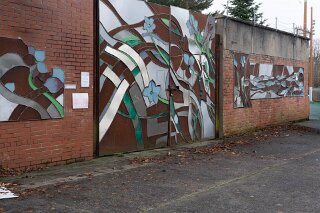
C.S. LEWIS SQUARE IS A MAJOR TOURIST ATTRACTION
C.S. LEWIS SQUARE IS A MAJOR TOURIST ATTRACTION [BUT DERELICTION IS THE URBAN CONTEXT]
Explore the industrial artistry of Alan Burke at C.S. Lewis Square. Discover how his Corten steel sculptures, like "Of The River," bridge the gap between Narnian fantasy and Belfast’s raw urban heritage in this photographic deep dive.
THE ART OF ALAN BURKE AT C.S. LEWIS SQUARE [BETWEEN FANTASY AND INDUSTRY]
Between Fantasy and Industry: The Art of Alan Burke at C.S. Lewis Square
C.S. Lewis Square has fast become one of Belfast’s most iconic landmarks, drawing visitors into a world of literary wonder. Yet, for those who look past the polished paving and the whimsical bronze figures of Narnia, there is a deeper, more industrial story being told.
As a photographer, what strikes me most isn't just the "fantasy," but the clash of context. The square is a pristine plaza carved out of an aging urban block. Its backdrop isn’t a manicured park, but the raw, red-brick reality of the Holywood Road’s rear facades—some crumbling, some derelict, and all carrying the weight of the city’s unvarnished history.
The Industrial Lens of Alan Burke
To navigate this friction between new investment and old masonry, the square utilises the formidable metalwork of Alan Burke. A central figure in Northern Irish contemporary sculpture, Burke’s career is defined by his ability to marry heavy industrial materials with delicate, organic storytelling.
Burke’s contributions here—specifically his monumental piece "Of The River" and the imposing industrial gates—serve a dual purpose:
The Aesthetic Screen: Using rusted Corten steel, Burke has created a visual filter. These sculptures act as a sophisticated screen, partially masking the neglect of the surrounding buildings while acknowledging the site's grit.
A Nod to Heritage: His work is steeped in local symbolism. By incorporating motifs of flax and chains, Burke anchors the square in Belfast’s industrial past—reminding us of the linen mills and shipyards that built this city long before it became a destination for literary tourism.
Materiality: The choice of weathered steel is intentional. It mirrors the ochre tones of the "old bricks" nearby, ensuring the art feels like it has grown out of the ground rather than being dropped onto it.
A Career Built on Steel
Alan Burke has spent decades refining this "industrial-organic" style. His work is frequently found in public spaces across the UK and Ireland, where he is known for transforming hard, unforgiving metals into narrative-driven landmarks. His career is a testament to the idea that public art shouldn't just be decorative; it should be functional, structural, and deeply conversational with its environment.
The Beauty in the Friction
For a street photographer, the real magic of C.S. Lewis Square lies in this "friction." It is the point where Burke’s rusted steel meets a crumbling chimney stack, or where a motif of a flax flower sits against a backdrop of urban decay.
Explore the industrial artistry of Alan Burke at C.S. Lewis Square. Discover how his Corten steel sculptures, like "Of The River," bridge the gap between Narnian fantasy and Belfast’s raw urban heritage in this photographic deep dive.
THE ART OF ALAN BURKE AT C.S. LEWIS SQUARE [BETWEEN FANTASY AND INDUSTRY]
Between Fantasy and Industry: The Art of Alan Burke at C.S. Lewis Square
C.S. Lewis Square has fast become one of Belfast’s most iconic landmarks, drawing visitors into a world of literary wonder. Yet, for those who look past the polished paving and the whimsical bronze figures of Narnia, there is a deeper, more industrial story being told.
As a photographer, what strikes me most isn't just the "fantasy," but the clash of context. The square is a pristine plaza carved out of an aging urban block. Its backdrop isn’t a manicured park, but the raw, red-brick reality of the Holywood Road’s rear facades—some crumbling, some derelict, and all carrying the weight of the city’s unvarnished history.
The Industrial Lens of Alan Burke
To navigate this friction between new investment and old masonry, the square utilises the formidable metalwork of Alan Burke. A central figure in Northern Irish contemporary sculpture, Burke’s career is defined by his ability to marry heavy industrial materials with delicate, organic storytelling.
Burke’s contributions here—specifically his monumental piece "Of The River" and the imposing industrial gates—serve a dual purpose:
The Aesthetic Screen: Using rusted Corten steel, Burke has created a visual filter. These sculptures act as a sophisticated screen, partially masking the neglect of the surrounding buildings while acknowledging the site's grit.
A Nod to Heritage: His work is steeped in local symbolism. By incorporating motifs of flax and chains, Burke anchors the square in Belfast’s industrial past—reminding us of the linen mills and shipyards that built this city long before it became a destination for literary tourism.
Materiality: The choice of weathered steel is intentional. It mirrors the ochre tones of the "old bricks" nearby, ensuring the art feels like it has grown out of the ground rather than being dropped onto it.
A Career Built on Steel
Alan Burke has spent decades refining this "industrial-organic" style. His work is frequently found in public spaces across the UK and Ireland, where he is known for transforming hard, unforgiving metals into narrative-driven landmarks. His career is a testament to the idea that public art shouldn't just be decorative; it should be functional, structural, and deeply conversational with its environment.
The Beauty in the Friction
For a street photographer, the real magic of C.S. Lewis Square lies in this "friction." It is the point where Burke’s rusted steel meets a crumbling chimney stack, or where a motif of a flax flower sits against a backdrop of urban decay.
ALAN BURKE AND HIS ART