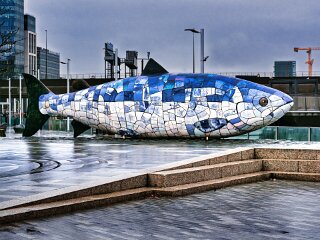
THE SALMON OF KNOWLEDGE AT THE LAGAN LOOKOUT
THE BIG FISH OR THE SALMON OF KNOWLEDGE BY JOHN KINDNESS [THE LAGAN LOOKOUT ON DONEGALL QUAY]
Often referred to by locals simply as "The Big Fish," the Salmon of Knowledge is a striking 10-metre-long sculpture that has become one of Belfast's most beloved landmarks. Situated at Donegall Quay, it serves as a shimmering sentinel overlooking the River Lagan, marking the spot where the river meets the hidden River Farset—the very waterway from which Belfast (Béal Feirste) takes its name.
The Artistry of John Kindness
Commissioned in 1999 to celebrate the regeneration of the Lagan, the sculpture was created by renowned Belfast-born artist John Kindness. It is not merely a statue but a mosaic masterpiece. Its "scales" are made of over 300 printed ceramic tiles, each telling a unique story about the city’s complex and colourful history.
Historic Depth: The tiles feature everything from Tudor-era maps and Victorian scenes to modern-day newspaper headlines.
Community Spirit: Many of the designs include drawings by local schoolchildren, featuring quirky Belfast staples like the "Ulster Fry" and scenes of daily life.
The Time Capsule: Hidden within the fish’s body is a time capsule containing images, poetry, and stories from the people of Belfast, intended for future generations to discover.
Mythology Meets the Modern Quay
The sculpture’s official name, the Salmon of Knowledge (Bradán Feasa), draws on a famous Irish legend. According to the myth, the warrior Fionn mac Cumhaill gained all the world's wisdom by tasting a magical salmon.
Belfast Folklore: It is a popular tradition for visitors to kiss the fish to gain a little bit of its legendary wisdom. Whether or not it works is up for debate, but it certainly makes for a fantastic photograph with the iconic Harland and Wolff cranes in the background.
Visiting the Big Fish
The sculpture is located near the Lagan Lookout and the Custom House, making it a perfect starting point for a walk along the waterfront or into the Cathedral Quarter. It is free to visit and particularly beautiful at night when it is illuminated, reflecting the blue and white ceramic textures against the river.
Often referred to by locals simply as "The Big Fish," the Salmon of Knowledge is a striking 10-metre-long sculpture that has become one of Belfast's most beloved landmarks. Situated at Donegall Quay, it serves as a shimmering sentinel overlooking the River Lagan, marking the spot where the river meets the hidden River Farset—the very waterway from which Belfast (Béal Feirste) takes its name.
The Artistry of John Kindness
Commissioned in 1999 to celebrate the regeneration of the Lagan, the sculpture was created by renowned Belfast-born artist John Kindness. It is not merely a statue but a mosaic masterpiece. Its "scales" are made of over 300 printed ceramic tiles, each telling a unique story about the city’s complex and colourful history.
Historic Depth: The tiles feature everything from Tudor-era maps and Victorian scenes to modern-day newspaper headlines.
Community Spirit: Many of the designs include drawings by local schoolchildren, featuring quirky Belfast staples like the "Ulster Fry" and scenes of daily life.
The Time Capsule: Hidden within the fish’s body is a time capsule containing images, poetry, and stories from the people of Belfast, intended for future generations to discover.
Mythology Meets the Modern Quay
The sculpture’s official name, the Salmon of Knowledge (Bradán Feasa), draws on a famous Irish legend. According to the myth, the warrior Fionn mac Cumhaill gained all the world's wisdom by tasting a magical salmon.
Belfast Folklore: It is a popular tradition for visitors to kiss the fish to gain a little bit of its legendary wisdom. Whether or not it works is up for debate, but it certainly makes for a fantastic photograph with the iconic Harland and Wolff cranes in the background.
Visiting the Big Fish
The sculpture is located near the Lagan Lookout and the Custom House, making it a perfect starting point for a walk along the waterfront or into the Cathedral Quarter. It is free to visit and particularly beautiful at night when it is illuminated, reflecting the blue and white ceramic textures against the river.
BY JOHN KINDNESS