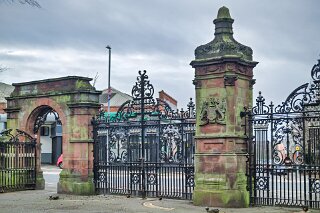
MY FIRST TIME TO EXPLORE THIS PUBLIC PARK
ORMEAU PARK - THE GRANDEUR AND THE GRIT [BELFAST DECEMBER 2025]
For the photographer or urban observer, Ormeau Park presents a complex subject. Its sheer scale is impressive, yet a closer inspection of the built environment reveals a friction between its Victorian grandeur and modern maintenance struggles. As the oldest municipal park in Belfast, it remains arguably the city's most important green lung, serving as a vital buffer between the affluent suburbs of the south and the denser working-class terraces of the east.
Location and Origins
Located in South Belfast, the park is framed by two major arterial routes: the Ormeau Road and the Ravenhill Road. Its name, Ormeau, is a French borrowing meaning "young elm," a nod to the trees that once defined the estate.
The land was originally the seat of the Marquess of Donegall (the Chichester family), one of the most powerful families in Ulster's history. The parkland was their private demesne until the family’s financial difficulties forced them to sell the land to the Belfast Corporation (now the City Council). It opened to the public in 1871, designed to offer the industrial workforce of Victorian Belfast a space for "rational recreation."
While the original Donegall family mansion was demolished long ago, the park's layout—with its rolling topography and mature tree lines—still reflects the landscaping of a private aristocratic estate rather than a planned municipal garden.
The Built Environment: A Legacy of Decay?
A walk through the park suggests that the built elements are often less than well maintained. While the horticulture—flower beds, tree surgery, and grass—is generally well-managed, the structural assets appear to have suffered from a combination of age, budget constraints, and vandalism.
The Bandstand: This is the centrepiece of the park, dating back to the Victorian era. However, it has frequently been a target for arson and graffiti. While it receives periodic repainting, the intricate ironwork often bears the scars of recent abuse.
The Shelters: The brick and timber shelters scattered throughout the park often look neglected. They are frequent magnets for low-level vandalism, leading to a cycle where they are cleaned and then rapidly defaced again.
The Superintendent’s House: Near the Ormeau Road entrance, this Queen Anne Revival style lodge (designed by Timothy Hevey) is a stunning piece of architecture. While the exterior is intact, these heritage buildings often struggle to find a consistent modern use that generates enough revenue for high-level upkeep.
The "tired" aesthetic often captured in photographs is likely the result of a municipal holding action against weathering and misuse, rather than investment in full-scale restoration.
Social Dynamics: The Dog Capital of Belfast
One of the most striking features of the park today is the sheer volume of dogs. Ormeau Park is unofficially the "dog capital" of Belfast. Because of its size and the variety of terrain—ranging from woodland paths to open playing fields and river proximity—it draws walkers from across the entire city, not just the immediate neighbourhood.
This has shifted the park's usage significantly. In the Victorian era, it was a place for formal promenading; today, it is a functional exercise space. This high volume of dog walkers actually contributes to the park's safety during daylight hours, providing "eyes on the street" that discourage isolated incidents of crime.
Anti-Social Behaviour: Past and Present
The park has a distinct dual personality regarding safety and social issues.
The Past Historically, Ormeau Park has suffered significant issues, particularly linked to its proximity to the "Holylands" (a dense student housing area). For years, St. Patrick’s Day and sunny bank holidays would see thousands of people descend on the park, leading to large-scale drinking, noise, and fighting.
Current and Ongoing Status
Night-Time Closure: Unlike some open urban spaces, Ormeau Park is gated. The City Council employs security contractors to lock the gates at dusk—a direct legacy of past vandalism and anti-social behaviour (ASB).
Current Issues: While massive uncontrolled gatherings have been curbed by better policing and by-laws, the park still suffers from sporadic ASB. This usually takes the form of youths gathering in the shelters or the bandstand after dark (sometimes breaching the fences) to drink or set small fires.
Safety: For the visitor or photographer, the park is statistically very safe during the day. The issues are almost exclusively nocturnal or linked to specific large-scale event days.
Ormeau Park is a space of contrast. It is a majestic remnant of Belfast’s aristocratic past that serves a vital modern function for the city's dog owners and runners. However, the condition of its structures tells a story of municipal struggle—a battle to maintain intricate Victorian architecture in the face of modern austerity and social challenges.
For the photographer or urban observer, Ormeau Park presents a complex subject. Its sheer scale is impressive, yet a closer inspection of the built environment reveals a friction between its Victorian grandeur and modern maintenance struggles. As the oldest municipal park in Belfast, it remains arguably the city's most important green lung, serving as a vital buffer between the affluent suburbs of the south and the denser working-class terraces of the east.
Location and Origins
Located in South Belfast, the park is framed by two major arterial routes: the Ormeau Road and the Ravenhill Road. Its name, Ormeau, is a French borrowing meaning "young elm," a nod to the trees that once defined the estate.
The land was originally the seat of the Marquess of Donegall (the Chichester family), one of the most powerful families in Ulster's history. The parkland was their private demesne until the family’s financial difficulties forced them to sell the land to the Belfast Corporation (now the City Council). It opened to the public in 1871, designed to offer the industrial workforce of Victorian Belfast a space for "rational recreation."
While the original Donegall family mansion was demolished long ago, the park's layout—with its rolling topography and mature tree lines—still reflects the landscaping of a private aristocratic estate rather than a planned municipal garden.
The Built Environment: A Legacy of Decay?
A walk through the park suggests that the built elements are often less than well maintained. While the horticulture—flower beds, tree surgery, and grass—is generally well-managed, the structural assets appear to have suffered from a combination of age, budget constraints, and vandalism.
The Bandstand: This is the centrepiece of the park, dating back to the Victorian era. However, it has frequently been a target for arson and graffiti. While it receives periodic repainting, the intricate ironwork often bears the scars of recent abuse.
The Shelters: The brick and timber shelters scattered throughout the park often look neglected. They are frequent magnets for low-level vandalism, leading to a cycle where they are cleaned and then rapidly defaced again.
The Superintendent’s House: Near the Ormeau Road entrance, this Queen Anne Revival style lodge (designed by Timothy Hevey) is a stunning piece of architecture. While the exterior is intact, these heritage buildings often struggle to find a consistent modern use that generates enough revenue for high-level upkeep.
The "tired" aesthetic often captured in photographs is likely the result of a municipal holding action against weathering and misuse, rather than investment in full-scale restoration.
Social Dynamics: The Dog Capital of Belfast
One of the most striking features of the park today is the sheer volume of dogs. Ormeau Park is unofficially the "dog capital" of Belfast. Because of its size and the variety of terrain—ranging from woodland paths to open playing fields and river proximity—it draws walkers from across the entire city, not just the immediate neighbourhood.
This has shifted the park's usage significantly. In the Victorian era, it was a place for formal promenading; today, it is a functional exercise space. This high volume of dog walkers actually contributes to the park's safety during daylight hours, providing "eyes on the street" that discourage isolated incidents of crime.
Anti-Social Behaviour: Past and Present
The park has a distinct dual personality regarding safety and social issues.
The Past Historically, Ormeau Park has suffered significant issues, particularly linked to its proximity to the "Holylands" (a dense student housing area). For years, St. Patrick’s Day and sunny bank holidays would see thousands of people descend on the park, leading to large-scale drinking, noise, and fighting.
Current and Ongoing Status
Night-Time Closure: Unlike some open urban spaces, Ormeau Park is gated. The City Council employs security contractors to lock the gates at dusk—a direct legacy of past vandalism and anti-social behaviour (ASB).
Current Issues: While massive uncontrolled gatherings have been curbed by better policing and by-laws, the park still suffers from sporadic ASB. This usually takes the form of youths gathering in the shelters or the bandstand after dark (sometimes breaching the fences) to drink or set small fires.
Safety: For the visitor or photographer, the park is statistically very safe during the day. The issues are almost exclusively nocturnal or linked to specific large-scale event days.
Ormeau Park is a space of contrast. It is a majestic remnant of Belfast’s aristocratic past that serves a vital modern function for the city's dog owners and runners. However, the condition of its structures tells a story of municipal struggle—a battle to maintain intricate Victorian architecture in the face of modern austerity and social challenges.
THE PARK AS IT IS TODAY