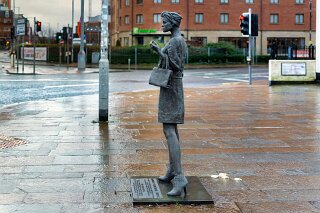
MOTHER DAUGHTER SISTER PHOTOGRAPHED DE CEMBER 2025
MOTHER DAUGHTER SISTER AND THE DEVIL'S MUSIC [ROSS WILSON SCULPTURE AT SANDY ROW]
Correction: Mapping the Artist In a previous update, I identified the Mother Daughter Sister sculpture on Sandy Row as the work of Cork sculptor Louise Walsh. However, while processing my photographs from this December trip, I realised the piece—a striking, freestanding bronze figure—felt visually distinct from Walsh's typical work (such as the utilitarian Monument to the Unknown Woman Worker nearby).
After re-examining my notes, I have corrected the record: this is, in fact, the work of the prolific Belfast sculptor Ross Wilson. Looking back at my files from May 2025, the difference in style should have been obvious to me then, but I am happy to set the record straight.
From "Devil's Music" to Bronze: The Strange Journey of 'Que Sera, Sera'
I recently came across a piece of public art on Sandy Row in Belfast that stopped me in my tracks—not just because of the sculpture itself, but because of the words lying at its feet.
The inscription is a line from a song that was very popular when I was young back in the early 1950s: "Que Sera, Sera (Whatever Will Be, Will Be)."
Seeing those words cast in bronze brought a vivid memory flooding back. I was four years old when that song was released, and I couldn't understand why my religion teacher in Donegal told us that it was the "devil's music" and that we must not listen to it. Not long after, I heard "Rock Around The Clock," got hooked, and was told I was well on my way to hell!
It begs the question: Did people actually object to such a gentle song, or was my teacher an outlier? And how did a Hollywood pop song end up on a solemn memorial in Belfast?
The "Devil’s Music": Why They Hated It
It turns out my teacher was not an outlier. In the 1950s, there was a widespread conservative backlash against American popular culture, but the objection to Que Sera, Sera was quite specific.
While rock and roll was banned for being rebellious, Que Sera, Sera (sung by Doris Day in the Hitchcock thriller The Man Who Knew Too Much) offended religious authorities because of its philosophy. The lyrics—"Whatever will be, will be"—suggest a fatalistic acceptance that the future is unknowable and beyond our control.
In the strict religious environment of 1950s Ireland, this was viewed as borderline heresy. It contradicted the doctrine of "Free Will" and the moral obligation to shape one’s own destiny through prayer and hard work. To a conservative teacher, singing about passively accepting the future sounded like spiritual laziness—a lack of trust in God’s plan wrapped up in a catchy Hollywood melody.
The Sculpture: A New Meaning on Sandy Row
Decades later, those same controversial lyrics have found a permanent home in Belfast, but their meaning has shifted entirely.
The monument I photographed is the Mother Daughter Sister sculpture, created by the renowned Belfast artist Ross Wilson. (Note: It is often confused with Louise Walsh's famous "Unknown Woman Worker" sculpture near the Europa Hotel, but they are distinct works).
Located on Sandy Row, one of the city's oldest working-class Loyalist communities, the sculpture features a life-size bronze statue of a woman. Dressed in a smart skirt suit with a handbag on her arm, she stands alone, looking out over the street.
The title—Mother Daughter Sister—is deceptive. There are not three women here, but one. She stands as a universal figure representing all the roles women in this community have played. This memorial serves as a permanent acknowledgement of the suffering endured by the women of Sandy Row who bore the brunt of loss and held families together during decades of conflict.
A Profound Re-contextualisation
In this context, "Whatever Will Be, Will Be" is stripped of its Hollywood cheerfulness.
For the community here, the violence of the Troubles was often random and unpredictable. The lyrics, displayed on a plaque beneath the figure, reflect a stoic resignation to a fate that ordinary people felt they could not control. It re-contextualises a song that many of these women would have sung in their own youth—perhaps innocently in the 1950s, just like I did—and links that memory to the tragedy that followed.
It is a powerful artistic choice. It takes a phrase once condemned as "lazy" or "fatalistic" and transforms it into a statement of endurance, grief, and survival.
About the Artist: Ross Wilson
The artist behind the Mother Daughter Sister sculpture, Ross Wilson, is one of Northern Ireland’s most significant living sculptors. If his style feels familiar to you, you have likely walked past his work elsewhere in the city.
He is the creator of "The Searcher" in C.S. Lewis Square, which captures the author stepping into the wardrobe. He also immortalised the city's industrial past with "The Barrel Man" (The Ulster Brewer) outside the Waterfront Hall and "The Yardmen" on the Newtownards Road, a striking tribute to the workers who built the Titanic.
His work often focuses on the "ordinary" history of Belfast—the millies, the dockers, and the mothers—giving permanent bronze dignity to the people who built the city.
Correction: Mapping the Artist In a previous update, I identified the Mother Daughter Sister sculpture on Sandy Row as the work of Cork sculptor Louise Walsh. However, while processing my photographs from this December trip, I realised the piece—a striking, freestanding bronze figure—felt visually distinct from Walsh's typical work (such as the utilitarian Monument to the Unknown Woman Worker nearby).
After re-examining my notes, I have corrected the record: this is, in fact, the work of the prolific Belfast sculptor Ross Wilson. Looking back at my files from May 2025, the difference in style should have been obvious to me then, but I am happy to set the record straight.
From "Devil's Music" to Bronze: The Strange Journey of 'Que Sera, Sera'
I recently came across a piece of public art on Sandy Row in Belfast that stopped me in my tracks—not just because of the sculpture itself, but because of the words lying at its feet.
The inscription is a line from a song that was very popular when I was young back in the early 1950s: "Que Sera, Sera (Whatever Will Be, Will Be)."
Seeing those words cast in bronze brought a vivid memory flooding back. I was four years old when that song was released, and I couldn't understand why my religion teacher in Donegal told us that it was the "devil's music" and that we must not listen to it. Not long after, I heard "Rock Around The Clock," got hooked, and was told I was well on my way to hell!
It begs the question: Did people actually object to such a gentle song, or was my teacher an outlier? And how did a Hollywood pop song end up on a solemn memorial in Belfast?
The "Devil’s Music": Why They Hated It
It turns out my teacher was not an outlier. In the 1950s, there was a widespread conservative backlash against American popular culture, but the objection to Que Sera, Sera was quite specific.
While rock and roll was banned for being rebellious, Que Sera, Sera (sung by Doris Day in the Hitchcock thriller The Man Who Knew Too Much) offended religious authorities because of its philosophy. The lyrics—"Whatever will be, will be"—suggest a fatalistic acceptance that the future is unknowable and beyond our control.
In the strict religious environment of 1950s Ireland, this was viewed as borderline heresy. It contradicted the doctrine of "Free Will" and the moral obligation to shape one’s own destiny through prayer and hard work. To a conservative teacher, singing about passively accepting the future sounded like spiritual laziness—a lack of trust in God’s plan wrapped up in a catchy Hollywood melody.
The Sculpture: A New Meaning on Sandy Row
Decades later, those same controversial lyrics have found a permanent home in Belfast, but their meaning has shifted entirely.
The monument I photographed is the Mother Daughter Sister sculpture, created by the renowned Belfast artist Ross Wilson. (Note: It is often confused with Louise Walsh's famous "Unknown Woman Worker" sculpture near the Europa Hotel, but they are distinct works).
Located on Sandy Row, one of the city's oldest working-class Loyalist communities, the sculpture features a life-size bronze statue of a woman. Dressed in a smart skirt suit with a handbag on her arm, she stands alone, looking out over the street.
The title—Mother Daughter Sister—is deceptive. There are not three women here, but one. She stands as a universal figure representing all the roles women in this community have played. This memorial serves as a permanent acknowledgement of the suffering endured by the women of Sandy Row who bore the brunt of loss and held families together during decades of conflict.
A Profound Re-contextualisation
In this context, "Whatever Will Be, Will Be" is stripped of its Hollywood cheerfulness.
For the community here, the violence of the Troubles was often random and unpredictable. The lyrics, displayed on a plaque beneath the figure, reflect a stoic resignation to a fate that ordinary people felt they could not control. It re-contextualises a song that many of these women would have sung in their own youth—perhaps innocently in the 1950s, just like I did—and links that memory to the tragedy that followed.
It is a powerful artistic choice. It takes a phrase once condemned as "lazy" or "fatalistic" and transforms it into a statement of endurance, grief, and survival.
About the Artist: Ross Wilson
The artist behind the Mother Daughter Sister sculpture, Ross Wilson, is one of Northern Ireland’s most significant living sculptors. If his style feels familiar to you, you have likely walked past his work elsewhere in the city.
He is the creator of "The Searcher" in C.S. Lewis Square, which captures the author stepping into the wardrobe. He also immortalised the city's industrial past with "The Barrel Man" (The Ulster Brewer) outside the Waterfront Hall and "The Yardmen" on the Newtownards Road, a striking tribute to the workers who built the Titanic.
His work often focuses on the "ordinary" history of Belfast—the millies, the dockers, and the mothers—giving permanent bronze dignity to the people who built the city.
MOTHER DAUGHTER SISTER