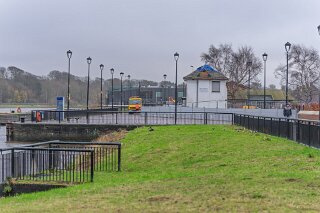
THE ORIGINAL AND NOT VERY SUCCESSFUL LAGAN WEIR
THE GHOST ON THE LAGAN IS ACTUALLY THE McCONNELL WEIR [DECEMBER 2025]
The Ghost on the Lagan: Unmasking the McConnell Weir
When I first visited Belfast in May 2025, the city greeted me with a persistent, unyielding rain for which I was entirely unprepared. However, having been told that Belfast "does Christmas" much better than Dublin, I decided to return for a week in December. This time, I arrived armed with the right gear and a plan to capture the city’s festive spirit.
I was well-prepared for the rain, but Storm Bram caught me by surprise. Paradoxically, the storm contributed to a much better photography session for a variety of reasons. With the gale-force winds and driving rain, there were very few people around, allowing me to visit spots I might have otherwise skipped. Most importantly, my cameras didn't attract any unwelcome attention or comment—I was just another figure in the mist, free to document the city’s industrial edges in peace.
It was during these atmospheric conditions on the 8th and 9th of December that I found myself staring at a moss-covered, brick-and-iron structure standing mid-river.
A Bridge to Nowhere?
With its rusted railings and high gantry, the structure is frequently mistaken for the remains of a derelict Victorian bridge. However, as I watched maintenance crews battling the elements to install storm barriers, the true identity of the "Ghost on the Lagan" was revealed. This is the McConnell Weir—a fascinating relic of Belfast’s engineering history that is finding a vital new lease of life in the age of climate change.
A Solution to a "Stinking" Problem
Built around 1937, the McConnell Weir (often misidentified as "O’Connell’s") was commissioned to solve a public health crisis. Before its construction, the tidal nature of the River Lagan meant that low tide exposed vast expanses of mudflats. In the summer heat, these muds emitted a pungent, sulphurous odour that plagued the city. The weir was designed to impound the river water, keeping the mudflats submerged and creating a permanent, aesthetic waterfront.
The Rise of the Lagan Weir
While the McConnell Weir successfully hid the mud, it created a new environmental issue known as a "salt wedge," where stagnant salt water depleted the river of oxygen. This led to the construction of the much larger, modern Lagan Weir (home to the "Big Fish") in 1994. The McConnell Weir was largely "retired," becoming the silent, green monument we see today.
From Industrial Relic to Storm Sentinel
As witnessed during the height of Storm Bram, this old structure is far from obsolete. As part of the Belfast Tidal Flood Alleviation Scheme, it remains a critical asset. Because it possesses deep-rooted foundations and spans the river, it serves as a perfect mounting point for modern storm barriers.
During the high tidal surges I photographed in early December, the infrastructure around the McConnell Weir acted as a "choke point," allowing engineers to manage the flow and prevent the Lagan from overtopping its banks into residential areas.
The "Bridge" That Wasn't
The metal framework that sits atop the brick piers—the part that looks so much like a pedestrian walkway—was actually a maintenance gantry. It once housed the mechanical winches used to lift the heavy steel gates of the weir.
While it may never carry foot traffic, its silhouette remains a poignant reminder of Belfast’s constant evolution. From a 1930s solution for river smells to a 2025 sentinel against tidal surges, the McConnell Weir continues to stand guard over the city’s changing tides.
The Ghost on the Lagan: Unmasking the McConnell Weir
When I first visited Belfast in May 2025, the city greeted me with a persistent, unyielding rain for which I was entirely unprepared. However, having been told that Belfast "does Christmas" much better than Dublin, I decided to return for a week in December. This time, I arrived armed with the right gear and a plan to capture the city’s festive spirit.
I was well-prepared for the rain, but Storm Bram caught me by surprise. Paradoxically, the storm contributed to a much better photography session for a variety of reasons. With the gale-force winds and driving rain, there were very few people around, allowing me to visit spots I might have otherwise skipped. Most importantly, my cameras didn't attract any unwelcome attention or comment—I was just another figure in the mist, free to document the city’s industrial edges in peace.
It was during these atmospheric conditions on the 8th and 9th of December that I found myself staring at a moss-covered, brick-and-iron structure standing mid-river.
A Bridge to Nowhere?
With its rusted railings and high gantry, the structure is frequently mistaken for the remains of a derelict Victorian bridge. However, as I watched maintenance crews battling the elements to install storm barriers, the true identity of the "Ghost on the Lagan" was revealed. This is the McConnell Weir—a fascinating relic of Belfast’s engineering history that is finding a vital new lease of life in the age of climate change.
A Solution to a "Stinking" Problem
Built around 1937, the McConnell Weir (often misidentified as "O’Connell’s") was commissioned to solve a public health crisis. Before its construction, the tidal nature of the River Lagan meant that low tide exposed vast expanses of mudflats. In the summer heat, these muds emitted a pungent, sulphurous odour that plagued the city. The weir was designed to impound the river water, keeping the mudflats submerged and creating a permanent, aesthetic waterfront.
The Rise of the Lagan Weir
While the McConnell Weir successfully hid the mud, it created a new environmental issue known as a "salt wedge," where stagnant salt water depleted the river of oxygen. This led to the construction of the much larger, modern Lagan Weir (home to the "Big Fish") in 1994. The McConnell Weir was largely "retired," becoming the silent, green monument we see today.
From Industrial Relic to Storm Sentinel
As witnessed during the height of Storm Bram, this old structure is far from obsolete. As part of the Belfast Tidal Flood Alleviation Scheme, it remains a critical asset. Because it possesses deep-rooted foundations and spans the river, it serves as a perfect mounting point for modern storm barriers.
During the high tidal surges I photographed in early December, the infrastructure around the McConnell Weir acted as a "choke point," allowing engineers to manage the flow and prevent the Lagan from overtopping its banks into residential areas.
The "Bridge" That Wasn't
The metal framework that sits atop the brick piers—the part that looks so much like a pedestrian walkway—was actually a maintenance gantry. It once housed the mechanical winches used to lift the heavy steel gates of the weir.
While it may never carry foot traffic, its silhouette remains a poignant reminder of Belfast’s constant evolution. From a 1930s solution for river smells to a 2025 sentinel against tidal surges, the McConnell Weir continues to stand guard over the city’s changing tides.
McCONNELL WEIR