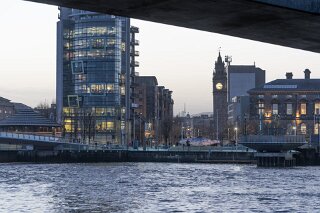
THE LAGAN WEIR AND QUEEN'S QUAY
THE LAGAN WEIR AND QUEEN'S QUAY [PHOTOGRAPHED DECEMBER 2025]
Belfast's Concrete Heart: Finding Beauty Under the Flyovers (and Questioning the Next Big Build)
Last December, I found myself in Belfast, camera in hand, trying to capture the vibrant regeneration around the Lagan Weir and Queen's Quay. The crisp winter light caught the "Big Fish" and the glittering new buildings of the Titanic Quarter, promising a bold, modern future for the city. Yet, in every direction, my lens seemed to find the same imposing concrete forms: the vast flyovers for road traffic and the crisscrossing railway lines.
My taxi driver, with that dry, dark Belfast humour, quipped that everyone just wanted to get out of the city; the best feature, he joked, was the exit road. While I genuinely like Belfast, his words resonated with a certain truth. The city centre, particularly around the waterfront, often feels overshadowed, defined by these colossal grey ribs of infrastructure.
It's a fascinating paradox. We seek out the new public spaces, the waterfront promenades, and the cultural landmarks, only to find them framed, or even dominated, by the very structures designed for rapid transit through or past the city.
The Legacy of the "Motor City" with a Belfast Twist
This isn’t unique to Belfast, but the city's specific history amplifies it. Much like other UK cities in the mid-20th century, Belfast embraced the car, pouring concrete for projects like the Westlink. However, during the Troubles, these elevated roads and sunken dual carriageways gained a secondary, tragic function: acting as security barriers, creating physical divides between communities and the city core.
The area I photographed—Queen's Quay—is a prime example of this "shatter zone." The beautiful Lagan Weir, a symbol of modern regeneration, sits almost directly beneath the M3 cross-harbour bridge and the Dargan Bridge for the railway. These structures provide vital connectivity, linking the port and the rest of Northern Ireland, but they also create a literal concrete ceiling over public spaces, making the city feel enclosed rather than openly embracing its lough.
From "Exit Roads" to "Under the Bridges": A Shifting Vision
However, Belfast is increasingly aware of this legacy and is actively working to "stitch" its urban fabric back together. There's a tangible shift from the "Motor City" mentality to a "Bolder Vision for Belfast," which aims to put people, not cars, at the heart of its design.
One of the most exciting concepts is the "Under the Bridges" project within the Belfast Waterfront Promenade Framework. Instead of viewing the shadows beneath these colossal structures as neglected no-man's-land, the vision is to transform them into vibrant, active public spaces. Imagine high-quality lighting installations, pop-up markets, or even urban sports facilities breathing life into these forgotten zones. On Queen's Quay itself, the master plan proposes building new residential blocks right up to the edges of the flyovers, creating street enclosures that visually "wall off" the imposing concrete and restore a sense of urban intimacy.
The York Street Interchange: A Step Forwards or Backwards?
Yet, the future isn't without its tensions. The proposed York Street Interchange (YSI) is a focal point of this debate. Currently paused without confirmed funding, the project aims to remove the last set of traffic lights between the M2, M3, and Westlink. From my perspective, and that of many urbanists, this feels like a regressive step – a 1960s solution for a 2020s city. Adding another monumental concrete grade-separation project risks reinforcing the very barriers we’re trying to overcome, further isolating North Belfast from the city centre.
There are positive signs, however. Internal discussions within the Department for Infrastructure are exploring a potential redesign: moving the junction underground into a "cut" and possibly "lidding" it. This would allow for parkland or development on top, transforming a traffic nightmare into a new public amenity. If Belfast can move away from simply adding more overhead concrete, it could be a truly transformative project.
Finding Beauty in the Brutal
For those of us who appreciate Belfast, there's a certain compelling beauty in its industrial brutalism. The stark contrast between Victorian red brick and monumental concrete creates a unique visual tension. The city wears its history, both industrial and political, on its sleeve, and these flyovers are an undeniable part of that narrative. They are the arteries of a busy port city, but increasingly, Belfast is asking how they can coexist with a vibrant, walkable, and connected urban life.
The challenge, and indeed the excitement, of Belfast's urban regeneration lies in this ongoing conversation: how to honour its gritty, working identity while creating a truly modern, liveable city for everyone. It's about finding life, light, and community, even in the shadows of the concrete giants.
Belfast's Concrete Heart: Finding Beauty Under the Flyovers (and Questioning the Next Big Build)
Last December, I found myself in Belfast, camera in hand, trying to capture the vibrant regeneration around the Lagan Weir and Queen's Quay. The crisp winter light caught the "Big Fish" and the glittering new buildings of the Titanic Quarter, promising a bold, modern future for the city. Yet, in every direction, my lens seemed to find the same imposing concrete forms: the vast flyovers for road traffic and the crisscrossing railway lines.
My taxi driver, with that dry, dark Belfast humour, quipped that everyone just wanted to get out of the city; the best feature, he joked, was the exit road. While I genuinely like Belfast, his words resonated with a certain truth. The city centre, particularly around the waterfront, often feels overshadowed, defined by these colossal grey ribs of infrastructure.
It's a fascinating paradox. We seek out the new public spaces, the waterfront promenades, and the cultural landmarks, only to find them framed, or even dominated, by the very structures designed for rapid transit through or past the city.
The Legacy of the "Motor City" with a Belfast Twist
This isn’t unique to Belfast, but the city's specific history amplifies it. Much like other UK cities in the mid-20th century, Belfast embraced the car, pouring concrete for projects like the Westlink. However, during the Troubles, these elevated roads and sunken dual carriageways gained a secondary, tragic function: acting as security barriers, creating physical divides between communities and the city core.
The area I photographed—Queen's Quay—is a prime example of this "shatter zone." The beautiful Lagan Weir, a symbol of modern regeneration, sits almost directly beneath the M3 cross-harbour bridge and the Dargan Bridge for the railway. These structures provide vital connectivity, linking the port and the rest of Northern Ireland, but they also create a literal concrete ceiling over public spaces, making the city feel enclosed rather than openly embracing its lough.
From "Exit Roads" to "Under the Bridges": A Shifting Vision
However, Belfast is increasingly aware of this legacy and is actively working to "stitch" its urban fabric back together. There's a tangible shift from the "Motor City" mentality to a "Bolder Vision for Belfast," which aims to put people, not cars, at the heart of its design.
One of the most exciting concepts is the "Under the Bridges" project within the Belfast Waterfront Promenade Framework. Instead of viewing the shadows beneath these colossal structures as neglected no-man's-land, the vision is to transform them into vibrant, active public spaces. Imagine high-quality lighting installations, pop-up markets, or even urban sports facilities breathing life into these forgotten zones. On Queen's Quay itself, the master plan proposes building new residential blocks right up to the edges of the flyovers, creating street enclosures that visually "wall off" the imposing concrete and restore a sense of urban intimacy.
The York Street Interchange: A Step Forwards or Backwards?
Yet, the future isn't without its tensions. The proposed York Street Interchange (YSI) is a focal point of this debate. Currently paused without confirmed funding, the project aims to remove the last set of traffic lights between the M2, M3, and Westlink. From my perspective, and that of many urbanists, this feels like a regressive step – a 1960s solution for a 2020s city. Adding another monumental concrete grade-separation project risks reinforcing the very barriers we’re trying to overcome, further isolating North Belfast from the city centre.
There are positive signs, however. Internal discussions within the Department for Infrastructure are exploring a potential redesign: moving the junction underground into a "cut" and possibly "lidding" it. This would allow for parkland or development on top, transforming a traffic nightmare into a new public amenity. If Belfast can move away from simply adding more overhead concrete, it could be a truly transformative project.
Finding Beauty in the Brutal
For those of us who appreciate Belfast, there's a certain compelling beauty in its industrial brutalism. The stark contrast between Victorian red brick and monumental concrete creates a unique visual tension. The city wears its history, both industrial and political, on its sleeve, and these flyovers are an undeniable part of that narrative. They are the arteries of a busy port city, but increasingly, Belfast is asking how they can coexist with a vibrant, walkable, and connected urban life.
The challenge, and indeed the excitement, of Belfast's urban regeneration lies in this ongoing conversation: how to honour its gritty, working identity while creating a truly modern, liveable city for everyone. It's about finding life, light, and community, even in the shadows of the concrete giants.
LANAN WEIR AND QUEEN'S QUAY