GHOST BIKE MEMORIALS IN BELFAST AND DUBLIN
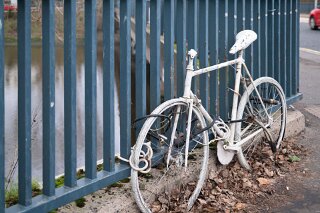
GHOST BIKE MEMORIAL TO MICHAEL CAULFIELD [PHOTOGRAPHED DECEMBER 2025]
🚲 Ghost Bikes: A Tale of Two Cities
This piece explores the stark difference in how two major Irish cities, Dublin and Belfast, treat the solemn memorial known as the Ghost Bike. A Ghost Bike—an entirely white bicycle locked at the site of a fatal cycling collision—serves as both a memorial to the deceased and a silent protest against dangerous road conditions.
The example of the Ghost Bike memorial to Michael Caulfield (photographed in December 2025) provides a specific lens for this comparison.
The Michael Caulfield Memorial, Belfast: On April 15, 2011, Michael Caulfield, a 56-year-old father of four, was cycling on the Ormeau Bridge in Belfast when he was killed in a collision with a delivery lorry. He died at the scene.
Significance: This memorial is widely believed to be the first Ghost Bike in Northern Ireland. It was initially placed anonymously by a local cycling group (Critical Mass). Michael’s widow, Bernie Caulfield, later publicly embraced the gesture, stating it ensured her husband was "not just another statistic."
The Incident Type: The fact that Michael was killed in a collision with a commercial vehicle is consistent with a broader, grim trend. The majority of fatal collisions involving cyclists in urban environments, particularly at junctions, involve Heavy Goods Vehicles (HGVs) and other large commercial vehicles, especially during turning manoeuvres. These vehicles have significant blind spots, making cyclists highly vulnerable. The Ghost Bike movement globally often highlights the need for improved vehicle design and segregation to prevent these specific kinds of accidents.
Resilience and Condition: The memorial is strapped to the railings of the Ormeau Bridge. Its poor condition—bent wheels, missing parts, and rust—is not simply due to natural weathering. The original bike and subsequent replacements have been repeatedly stolen, vandalised, and maliciously attacked since 2011. This visible degradation means the object you see is likely a "Frankenstein" replacement, a symbol of the cycling community's persistent, stubborn resolve to keep the memory alive despite continuous anti-social behaviour.
The Dublin vs. Belfast Contrast
The differences in the visible Ghost Bike landscape across the two cities are striking and reveal distinct civic problems.
1. The Dublin Problem: Bureaucratic Removal
Why Bikes Disappear: In Dublin, Ghost Bikes are generally not destroyed by the public; they are removed due to bureaucratic policy.
Mechanism: Dublin City Council employs a strict "abandoned bicycle" policy. Ghost Bikes, by their nature, eventually look derelict (flat tyres, rust) and are therefore viewed as "street clutter."
Result: The city's streets are "sanitised" of these memorials, meaning the number of visible Ghost Bikes remains low and constant due to official authority removing them.
2. The Belfast Problem: Malicious Vandalism
Why Bikes Stay (But are Damaged): In Belfast, the challenge is sustained malicious vandalism and theft.
Mechanism: Memorials like Michael Caulfield's have suffered repeated, intentional damage and theft by a minority who view unsecured public infrastructure as a target for anti-social behaviour.
Result: The memorials suffer devastating damage but remain visible because the local community is exceptionally dedicated and persistent, constantly repairing and replacing the bikes despite the abuse.
Cyclist Mortality: Has Infrastructure Helped? Evaluating accident rates in Dublin and Belfast offers a crucial perspective on the effectiveness of recent cycling infrastructure investment.
Dublin (Republic of Ireland): Data from the Road Safety Authority (RSA) and An Garda Síochána shows that while cycling has grown significantly, the number of cyclist fatalities nationally has not consistently decreased, often fluctuating year-on-year. For Dublin specifically, investment in segregated cycle lanes and protected junctions is relatively recent. There is evidence that where fully segregated, high-quality infrastructure exists, it significantly reduces the risk of serious collisions. However, the benefits are often diluted by a lack of network completion and 'stop-start' lanes. A sustained, clear downward trend in serious injuries attributable only to infrastructure is still emerging.
Belfast (Northern Ireland): Data from the Police Service of Northern Ireland (PSNI) and the Department for Infrastructure shows a similar picture. While Belfast has made progress with new greenways and some cycle paths, its urban cycling infrastructure is often criticised as being inadequate. The overall trend for cyclist fatalities remains volatile. The perception is that meaningful safety improvements are being held back by a lack of political will to reallocate significant road space away from motor traffic in the city centre.
In summary, while infrastructure investment is undeniably improving safety on the specific routes where it is implemented, a comprehensive, sustained reduction in urban cyclist mortality for both Dublin and Belfast is yet to be fully realised. The risks remain disproportionately high at major junctions and on roads lacking physical segregation.
🚲 Ghost Bikes: A Tale of Two Cities
This piece explores the stark difference in how two major Irish cities, Dublin and Belfast, treat the solemn memorial known as the Ghost Bike. A Ghost Bike—an entirely white bicycle locked at the site of a fatal cycling collision—serves as both a memorial to the deceased and a silent protest against dangerous road conditions.
The example of the Ghost Bike memorial to Michael Caulfield (photographed in December 2025) provides a specific lens for this comparison.
The Michael Caulfield Memorial, Belfast: On April 15, 2011, Michael Caulfield, a 56-year-old father of four, was cycling on the Ormeau Bridge in Belfast when he was killed in a collision with a delivery lorry. He died at the scene.
Significance: This memorial is widely believed to be the first Ghost Bike in Northern Ireland. It was initially placed anonymously by a local cycling group (Critical Mass). Michael’s widow, Bernie Caulfield, later publicly embraced the gesture, stating it ensured her husband was "not just another statistic."
The Incident Type: The fact that Michael was killed in a collision with a commercial vehicle is consistent with a broader, grim trend. The majority of fatal collisions involving cyclists in urban environments, particularly at junctions, involve Heavy Goods Vehicles (HGVs) and other large commercial vehicles, especially during turning manoeuvres. These vehicles have significant blind spots, making cyclists highly vulnerable. The Ghost Bike movement globally often highlights the need for improved vehicle design and segregation to prevent these specific kinds of accidents.
Resilience and Condition: The memorial is strapped to the railings of the Ormeau Bridge. Its poor condition—bent wheels, missing parts, and rust—is not simply due to natural weathering. The original bike and subsequent replacements have been repeatedly stolen, vandalised, and maliciously attacked since 2011. This visible degradation means the object you see is likely a "Frankenstein" replacement, a symbol of the cycling community's persistent, stubborn resolve to keep the memory alive despite continuous anti-social behaviour.
The Dublin vs. Belfast Contrast
The differences in the visible Ghost Bike landscape across the two cities are striking and reveal distinct civic problems.
1. The Dublin Problem: Bureaucratic Removal
Why Bikes Disappear: In Dublin, Ghost Bikes are generally not destroyed by the public; they are removed due to bureaucratic policy.
Mechanism: Dublin City Council employs a strict "abandoned bicycle" policy. Ghost Bikes, by their nature, eventually look derelict (flat tyres, rust) and are therefore viewed as "street clutter."
Result: The city's streets are "sanitised" of these memorials, meaning the number of visible Ghost Bikes remains low and constant due to official authority removing them.
2. The Belfast Problem: Malicious Vandalism
Why Bikes Stay (But are Damaged): In Belfast, the challenge is sustained malicious vandalism and theft.
Mechanism: Memorials like Michael Caulfield's have suffered repeated, intentional damage and theft by a minority who view unsecured public infrastructure as a target for anti-social behaviour.
Result: The memorials suffer devastating damage but remain visible because the local community is exceptionally dedicated and persistent, constantly repairing and replacing the bikes despite the abuse.
Cyclist Mortality: Has Infrastructure Helped? Evaluating accident rates in Dublin and Belfast offers a crucial perspective on the effectiveness of recent cycling infrastructure investment.
Dublin (Republic of Ireland): Data from the Road Safety Authority (RSA) and An Garda Síochána shows that while cycling has grown significantly, the number of cyclist fatalities nationally has not consistently decreased, often fluctuating year-on-year. For Dublin specifically, investment in segregated cycle lanes and protected junctions is relatively recent. There is evidence that where fully segregated, high-quality infrastructure exists, it significantly reduces the risk of serious collisions. However, the benefits are often diluted by a lack of network completion and 'stop-start' lanes. A sustained, clear downward trend in serious injuries attributable only to infrastructure is still emerging.
Belfast (Northern Ireland): Data from the Police Service of Northern Ireland (PSNI) and the Department for Infrastructure shows a similar picture. While Belfast has made progress with new greenways and some cycle paths, its urban cycling infrastructure is often criticised as being inadequate. The overall trend for cyclist fatalities remains volatile. The perception is that meaningful safety improvements are being held back by a lack of political will to reallocate significant road space away from motor traffic in the city centre.
In summary, while infrastructure investment is undeniably improving safety on the specific routes where it is implemented, a comprehensive, sustained reduction in urban cyclist mortality for both Dublin and Belfast is yet to be fully realised. The risks remain disproportionately high at major junctions and on roads lacking physical segregation.
GHOST BIKES