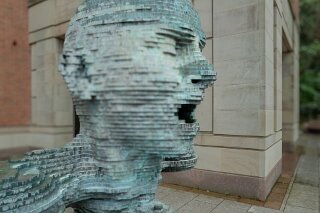
AN INTERESTING SCULPTURE WITH A HIDDEN FEATURE
UNTIL NOW I FAILED TO NOTICE THE OPTICAL ILLUSION [ECO AT QUEENS DECEMBER 2025]
Hidden in Plain Sight: The Secret of the "ECO" Sculpture at Queen’s
If you have ever visited the McClay Library at Queen’s University Belfast, you will have walked past the imposing bronze sentinel that stands guard at the main entrance.
This is "ECO" (2004–2005), a monumental sculpture by the Breton artist Marc Didou. It was installed in 2008 to celebrate the university's centenary and mark the opening of the new library. Standing 2.5 metres tall, it’s a striking piece of contemporary public art that perfectly juxtaposes the classic red brick of the campus.
As a photographer, I have always been drawn to ECO. I’ve shot it dozens of times, fascinated by its texture. The sculpture is constructed from stacked layers of bronze, mimicking the cross-sectional data slices of a Magnetic Resonance Imaging (MRI) scan—a signature technique of Didou, who loves blending classical materials with modern scientific imaging.
I always interpreted it as a single, towering, digitized head rising from a heavy, abstract base. I admired the way light catches the ridges of the bronze plates and how its silhouette changes depending on where you stand on the granite paving.
But recently, I discovered I have been completely blind to the artist's true intent. I was missing half the sculpture.
The "Aha!" Moment
It turns out, that "abstract base" isn't a base at all. "ECO" is actually a complex, dual form depicting two heads. The top section is an upright head, and the bottom section is an inverted, distorted reflection of that head.
Didou has created a brilliant optical illusion using a technique called anamorphosis. Because the layers break up the smooth contour of a face, your brain doesn't immediately register the bottom half as anatomy. It just reads it as a pedestal.
The sculpture is a modern nod to the myth of Narcissus gazing at his reflection in a pool of water. The point where the two heads meet represents the water's surface.
I have to admit, I was amazed that I missed it. Despite studying it through a lens multiple times, I fell squarely into the artist's visual trap. It was a humbling reminder that sometimes, as photographers, we get so caught up in the composition, the light, and the angles that we miss the deeper story staring right back at us.
Now, when I look at ECO, I don't just see a bronze tower. I see a brilliant interplay of science, myth, and reflection. It just means I'll have to go back with my camera and try to capture the "reflection" I missed for so long.
Hidden in Plain Sight: The Secret of the "ECO" Sculpture at Queen’s
If you have ever visited the McClay Library at Queen’s University Belfast, you will have walked past the imposing bronze sentinel that stands guard at the main entrance.
This is "ECO" (2004–2005), a monumental sculpture by the Breton artist Marc Didou. It was installed in 2008 to celebrate the university's centenary and mark the opening of the new library. Standing 2.5 metres tall, it’s a striking piece of contemporary public art that perfectly juxtaposes the classic red brick of the campus.
As a photographer, I have always been drawn to ECO. I’ve shot it dozens of times, fascinated by its texture. The sculpture is constructed from stacked layers of bronze, mimicking the cross-sectional data slices of a Magnetic Resonance Imaging (MRI) scan—a signature technique of Didou, who loves blending classical materials with modern scientific imaging.
I always interpreted it as a single, towering, digitized head rising from a heavy, abstract base. I admired the way light catches the ridges of the bronze plates and how its silhouette changes depending on where you stand on the granite paving.
But recently, I discovered I have been completely blind to the artist's true intent. I was missing half the sculpture.
The "Aha!" Moment
It turns out, that "abstract base" isn't a base at all. "ECO" is actually a complex, dual form depicting two heads. The top section is an upright head, and the bottom section is an inverted, distorted reflection of that head.
Didou has created a brilliant optical illusion using a technique called anamorphosis. Because the layers break up the smooth contour of a face, your brain doesn't immediately register the bottom half as anatomy. It just reads it as a pedestal.
The sculpture is a modern nod to the myth of Narcissus gazing at his reflection in a pool of water. The point where the two heads meet represents the water's surface.
I have to admit, I was amazed that I missed it. Despite studying it through a lens multiple times, I fell squarely into the artist's visual trap. It was a humbling reminder that sometimes, as photographers, we get so caught up in the composition, the light, and the angles that we miss the deeper story staring right back at us.
Now, when I look at ECO, I don't just see a bronze tower. I see a brilliant interplay of science, myth, and reflection. It just means I'll have to go back with my camera and try to capture the "reflection" I missed for so long.
AN OPTICAL ILLUSION