ABOUT THE CLARENDON DOCK AREA
Shadows of Sailortown: The Hidden History of Clarendon Road
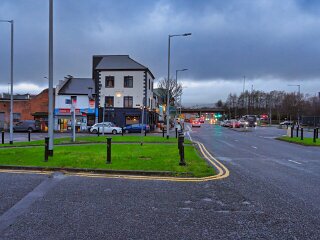
If you stand at the junction of Clarendon Road and Pilot Street in Belfast, you are standing on a fault line between two worlds. On one side lies the gleaming glass of the modern Harbour Estate; on the other, the faded red bricks and cobblestones of historic Sailortown.
For the casual passer-by, the area presents a confusing collection of landmarks: a modern square guarded by heavy gates, a silent pub, a solitary church, and striking artwork scattered amidst major construction. But look closer, and you will see that each element tells a chapter of Belfast’s maritime story.
The Gates and Barrow Square
The public space you see is Barrow Square, a relatively recent addition designed to honour the area’s maritime past. However, the large gates that open onto Pilot Street often baffle visitors. While they may appear purposeless during the day, they mark the legal boundary between the public city streets and the private Belfast Harbour Estate. Historically, this separation was strict, keeping the customs-controlled docks distinct from the residential streets. Today, they remain a functional security measure for the business park.
Short Street and Benny's Café
Just off the main drag lies Short Street, one of the last remaining cobbled streets in the area. Walking on these stones gives you a rare tactile connection to the 19th century, before the motorways and high-rises changed the landscape.
At the heart of this street is Benny's Café. A true survivor, this building has witnessed the area's darkest days. Formerly Benny's Bar, it was the site of a tragic bombing in 1972. Today, it stands as a testament to the community's resilience—a warm, welcoming café that serves as a living link between the old dock workers and the new office workers.
The Flying Angel (The Ship’s Prow)
On Princes Dock Street, near the Mission to Seafarers, you will find a striking sculpture that often stops visitors in their tracks: a bronze angel reaching out from the prow of a ship.
This piece is known as The Flying Angel. It is not just decorative; it symbolises the work of the Mission to Seafarers, a charity that has provided shelter and comfort to sailors for over a century. The angel is depicted calming the waves, a poignant tribute to the dangers faced by those who worked the Irish Sea and the Atlantic.
The Union Stronghold (ITGWU)
You may have also noticed a mural or building references to the ITGWU (Irish Transport and General Workers' Union). This area is hallowed ground for the trade union movement.
Sailortown was the epicentre of the famous 1907 Belfast Dock Strike, led by James Larkin. It was here that Catholic and Protestant workers famously set aside sectarian differences to march together for better wages and conditions. The murals and union buildings in this area serve as permanent memorials to that rare moment of unity and the ongoing struggle for workers' rights on the docks.
The Chapel on the Quays
Dominated by the surrounding construction of the City Quays development, the "derelict" church on Princes Dock Street is St. Joseph’s, known locally as the "Chapel on the Quays."
Opened in 1880, its spire was often the last sight of home for sailors leaving Belfast. Although deconsecrated in 2001 after the community was displaced by motorway construction, it is not abandoned. The local community is slowly restoring it as a cultural hub, refusing to let this piece of heritage disappear.
The Rotterdam Bar
The iconic Rotterdam Bar stands nearby, a legendary venue that once hosted Bob Dylan and Van Morrison. Historically an inn for convicts awaiting transportation to Australia, it became the quintessential "dockers' pub." While currently closed and awaiting its fate amidst development plans, its weathered façade remains a favourite subject for photographers.
The Tall Ship Mural
Overlooking the square is a massive mural of a sailing ship. Commissioned in 2015 to celebrate the Tall Ships Race, it was designed by a local student and painted by muralist Danny Devenny. It serves as a visual anchor, reminding us that long before the office blocks arrived, this was a forest of masts and rigging.
If you stand at the junction of Clarendon Road and Pilot Street in Belfast, you are standing on a fault line between two worlds. On one side lies the gleaming glass of the modern Harbour Estate; on the other, the faded red bricks and cobblestones of historic Sailortown.
For the casual passer-by, the area presents a confusing collection of landmarks: a modern square guarded by heavy gates, a silent pub, a solitary church, and striking artwork scattered amidst major construction. But look closer, and you will see that each element tells a chapter of Belfast’s maritime story.
The Gates and Barrow Square
The public space you see is Barrow Square, a relatively recent addition designed to honour the area’s maritime past. However, the large gates that open onto Pilot Street often baffle visitors. While they may appear purposeless during the day, they mark the legal boundary between the public city streets and the private Belfast Harbour Estate. Historically, this separation was strict, keeping the customs-controlled docks distinct from the residential streets. Today, they remain a functional security measure for the business park.
Short Street and Benny's Café
Just off the main drag lies Short Street, one of the last remaining cobbled streets in the area. Walking on these stones gives you a rare tactile connection to the 19th century, before the motorways and high-rises changed the landscape.
At the heart of this street is Benny's Café. A true survivor, this building has witnessed the area's darkest days. Formerly Benny's Bar, it was the site of a tragic bombing in 1972. Today, it stands as a testament to the community's resilience—a warm, welcoming café that serves as a living link between the old dock workers and the new office workers.
The Flying Angel (The Ship’s Prow)
On Princes Dock Street, near the Mission to Seafarers, you will find a striking sculpture that often stops visitors in their tracks: a bronze angel reaching out from the prow of a ship.
This piece is known as The Flying Angel. It is not just decorative; it symbolises the work of the Mission to Seafarers, a charity that has provided shelter and comfort to sailors for over a century. The angel is depicted calming the waves, a poignant tribute to the dangers faced by those who worked the Irish Sea and the Atlantic.
The Union Stronghold (ITGWU)
You may have also noticed a mural or building references to the ITGWU (Irish Transport and General Workers' Union). This area is hallowed ground for the trade union movement.
Sailortown was the epicentre of the famous 1907 Belfast Dock Strike, led by James Larkin. It was here that Catholic and Protestant workers famously set aside sectarian differences to march together for better wages and conditions. The murals and union buildings in this area serve as permanent memorials to that rare moment of unity and the ongoing struggle for workers' rights on the docks.
The Chapel on the Quays
Dominated by the surrounding construction of the City Quays development, the "derelict" church on Princes Dock Street is St. Joseph’s, known locally as the "Chapel on the Quays."
Opened in 1880, its spire was often the last sight of home for sailors leaving Belfast. Although deconsecrated in 2001 after the community was displaced by motorway construction, it is not abandoned. The local community is slowly restoring it as a cultural hub, refusing to let this piece of heritage disappear.
The Rotterdam Bar
The iconic Rotterdam Bar stands nearby, a legendary venue that once hosted Bob Dylan and Van Morrison. Historically an inn for convicts awaiting transportation to Australia, it became the quintessential "dockers' pub." While currently closed and awaiting its fate amidst development plans, its weathered façade remains a favourite subject for photographers.
The Tall Ship Mural
Overlooking the square is a massive mural of a sailing ship. Commissioned in 2015 to celebrate the Tall Ships Race, it was designed by a local student and painted by muralist Danny Devenny. It serves as a visual anchor, reminding us that long before the office blocks arrived, this was a forest of masts and rigging.
CLARENDON DOCK AREA