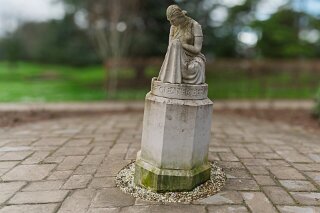
PHOTOGRAPHED IN MARCH 2019
THE GLEANER BY JOHN KNOX [STORMONT ESTATE 2019]
As you can see from my photograph this sculpture is leaning to one side.
The Story Behind "The Gleaner"
The sculpture was crafted by John Knox, a notable Belfast sculptor, specifically for the 1951 Festival of Britain. This national exhibition was designed to showcase British recovery and ingenuity following the devastation of the Second World War.
While many exhibits from the festival were temporary, The Gleaner was built to endure. It originally stood at the entrance to the "Farm and Factory" exhibition at Castlereagh before eventually finding its permanent home within the Stormont Estate.
What is a Gleaner?
In a historical sense, a gleaner is someone who gathers the leftover grain after a harvest. Traditionally, it was a task performed by the poor or the landless, who were legally permitted to collect what the mechanical harvesters or scythes missed.
In Knox's interpretation, the figure represents more than just agricultural labour. She is a symbol of resourcefulness. By depicting her on a bended knee, Knox highlights the humility and physical toll of "frugality."
The Meaning of the Inscription - The quote, "Thrift is the Gleaner behind all human effort," serves as a moral reminder. In the post-war era of 1951, rationing was still a fresh memory and "waste not, want not" was a national mantra. The sculpture suggests that no matter how much we produce through "industry," it is our ability to save and be mindful (to "glean") that truly sustains us.
Why is it leaning?
As already mentioned the sculpture appears to be leaning. There are two likely reasons for this:
Artistic Intent: Knox may have designed the posture to emphasise the strain of the work, giving the figure a more dynamic, weighted feel as she reaches for the grain.
Structural Subsidence: Like many heavy stone or concrete works situated outdoors, the soft ground of the Stormont Estate can occasionally cause a slight shift in the plinth over the decades.
Whatever the cause, it adds a certain "weathered" character to a figure that has watched over Belfast for over 70 years.
John Knox’s Belfast Footprint
John Knox was a Belfast-based sculptor who eventually became the Head of Sculpture at the Belfast School of Art (now part of Ulster University). Despite his influential role in teaching many of Northern Ireland's future artists, his own public commissions are few and far between.
Notable Works
Mother and Child (1929–1930): This is perhaps his other most famous piece, though you won't find it on a Belfast street corner. It is a Portland stone sculpture currently held in the collection of the Glasgow School of Art. It echoes the same smooth, heavy, maternal aesthetic seen in The Gleaner.
The Gleaner (1951): As you know, this is his most prominent public work in Belfast. It was commissioned by the Ulster Savings Committee specifically for the Festival of Britain.
Why aren't there more?
Knox was primarily an academic and a "sculptor's sculptor." Much of his work was likely small-scale studio pieces or maquettes used for teaching. Furthermore, mid-century public art in Belfast was often conservative or functional; many artists of his generation focused on architectural details for buildings rather than standalone monuments.
A Note on "The Other John Knoxes"
When researching him, it is very easy to fall down a rabbit hole of historical "John Knoxes"! To avoid any confusion:
The Scottish Painter: There is a famous 19th-century Scottish landscape painter named John Knox (1778–1845).
The Reformer: The most famous John Knox was, of course, the 16th-century religious reformer.
As you can see from my photograph this sculpture is leaning to one side.
The Story Behind "The Gleaner"
The sculpture was crafted by John Knox, a notable Belfast sculptor, specifically for the 1951 Festival of Britain. This national exhibition was designed to showcase British recovery and ingenuity following the devastation of the Second World War.
While many exhibits from the festival were temporary, The Gleaner was built to endure. It originally stood at the entrance to the "Farm and Factory" exhibition at Castlereagh before eventually finding its permanent home within the Stormont Estate.
What is a Gleaner?
In a historical sense, a gleaner is someone who gathers the leftover grain after a harvest. Traditionally, it was a task performed by the poor or the landless, who were legally permitted to collect what the mechanical harvesters or scythes missed.
In Knox's interpretation, the figure represents more than just agricultural labour. She is a symbol of resourcefulness. By depicting her on a bended knee, Knox highlights the humility and physical toll of "frugality."
The Meaning of the Inscription - The quote, "Thrift is the Gleaner behind all human effort," serves as a moral reminder. In the post-war era of 1951, rationing was still a fresh memory and "waste not, want not" was a national mantra. The sculpture suggests that no matter how much we produce through "industry," it is our ability to save and be mindful (to "glean") that truly sustains us.
Why is it leaning?
As already mentioned the sculpture appears to be leaning. There are two likely reasons for this:
Artistic Intent: Knox may have designed the posture to emphasise the strain of the work, giving the figure a more dynamic, weighted feel as she reaches for the grain.
Structural Subsidence: Like many heavy stone or concrete works situated outdoors, the soft ground of the Stormont Estate can occasionally cause a slight shift in the plinth over the decades.
Whatever the cause, it adds a certain "weathered" character to a figure that has watched over Belfast for over 70 years.
John Knox’s Belfast Footprint
John Knox was a Belfast-based sculptor who eventually became the Head of Sculpture at the Belfast School of Art (now part of Ulster University). Despite his influential role in teaching many of Northern Ireland's future artists, his own public commissions are few and far between.
Notable Works
Mother and Child (1929–1930): This is perhaps his other most famous piece, though you won't find it on a Belfast street corner. It is a Portland stone sculpture currently held in the collection of the Glasgow School of Art. It echoes the same smooth, heavy, maternal aesthetic seen in The Gleaner.
The Gleaner (1951): As you know, this is his most prominent public work in Belfast. It was commissioned by the Ulster Savings Committee specifically for the Festival of Britain.
Why aren't there more?
Knox was primarily an academic and a "sculptor's sculptor." Much of his work was likely small-scale studio pieces or maquettes used for teaching. Furthermore, mid-century public art in Belfast was often conservative or functional; many artists of his generation focused on architectural details for buildings rather than standalone monuments.
A Note on "The Other John Knoxes"
When researching him, it is very easy to fall down a rabbit hole of historical "John Knoxes"! To avoid any confusion:
The Scottish Painter: There is a famous 19th-century Scottish landscape painter named John Knox (1778–1845).
The Reformer: The most famous John Knox was, of course, the 16th-century religious reformer.
BY JOHN KNOX