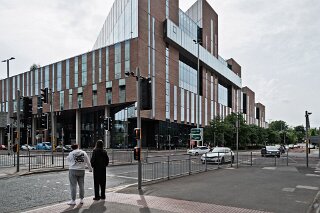
[PHOTOGRAPHED MAY 2025 USING A LECIA Q3
ULSTER UNIVERSITY BELFAST CITY CAMPUS
Photographer’s Note When I visited Belfast in May, I took a gamble by carrying two cameras I had no prior experience with: a Fuji GFX100RF and a Leica Q3. Writing this now in January 2026, I remain undecided on which system I prefer overall. However, there is no doubt as to which camera proved superior in low-light conditions. However, Now in 2026 I am using the Leica Q3 much more than any other camera.
A New Landmark: The Belfast City Campus
Ulster University’s Belfast City Campus has undergone a monumental transformation, evolving into a defining feature of the city’s skyline. Situated firmly within the Cathedral Quarter, the campus is a substantial urban development designed to weave directly into the historic fabric of the city.
The structure comprises four core buildings—Blocks BA, BB, BC, and BD—connected by a link bridge. The most recent addition alone covers a massive 75,000 square metres, making it one of the largest higher education capital builds in Europe.
The architectural design emphasises vertical stacking across 14 occupied floors. The aim is to create a truly 24-hour campus, featuring connected spaces that foster community and collaboration rather than isolation.
Facilities and Amenities
The campus hosts a comprehensive range of facilities across its multiple levels, designed to support modern learning and student life:
Teaching and Learning: The campus features numerous lecture theatres, including a 350-seat auditorium, alongside smaller study rooms, tutorial spaces, and various social learning hubs.
Specialist Studios and Labs: Facilities include art studios and workshops for metal, wood, mould making, and foundry work. It also houses film and cinematic arts studios equipped with green screens, virtual production facilities (linked to the £72 million Studio Ulster in Belfast Harbour), music studios, and advanced labs for Computing, Engineering, the Built Environment, and Life & Health Sciences.
The Business School: This section includes dedicated offices and specialist spaces, such as a Financial Innovation Laboratory.
Student Support: Comprehensive services are available, including the Students’ Union, library, student wellbeing centre, employability and careers services, chaplaincy, and prayer rooms.
General Amenities: The campus is serviced by various cafés, restaurants, shops, and a gym.
Administration: Administrative offices, including the Vice Chancellor’s Leadership Hub, are distributed across several levels.
A Decade of Evolution
The last ten years have witnessed the monumental expansion of the Ulster University Belfast campus. While the initial phases of this redevelopment began welcoming staff and students in September 2021, the project has only recently reached substantial completion.
Key Highlights of the Development:
Consolidation: The project has moved faculties and operations previously dispersed across different sites into the city centre.
Scale: The 75,000m² extension has significantly increased the university’s physical capacity.
Economic Impact: The regeneration impact on the Northern Ireland economy is estimated at £1.4 billion. The construction phase generated numerous apprenticeships, and the campus is expected to support the creation of 5,000 new jobs in Belfast in the coming years.
Sustainability: The build incorporates sustainable travel options, biodiversity rooftops, renewable technologies, and energy-efficient ventilation.
Civic Engagement: Through initiatives like the "Taking Boys Seriously Programme," the university actively engages with local communities, particularly in North Belfast, to maximise social and educational benefits.
Funding the Vision
Ulster University’s operations and capital projects are supported by a diverse mix of funding streams:
Government Funding (DfE): As a publicly funded institution, the university receives significant support from the Department for the Economy. Large-scale developments like this campus also benefit from initiatives such as the Belfast Region City Deal.
Tuition Fees: A primary income source drawn from undergraduate and postgraduate students.
Research Grants: External funding for research is secured from bodies such as the ESRC, the European Union Peace and Reconciliation Fund, Atlantic Philanthropies, and the Wolfson Foundation.
Philanthropy and Partnerships: The Development & Alumni Relations Office secures donations, while commercial engagement with businesses leads to project-specific funding. Scholarships are often funded by alumni and external organisations (e.g., Inspire Scholarships, McColgan Engineering Scholarship).
Competition with Queen’s University Belfast
Is Ulster University "overtaking" Queen's University Belfast (QUB)? The answer is nuanced. While Ulster University is not definitively overtaking QUB in all metrics, it is rapidly strengthening its position.
Physical Presence: Ulster’s new campus provides a distinct urban advantage, offering high visibility and integration in the city centre, whereas QUB maintains its grand, historic campus in South Belfast.
Academic Profile: QUB remains a Russell Group university with a reputation for traditional academic prestige and research intensity. Ulster University, however, has carved out a strong identity in applied research, professional programmes, and the creative industries.
Perception: While QUB is traditionally viewed as the more academically selective institution, Ulster’s focus on industry relevance and modern facilities is enhancing its appeal to students seeking practical skills and job market links.
Ultimately, this is a complementary development that strengthens Northern Ireland's higher education landscape rather than a zero-sum game.
Demographic Dynamics
Historically, university demographics in Northern Ireland have been complex. While current data on religious breakdown is not always publicised, historical trends suggest distinct patterns.
Queen's University was established in the 19th century partly to encourage higher education for Catholics and Presbyterians, yet Catholics were underrepresented for a long time. This shifted significantly from the 1960s onwards. Recently, data suggests a growing proportion of Catholic students entering higher education, driven by higher attainment levels at A-Level and a higher propensity to study within Northern Ireland compared to Protestant school leavers, who often opt for universities in Great Britain.
There have been historical perceptions that QUB was more aligned with the Unionist tradition, while Ulster University was seen as more neutral or accessible. Consequently, Ulster University’s accessible city-centre location and vocational focus may attract a broad demographic, including a significant number of Catholic students. However, both universities are actively committed to inclusivity and diversity, and any perceived imbalances are the result of complex historical, geographical, and societal factors rather than institutional policy.
Photographer’s Note When I visited Belfast in May, I took a gamble by carrying two cameras I had no prior experience with: a Fuji GFX100RF and a Leica Q3. Writing this now in January 2026, I remain undecided on which system I prefer overall. However, there is no doubt as to which camera proved superior in low-light conditions. However, Now in 2026 I am using the Leica Q3 much more than any other camera.
A New Landmark: The Belfast City Campus
Ulster University’s Belfast City Campus has undergone a monumental transformation, evolving into a defining feature of the city’s skyline. Situated firmly within the Cathedral Quarter, the campus is a substantial urban development designed to weave directly into the historic fabric of the city.
The structure comprises four core buildings—Blocks BA, BB, BC, and BD—connected by a link bridge. The most recent addition alone covers a massive 75,000 square metres, making it one of the largest higher education capital builds in Europe.
The architectural design emphasises vertical stacking across 14 occupied floors. The aim is to create a truly 24-hour campus, featuring connected spaces that foster community and collaboration rather than isolation.
Facilities and Amenities
The campus hosts a comprehensive range of facilities across its multiple levels, designed to support modern learning and student life:
Teaching and Learning: The campus features numerous lecture theatres, including a 350-seat auditorium, alongside smaller study rooms, tutorial spaces, and various social learning hubs.
Specialist Studios and Labs: Facilities include art studios and workshops for metal, wood, mould making, and foundry work. It also houses film and cinematic arts studios equipped with green screens, virtual production facilities (linked to the £72 million Studio Ulster in Belfast Harbour), music studios, and advanced labs for Computing, Engineering, the Built Environment, and Life & Health Sciences.
The Business School: This section includes dedicated offices and specialist spaces, such as a Financial Innovation Laboratory.
Student Support: Comprehensive services are available, including the Students’ Union, library, student wellbeing centre, employability and careers services, chaplaincy, and prayer rooms.
General Amenities: The campus is serviced by various cafés, restaurants, shops, and a gym.
Administration: Administrative offices, including the Vice Chancellor’s Leadership Hub, are distributed across several levels.
A Decade of Evolution
The last ten years have witnessed the monumental expansion of the Ulster University Belfast campus. While the initial phases of this redevelopment began welcoming staff and students in September 2021, the project has only recently reached substantial completion.
Key Highlights of the Development:
Consolidation: The project has moved faculties and operations previously dispersed across different sites into the city centre.
Scale: The 75,000m² extension has significantly increased the university’s physical capacity.
Economic Impact: The regeneration impact on the Northern Ireland economy is estimated at £1.4 billion. The construction phase generated numerous apprenticeships, and the campus is expected to support the creation of 5,000 new jobs in Belfast in the coming years.
Sustainability: The build incorporates sustainable travel options, biodiversity rooftops, renewable technologies, and energy-efficient ventilation.
Civic Engagement: Through initiatives like the "Taking Boys Seriously Programme," the university actively engages with local communities, particularly in North Belfast, to maximise social and educational benefits.
Funding the Vision
Ulster University’s operations and capital projects are supported by a diverse mix of funding streams:
Government Funding (DfE): As a publicly funded institution, the university receives significant support from the Department for the Economy. Large-scale developments like this campus also benefit from initiatives such as the Belfast Region City Deal.
Tuition Fees: A primary income source drawn from undergraduate and postgraduate students.
Research Grants: External funding for research is secured from bodies such as the ESRC, the European Union Peace and Reconciliation Fund, Atlantic Philanthropies, and the Wolfson Foundation.
Philanthropy and Partnerships: The Development & Alumni Relations Office secures donations, while commercial engagement with businesses leads to project-specific funding. Scholarships are often funded by alumni and external organisations (e.g., Inspire Scholarships, McColgan Engineering Scholarship).
Competition with Queen’s University Belfast
Is Ulster University "overtaking" Queen's University Belfast (QUB)? The answer is nuanced. While Ulster University is not definitively overtaking QUB in all metrics, it is rapidly strengthening its position.
Physical Presence: Ulster’s new campus provides a distinct urban advantage, offering high visibility and integration in the city centre, whereas QUB maintains its grand, historic campus in South Belfast.
Academic Profile: QUB remains a Russell Group university with a reputation for traditional academic prestige and research intensity. Ulster University, however, has carved out a strong identity in applied research, professional programmes, and the creative industries.
Perception: While QUB is traditionally viewed as the more academically selective institution, Ulster’s focus on industry relevance and modern facilities is enhancing its appeal to students seeking practical skills and job market links.
Ultimately, this is a complementary development that strengthens Northern Ireland's higher education landscape rather than a zero-sum game.
Demographic Dynamics
Historically, university demographics in Northern Ireland have been complex. While current data on religious breakdown is not always publicised, historical trends suggest distinct patterns.
Queen's University was established in the 19th century partly to encourage higher education for Catholics and Presbyterians, yet Catholics were underrepresented for a long time. This shifted significantly from the 1960s onwards. Recently, data suggests a growing proportion of Catholic students entering higher education, driven by higher attainment levels at A-Level and a higher propensity to study within Northern Ireland compared to Protestant school leavers, who often opt for universities in Great Britain.
There have been historical perceptions that QUB was more aligned with the Unionist tradition, while Ulster University was seen as more neutral or accessible. Consequently, Ulster University’s accessible city-centre location and vocational focus may attract a broad demographic, including a significant number of Catholic students. However, both universities are actively committed to inclusivity and diversity, and any perceived imbalances are the result of complex historical, geographical, and societal factors rather than institutional policy.
ULSTER UNIVERSITY