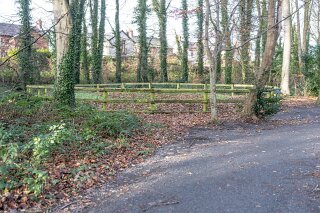
THE WOODLAND TRAIL AS IT WAS IN DECEMBER 2025
Exploring the Stormont Nature Trail: A Stormy December Visit
My visit to the Stormont Estate in December 2025 did not go quite as planned. On the first day, the estate was entirely closed due to severe weather. When I returned the following day, access remained limited; many areas were impassable as the ground had become completely saturated by the recent storm.
I have intentionally delayed publishing these photographs. My goal was to identify the artists behind each individual sculpture to provide a detailed commentary. However, this has proven surprisingly difficult. Official maps and descriptions tend to be generic, and specific information regarding the sculptors is not readily available in the public domain.
A Green Flag Sanctuary
Despite the weather, Stormont Estate remains one of Northern Ireland’s premier green spaces, consistently earning the prestigious Green Flag Award. As the seat of the Northern Ireland Government, the estate offers a unique blend of political history, fitness trails, and family-friendly facilities.
The public area features two primary woodland walks—a 4km long loop and a 2km short walk. For those seeking a workout, the 1.6km fitness trail is dotted with outdoor gym equipment. Families often congregate near the Upper Newtownards Road entrance, where the children’s playground offers climbing frames, swings, and picnic facilities.
Traces of History and War
Beyond the gardens, the estate is a living museum. You will find various statues, memorials, and fascinating remnants of World War II. Notably, the grounds still contain the original barrage balloon anchors used to protect the government buildings from aerial bombardment during the war.
The Evolution of the Estate
The estate was established in the early nineteenth century by the Reverend John Cleland (1755–1834). In 1830, he built Stormont Castle—originally described as a "large plain house." It wasn't until 1858 that the castle was transformed into its current Scottish Baronial style by local architect Thomas Turner.
The name "Stormont" itself is steeped in mystery. It may be a contraction of "Storm Mount" (noted in 1834), or a nod to the Perthshire district in Scotland, derived from the Gaelic star monadh, meaning "place for crossing the mountain."
The Move to Government Ownership
After the Cleland family moved abroad in 1893, the estate was eventually sold to the newly formed Parliament of Northern Ireland in 1921. The 224-acre site, including 100 acres of woodland, was purchased for approximately £21,000.
The estate now houses several architectural landmarks:
Stormont House: A Neo-Georgian structure designed by Ralph Knott, completed in 1926.
Parliament Buildings: Designed by Sir Arnold Thornely in a Greek Classical style and opened in 1932 by the Prince of Wales.
The Lord Carson Statue: A bronze tribute to the Unionist politician, designed by Leonard Stanford Merrifield and erected in 1933.
Dundonald House: A 1960s addition in the "International Style," designed by Robert Hanna Gibson.
The Tomb of Viscount Craigavon: Located east of the Parliament Buildings, this Portland limestone memorial houses Northern Ireland’s first Prime Minister and his wife, Cecil.
My visit to the Stormont Estate in December 2025 did not go quite as planned. On the first day, the estate was entirely closed due to severe weather. When I returned the following day, access remained limited; many areas were impassable as the ground had become completely saturated by the recent storm.
I have intentionally delayed publishing these photographs. My goal was to identify the artists behind each individual sculpture to provide a detailed commentary. However, this has proven surprisingly difficult. Official maps and descriptions tend to be generic, and specific information regarding the sculptors is not readily available in the public domain.
A Green Flag Sanctuary
Despite the weather, Stormont Estate remains one of Northern Ireland’s premier green spaces, consistently earning the prestigious Green Flag Award. As the seat of the Northern Ireland Government, the estate offers a unique blend of political history, fitness trails, and family-friendly facilities.
The public area features two primary woodland walks—a 4km long loop and a 2km short walk. For those seeking a workout, the 1.6km fitness trail is dotted with outdoor gym equipment. Families often congregate near the Upper Newtownards Road entrance, where the children’s playground offers climbing frames, swings, and picnic facilities.
Traces of History and War
Beyond the gardens, the estate is a living museum. You will find various statues, memorials, and fascinating remnants of World War II. Notably, the grounds still contain the original barrage balloon anchors used to protect the government buildings from aerial bombardment during the war.
The Evolution of the Estate
The estate was established in the early nineteenth century by the Reverend John Cleland (1755–1834). In 1830, he built Stormont Castle—originally described as a "large plain house." It wasn't until 1858 that the castle was transformed into its current Scottish Baronial style by local architect Thomas Turner.
The name "Stormont" itself is steeped in mystery. It may be a contraction of "Storm Mount" (noted in 1834), or a nod to the Perthshire district in Scotland, derived from the Gaelic star monadh, meaning "place for crossing the mountain."
The Move to Government Ownership
After the Cleland family moved abroad in 1893, the estate was eventually sold to the newly formed Parliament of Northern Ireland in 1921. The 224-acre site, including 100 acres of woodland, was purchased for approximately £21,000.
The estate now houses several architectural landmarks:
Stormont House: A Neo-Georgian structure designed by Ralph Knott, completed in 1926.
Parliament Buildings: Designed by Sir Arnold Thornely in a Greek Classical style and opened in 1932 by the Prince of Wales.
The Lord Carson Statue: A bronze tribute to the Unionist politician, designed by Leonard Stanford Merrifield and erected in 1933.
Dundonald House: A 1960s addition in the "International Style," designed by Robert Hanna Gibson.
The Tomb of Viscount Craigavon: Located east of the Parliament Buildings, this Portland limestone memorial houses Northern Ireland’s first Prime Minister and his wife, Cecil.
WOODLAND TRAIL