PHOTOGRAPHED IN MAY 2025 USING A FUJIFILM GFX100RF
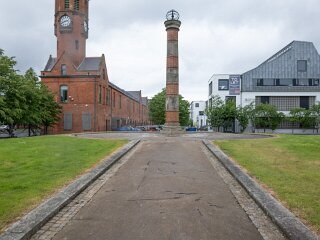
THE GASWORKS CLOCK TOWER AND METER HOUSE [ORMEAU ROAD IN BELFAST]
The Industrial Legacy of the Belfast Gasworks: A Monument to Innovation
The Belfast Gasworks site, situated between the Ormeau Road and the River Lagan, stands as a testament to the city’s Victorian industrial prowess and its subsequent 21st-century regeneration. Established in 1822, this site was the primary source of energy for Belfast, powering the streetlights that illuminated the bustling merchant city and fueling the domestic lives of its citizens for over 160 years. While much of the heavy industrial infrastructure was removed after the site’s closure in 1985, several key Grade B1 listed structures remain as permanent markers of this heritage.
The Gasworks Clock Tower and Meter House
The most prominent feature of the skyline is the red-brick clock tower, which formed part of the Gasworks Office and Meter House. Designed by the architect Robert Watt and completed in approximately 1887, the building served as the administrative heart of the Belfast Corporation Gas Department.
The clock itself holds significant historical value. It was one of the earliest examples of an electrically synchronised timekeeping system in the British Isles. In an era where precision was vital for the massive workforce and the timed release of gas into the city mains, this tower ensured that every department operated in perfect unison. During the restoration project in the late 1990s, the Victorian facade was meticulously preserved, allowing the building to transition into a high-end corporate office space while retaining its architectural integrity.
The Decorative Column and the Metal Globe
Standing adjacent to the clock tower is a slender brick column, often identified by passers-by as a chimney. In reality, this structure served as a ventilation shaft for the retort houses, where coal was heated to extract gas. The column features a unique blend of industrial utility and decorative masonry, characteristic of the Victorian desire to beautify even the most functional structures.
The metal globe or "cage" that sits atop the column is a contemporary addition. Installed during the site’s redevelopment into the Gasworks Business Park, the globe represents Belfast’s global connectivity and the evolution of the site from a local coal-processing plant to an international hub for finance and technology. A second, smaller ventilation shaft remains on the site, though it is less prominently featured than the central column located near Cromac Place.
Urban Regeneration and the Gasworks Park
The landscape surrounding these structures is intentionally designed to reflect the site’s past. The circular grassy area, known as Gasworks Park, is not merely a decorative lawn; its geometry follows the exact footprint of one of the massive "gasometers"—the telescopic steel frames that once dominated the horizon and stored the city’s gas supply.
The contemporary black gates at the entrance to the park further bridge the gap between history and modernity. The fluid, sweeping metalwork is designed to evoke the movement of both the adjacent River Lagan and the gaseous energy that once flowed through the pipes beneath the ground. Today, the site successfully integrates these Victorian monuments with modern architecture, such as the Radisson Blu Hotel and various international corporate headquarters, making it one of the most successful brownfield restoration projects in Northern Ireland.
The Industrial Legacy of the Belfast Gasworks: A Monument to Innovation
The Belfast Gasworks site, situated between the Ormeau Road and the River Lagan, stands as a testament to the city’s Victorian industrial prowess and its subsequent 21st-century regeneration. Established in 1822, this site was the primary source of energy for Belfast, powering the streetlights that illuminated the bustling merchant city and fueling the domestic lives of its citizens for over 160 years. While much of the heavy industrial infrastructure was removed after the site’s closure in 1985, several key Grade B1 listed structures remain as permanent markers of this heritage.
The Gasworks Clock Tower and Meter House
The most prominent feature of the skyline is the red-brick clock tower, which formed part of the Gasworks Office and Meter House. Designed by the architect Robert Watt and completed in approximately 1887, the building served as the administrative heart of the Belfast Corporation Gas Department.
The clock itself holds significant historical value. It was one of the earliest examples of an electrically synchronised timekeeping system in the British Isles. In an era where precision was vital for the massive workforce and the timed release of gas into the city mains, this tower ensured that every department operated in perfect unison. During the restoration project in the late 1990s, the Victorian facade was meticulously preserved, allowing the building to transition into a high-end corporate office space while retaining its architectural integrity.
The Decorative Column and the Metal Globe
Standing adjacent to the clock tower is a slender brick column, often identified by passers-by as a chimney. In reality, this structure served as a ventilation shaft for the retort houses, where coal was heated to extract gas. The column features a unique blend of industrial utility and decorative masonry, characteristic of the Victorian desire to beautify even the most functional structures.
The metal globe or "cage" that sits atop the column is a contemporary addition. Installed during the site’s redevelopment into the Gasworks Business Park, the globe represents Belfast’s global connectivity and the evolution of the site from a local coal-processing plant to an international hub for finance and technology. A second, smaller ventilation shaft remains on the site, though it is less prominently featured than the central column located near Cromac Place.
Urban Regeneration and the Gasworks Park
The landscape surrounding these structures is intentionally designed to reflect the site’s past. The circular grassy area, known as Gasworks Park, is not merely a decorative lawn; its geometry follows the exact footprint of one of the massive "gasometers"—the telescopic steel frames that once dominated the horizon and stored the city’s gas supply.
The contemporary black gates at the entrance to the park further bridge the gap between history and modernity. The fluid, sweeping metalwork is designed to evoke the movement of both the adjacent River Lagan and the gaseous energy that once flowed through the pipes beneath the ground. Today, the site successfully integrates these Victorian monuments with modern architecture, such as the Radisson Blu Hotel and various international corporate headquarters, making it one of the most successful brownfield restoration projects in Northern Ireland.
Explore the history of the Belfast Gasworks on Ormeau Road. From the iconic Victorian clock tower to the decorative retort column, learn how this 19th-century industrial powerhouse was transformed into a modern business hub while preserving its architectural legacy.
GASWORKS CLOCK TOWER