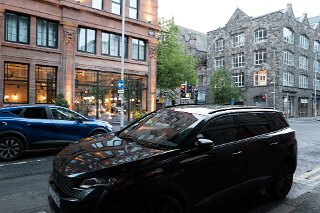
BRUNSWICK STREET MAY 2025
BRUNSWICK STREET IN BELFAST HAS A MAJOR VOID [AN UGLY DERELICT SITE]
The Gap in the Street: A Decade of Waiting on Brunswick Street
Walking down Brunswick Street in Belfast today, the contrast is impossible to miss. Between the bustling pavement of the Howard Building and the red-brick office block next door, there sits a silent, ugly gap.
I have been photographing this area of the city centre once a year since 2006. In my early archival photos, this site was occupied by Brunswick House, an eight-storey office block. Around 2017, the bulldozers moved in, the building came down, and hoarding went up. At the time, the city was promised a glossy new future—specifically, a project called "The Brunswick," a 12-storey residential tower designed to bring modern living to the Linen Quarter.
That was years ago. Today, the site remains a hole in the ground, hidden behind vinyl wraps and colourful artwork. It stands as a stark example of a problem that plagues Belfast: the gulf between the glossy artist's impression and the reality of getting bricks laid.
The Buildings on Either Side
The emptiness of the site is made even more obvious by the quality and activity of the buildings that flank it.
To the right (north) stands the magnificent Howard Building. Clad in red sandstone rather than brick, this neo-baroque gem was built in the 1920s as a War Memorial Hostel. It exudes permanence and history. Today, it is a hive of activity, housing the famous Deanes restaurant complex and, more recently, the bustling Amelia Hall beer hall and pizzeria. It is a shining example of how heritage buildings can be repurposed for modern leisure.
To the left (south) is Frances House (No. 9-11). Built in the late 1980s or early 90s, it is a modest six-storey office block. While it lacks the grandeur of its older neighbour, its red brick façade was clearly designed to respect the historic warehouse aesthetic of the Linen Quarter.
And between them? Nothing. Just a derelict void that has outlasted three Prime Ministers.
Why Does This Keep Happening?
Having documented this street for nearly two decades, one pattern becomes clear: there is never a shortage of "wonderful plans," yet execution almost always stalls. Belfast city centre is currently pockmarked with similar sites—Tribeca being the most infamous—but the reasons for these delays are often less visible than the hoardings.
First, there is the "No Drains, No Cranes" crisis. This is arguably the biggest un-discussed blocker in Belfast right now. The Victorian-era sewer network is at bursting point. NI Water has formally objected to thousands of planning applications across the city because the wastewater infrastructure simply cannot cope with new connections. Developers often secure planning permission in principle, only to find they cannot actually build because the grid requires upgrades that remain chronically underfunded.
Second is the issue of viability. Since the pandemic, the cost of construction materials has skyrocketed. A project that made financial sense on paper in 2019 might now cost 30% more to build, rendering it unprofitable before the ground is even broken.
For now, Brunswick Street remains a smile with a missing tooth. The hoarding may be dressed up with art, but it cannot hide the fact that in a city crying out for regeneration, the wait for the cranes continues.
The Gap in the Street: A Decade of Waiting on Brunswick Street
Walking down Brunswick Street in Belfast today, the contrast is impossible to miss. Between the bustling pavement of the Howard Building and the red-brick office block next door, there sits a silent, ugly gap.
I have been photographing this area of the city centre once a year since 2006. In my early archival photos, this site was occupied by Brunswick House, an eight-storey office block. Around 2017, the bulldozers moved in, the building came down, and hoarding went up. At the time, the city was promised a glossy new future—specifically, a project called "The Brunswick," a 12-storey residential tower designed to bring modern living to the Linen Quarter.
That was years ago. Today, the site remains a hole in the ground, hidden behind vinyl wraps and colourful artwork. It stands as a stark example of a problem that plagues Belfast: the gulf between the glossy artist's impression and the reality of getting bricks laid.
The Buildings on Either Side
The emptiness of the site is made even more obvious by the quality and activity of the buildings that flank it.
To the right (north) stands the magnificent Howard Building. Clad in red sandstone rather than brick, this neo-baroque gem was built in the 1920s as a War Memorial Hostel. It exudes permanence and history. Today, it is a hive of activity, housing the famous Deanes restaurant complex and, more recently, the bustling Amelia Hall beer hall and pizzeria. It is a shining example of how heritage buildings can be repurposed for modern leisure.
To the left (south) is Frances House (No. 9-11). Built in the late 1980s or early 90s, it is a modest six-storey office block. While it lacks the grandeur of its older neighbour, its red brick façade was clearly designed to respect the historic warehouse aesthetic of the Linen Quarter.
And between them? Nothing. Just a derelict void that has outlasted three Prime Ministers.
Why Does This Keep Happening?
Having documented this street for nearly two decades, one pattern becomes clear: there is never a shortage of "wonderful plans," yet execution almost always stalls. Belfast city centre is currently pockmarked with similar sites—Tribeca being the most infamous—but the reasons for these delays are often less visible than the hoardings.
First, there is the "No Drains, No Cranes" crisis. This is arguably the biggest un-discussed blocker in Belfast right now. The Victorian-era sewer network is at bursting point. NI Water has formally objected to thousands of planning applications across the city because the wastewater infrastructure simply cannot cope with new connections. Developers often secure planning permission in principle, only to find they cannot actually build because the grid requires upgrades that remain chronically underfunded.
Second is the issue of viability. Since the pandemic, the cost of construction materials has skyrocketed. A project that made financial sense on paper in 2019 might now cost 30% more to build, rendering it unprofitable before the ground is even broken.
For now, Brunswick Street remains a smile with a missing tooth. The hoarding may be dressed up with art, but it cannot hide the fact that in a city crying out for regeneration, the wait for the cranes continues.
BRUNSWICK STREET