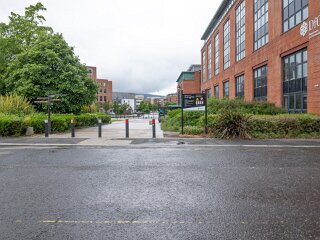
BELFAST GASWORKS PROJECT PHOTOGRAPHED IN MAY 2025
The Gasworks Project: A Blueprint for Urban Transformation in Belfast
The Gasworks Project stands as one of the most significant and successful examples of brownfield regeneration in Northern Ireland. Spanning approximately 25 acres between the Ormeau Road and the River Lagan, this vast site was transformed from a derelict, heavily contaminated industrial wasteland into a premier business, residential, and leisure district. The project is frequently cited as a model for how cities can reconcile a gritty industrial past with the economic requirements of the modern service and technology sectors.
From Industrial Decline to Economic Catalyst
By the mid-1980s, the closure of the gas production plant left a void in the heart of South Belfast. The land was severely polluted by decades of coal-gas manufacturing, making it unsuitable for immediate redevelopment. However, in the early 1990s, a partnership between Belfast City Council, the Laganside Corporation, and central government—backed by European Union funding—initiated a radical decontamination and infrastructure programme.
The goal was to create a "city within a city" that would attract international investment while remaining physically connected to the surrounding local communities. The arrival of major financial institutions, such as the Halifax (now Lloyds Banking Group), acted as an anchor for the project, proving that a former industrial site could house high-tech, international service centres. Today, the Gasworks supports thousands of jobs and hosts a diverse array of global firms, law practices, and software companies.
Architectural Harmony and Social Integration
A defining characteristic of the Gasworks Project is the balance between contemporary design and heritage conservation. Modern office blocks, such as the Batik Building, were designed to integrate sensitively with the original Victorian red-brick structures. This architectural continuity ensures that the site feels like a natural extension of Belfast's history rather than an isolated corporate campus.
The project has recently entered a new phase of evolution, shifting focus toward social sustainability and community integration. Significant developments include:
Social Housing: The "Northern Fringe" masterplan has successfully delivered high-quality social housing, bringing a residential population back to the city centre and addressing local housing needs.
Public Realm Improvements: Recent initiatives have focused on enhancing the central green spaces to create a "social focal point." Plans include improved lighting, pedestrian-friendly pathways, and better connectivity to the River Lagan.
The Lagan Bridge: The proposed pedestrian and cycle bridge will further link the Gasworks to East Belfast, cementing its role as a vital corridor for active travel and urban mobility.
A Legacy of Resilience
The Gasworks Project demonstrates that urban regeneration is a continuous process. What began as an environmental clean-up has matured into a vibrant multi-use district that balances commercial success with public amenity. By preserving the iconic clock tower and retort columns, the project ensures that while the city moves forward, the industrial efforts of previous generations are not forgotten.
The Gasworks Project stands as one of the most significant and successful examples of brownfield regeneration in Northern Ireland. Spanning approximately 25 acres between the Ormeau Road and the River Lagan, this vast site was transformed from a derelict, heavily contaminated industrial wasteland into a premier business, residential, and leisure district. The project is frequently cited as a model for how cities can reconcile a gritty industrial past with the economic requirements of the modern service and technology sectors.
From Industrial Decline to Economic Catalyst
By the mid-1980s, the closure of the gas production plant left a void in the heart of South Belfast. The land was severely polluted by decades of coal-gas manufacturing, making it unsuitable for immediate redevelopment. However, in the early 1990s, a partnership between Belfast City Council, the Laganside Corporation, and central government—backed by European Union funding—initiated a radical decontamination and infrastructure programme.
The goal was to create a "city within a city" that would attract international investment while remaining physically connected to the surrounding local communities. The arrival of major financial institutions, such as the Halifax (now Lloyds Banking Group), acted as an anchor for the project, proving that a former industrial site could house high-tech, international service centres. Today, the Gasworks supports thousands of jobs and hosts a diverse array of global firms, law practices, and software companies.
Architectural Harmony and Social Integration
A defining characteristic of the Gasworks Project is the balance between contemporary design and heritage conservation. Modern office blocks, such as the Batik Building, were designed to integrate sensitively with the original Victorian red-brick structures. This architectural continuity ensures that the site feels like a natural extension of Belfast's history rather than an isolated corporate campus.
The project has recently entered a new phase of evolution, shifting focus toward social sustainability and community integration. Significant developments include:
Social Housing: The "Northern Fringe" masterplan has successfully delivered high-quality social housing, bringing a residential population back to the city centre and addressing local housing needs.
Public Realm Improvements: Recent initiatives have focused on enhancing the central green spaces to create a "social focal point." Plans include improved lighting, pedestrian-friendly pathways, and better connectivity to the River Lagan.
The Lagan Bridge: The proposed pedestrian and cycle bridge will further link the Gasworks to East Belfast, cementing its role as a vital corridor for active travel and urban mobility.
A Legacy of Resilience
The Gasworks Project demonstrates that urban regeneration is a continuous process. What began as an environmental clean-up has matured into a vibrant multi-use district that balances commercial success with public amenity. By preserving the iconic clock tower and retort columns, the project ensures that while the city moves forward, the industrial efforts of previous generations are not forgotten.
BELFAST GASWORKS