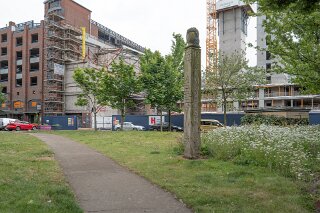
BANKMORE SQUARE AS IT WAS IN MAY 2025
BANKMORE SQUARE IS A POCKET OF GREEN ON THE DUBLIN ROAD [BELFAST MAY 2025]
Bankmore Square: From Victorian Villa to Urban Oasis
If you’ve walked down Belfast’s Dublin Road recently, you might have noticed the changing face of the area. Amongst the red brick of the Linen Quarter and the rising steel of new developments sits a modest but vital patch of green: Bankmore Square.
While it currently serves as a modern "pocket park" for office workers and passers-by, this small square holds a deep connection to Belfast's revolutionary and industrial past.
What’s in a Name? The Origins of "Bankmore"
It would be easy to assume the name is just a generic city label, but "Bankmore" is a nod to a significant piece of lost architecture: Bankmore House.
Built in the early 19th century, Bankmore House was a grand villa that once stood on this very site. The name—likely derived from the Irish An Banc Mór ("The Big Bank")—referred to the rising ground near the River Blackstaff or the embankment of the old water basin that once supplied the city.
The house is historically significant for its residents. It was the home of Maria McCleery, the daughter of the famous United Irishman Henry Joy McCracken. She lived here with her husband, William McCleery, making this corner of Belfast a direct link to the 1798 Rebellion.
The Industrial Shift: The Marcus Ward Connection
By 1870, the era of the private villa had passed. The site was purchased by the Ward family, who transformed the grounds into the Royal Ulster Works—a massive printing and stationery factory for their company, Marcus Ward & Co.
If you look closely, this history is still alive today. The popular bar immediately adjacent to the square, The Marcus Ward, occupies part of that old factory site, keeping the name of the industrial titan alive even as the presses have long since stopped rolling.
A Modern Pocket Park Revival
Today, Bankmore Square has been reclaimed as a space for people rather than industry. Thanks to a recent collaboration between the Linen Quarter BID (Business Improvement District) and the Department for Infrastructure, the square has been rejuvenated into a functional green retreat.
The project introduced features designed to soften the urban hardscape:
Wildflower Meadows: A biodiversity boost that brings a rare splash of colour to the Dublin Road.
Social Seating: New picnic tables and benches have turned it into a prime spot for an alfresco lunch.
Lighting: Enhanced illumination makes the square a safer, more inviting thoroughfare in the evening.
The Changing Skyline
It is impossible to view Bankmore Square today without noticing the giant neighbour rising beside it. The square sits in the shadow of the "One Bankmore" (Bankmore Exchange) development, soon to be the headquarters for digital giant Kainos.
The contrast is striking: a wildflower meadow sitting on the site of a Victorian villa, now reflecting in the glass of a future-facing tech hub. It is a perfect cross-section of Belfast’s evolution—from revolutionary history to industrial powerhouse, and finally to a modern digital city.
Next time you grab a sandwich and sit on a bench at Bankmore Square, take a moment to look around. You aren't just sitting in a park; you’re sitting in the front garden of history.
Bankmore Square: From Victorian Villa to Urban Oasis
If you’ve walked down Belfast’s Dublin Road recently, you might have noticed the changing face of the area. Amongst the red brick of the Linen Quarter and the rising steel of new developments sits a modest but vital patch of green: Bankmore Square.
While it currently serves as a modern "pocket park" for office workers and passers-by, this small square holds a deep connection to Belfast's revolutionary and industrial past.
What’s in a Name? The Origins of "Bankmore"
It would be easy to assume the name is just a generic city label, but "Bankmore" is a nod to a significant piece of lost architecture: Bankmore House.
Built in the early 19th century, Bankmore House was a grand villa that once stood on this very site. The name—likely derived from the Irish An Banc Mór ("The Big Bank")—referred to the rising ground near the River Blackstaff or the embankment of the old water basin that once supplied the city.
The house is historically significant for its residents. It was the home of Maria McCleery, the daughter of the famous United Irishman Henry Joy McCracken. She lived here with her husband, William McCleery, making this corner of Belfast a direct link to the 1798 Rebellion.
The Industrial Shift: The Marcus Ward Connection
By 1870, the era of the private villa had passed. The site was purchased by the Ward family, who transformed the grounds into the Royal Ulster Works—a massive printing and stationery factory for their company, Marcus Ward & Co.
If you look closely, this history is still alive today. The popular bar immediately adjacent to the square, The Marcus Ward, occupies part of that old factory site, keeping the name of the industrial titan alive even as the presses have long since stopped rolling.
A Modern Pocket Park Revival
Today, Bankmore Square has been reclaimed as a space for people rather than industry. Thanks to a recent collaboration between the Linen Quarter BID (Business Improvement District) and the Department for Infrastructure, the square has been rejuvenated into a functional green retreat.
The project introduced features designed to soften the urban hardscape:
Wildflower Meadows: A biodiversity boost that brings a rare splash of colour to the Dublin Road.
Social Seating: New picnic tables and benches have turned it into a prime spot for an alfresco lunch.
Lighting: Enhanced illumination makes the square a safer, more inviting thoroughfare in the evening.
The Changing Skyline
It is impossible to view Bankmore Square today without noticing the giant neighbour rising beside it. The square sits in the shadow of the "One Bankmore" (Bankmore Exchange) development, soon to be the headquarters for digital giant Kainos.
The contrast is striking: a wildflower meadow sitting on the site of a Victorian villa, now reflecting in the glass of a future-facing tech hub. It is a perfect cross-section of Belfast’s evolution—from revolutionary history to industrial powerhouse, and finally to a modern digital city.
Next time you grab a sandwich and sit on a bench at Bankmore Square, take a moment to look around. You aren't just sitting in a park; you’re sitting in the front garden of history.
BANKMORE SQUARE