AN EXAMPLE OF URBAN EXPRESSION IN DUBLIN 8 MARCH 2026
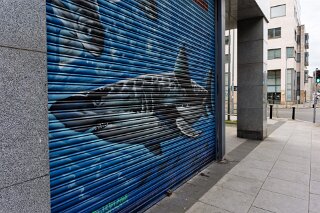
EXAMPLE OF PAINT-A-SHUTTER STREET ART [URBAN EXPRESSION IN DUBLIN 8 MARCH 2026]
A few weeks ago a friend of mine who owns a hardware shop in Dublin City centre was approached by Dublin City Council with an offer to paint murals on his shutters as it generally reduces random/unsightly graffiti. This series of photographs features examples from Cork Street in the Coombe area of the city - Southside Angling: "Fishing Tackle shop run by Specialists for Specialist. Everything from a needle to an Anchor for your angling needs." Note: The mural of the mother and baby is nearby but is unrelated.
Paint-A-Shutter is a fascinating shift in the urban landscape. What was once seen as a purely defensive measure against vandalism has evolved into a strategic marriage between local government, small businesses, and the arts community.
In Dublin, this trend has gained significant momentum through initiatives like Dublin Canvass and various business improvement district (BID) schemes. Here is a breakdown of why "Paint-A-Shutter" is becoming a staple of modern street photography and urban planning.
The Rise of the "Open-Air Gallery" Trend
From Vandalism to Valorisation
The logic for my friend’s hardware shop is rooted in the "broken windows theory" in reverse. Tagging often occurs on "blank" canvases—grey shutters or derelict walls. By commissioning professional murals, the council creates a sense of ownership. Interestingly, there is an unwritten "code" among many street artists: you don’t tag over someone else’s quality work. This reduces maintenance costs for the shop owner while beautifying the street.
The "After-Hours" Aesthetic
Traditionally, street art was sought out on gable ends or dedicated "halls of fame." The shutter trend transforms commercial streets into galleries specifically after 6:00 PM. For a street photographer, this doubles the personality of a single location: a bustling shop by day, and a vibrant, silent masterpiece by night.
Local Identity and Storytelling
Councils often encourage murals that reflect the heritage of the specific street. For a hardware shop in the city centre, the mural might feature industrial tools, local characters, or historical Dublin motifs, turning a functional security feature into a landmark.
A few weeks ago a friend of mine who owns a hardware shop in Dublin City centre was approached by Dublin City Council with an offer to paint murals on his shutters as it generally reduces random/unsightly graffiti. This series of photographs features examples from Cork Street in the Coombe area of the city - Southside Angling: "Fishing Tackle shop run by Specialists for Specialist. Everything from a needle to an Anchor for your angling needs." Note: The mural of the mother and baby is nearby but is unrelated.
Paint-A-Shutter is a fascinating shift in the urban landscape. What was once seen as a purely defensive measure against vandalism has evolved into a strategic marriage between local government, small businesses, and the arts community.
In Dublin, this trend has gained significant momentum through initiatives like Dublin Canvass and various business improvement district (BID) schemes. Here is a breakdown of why "Paint-A-Shutter" is becoming a staple of modern street photography and urban planning.
The Rise of the "Open-Air Gallery" Trend
From Vandalism to Valorisation
The logic for my friend’s hardware shop is rooted in the "broken windows theory" in reverse. Tagging often occurs on "blank" canvases—grey shutters or derelict walls. By commissioning professional murals, the council creates a sense of ownership. Interestingly, there is an unwritten "code" among many street artists: you don’t tag over someone else’s quality work. This reduces maintenance costs for the shop owner while beautifying the street.
The "After-Hours" Aesthetic
Traditionally, street art was sought out on gable ends or dedicated "halls of fame." The shutter trend transforms commercial streets into galleries specifically after 6:00 PM. For a street photographer, this doubles the personality of a single location: a bustling shop by day, and a vibrant, silent masterpiece by night.
Local Identity and Storytelling
Councils often encourage murals that reflect the heritage of the specific street. For a hardware shop in the city centre, the mural might feature industrial tools, local characters, or historical Dublin motifs, turning a functional security feature into a landmark.