MY FIRST TIME TO USE A FUJIFILM GFX100RF
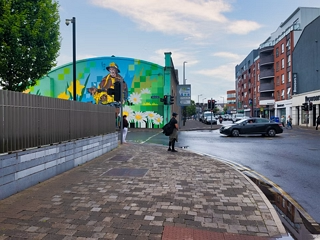
LIMERICK'S STREET ART SCENE AS IT WAS IN JULY 2025 - FUJIFILM GFX100RF SESSIONS
Limerick’s street art landscape in July 2025 presented an intriguing contrast: a collection of striking, high-calibre legacy murals anchored primarily by past editions of the Draw Out urban exhibition initiative, set against a streetscape where new additions had slowed to an occasional trickle. Notable focal points—such as the poignant Dolores O’Riordan tribute, the beloved Dodo Reddan mural at St John’s Pavilion, and decorative ground and gable works along Honan’s Quay and Thomondgate—remained prominent civic markers. However, the broader scene felt largely static, with the bulk of the city's signature installations dating back to the late 2010s and early 2020s.
Between late 2025 and 2026, modest progress occurred rather than an explosive revival. The primary advancement came through the Council’s Environmental Department and Draw Out completing their targeted Wildlife Walls series in late 2025, which added vibrant native biodiversity murals—including Ohhi Uisce’s red fox (Madra Rua) and butterfly pieces—to selected gable ends. In spring 2026, Limerick City and County Council issued an open call asking private property owners to volunteer gable walls for future curated mural installations, attempting to build a fresh pipeline of approved surfaces. Despite these efforts, the volume of fresh, large-scale work remains modest compared to national peers like Waterford or Belfast.
Why Limerick Has Fewer Murals Than Expected
Several architectural, financial, and planning factors explain why Limerick’s mural catalogue is neither as expansive nor as frequently refreshed as visitors often anticipate:
Architectural Conservation and Georgian Fabric: Limerick boasts one of Ireland’s finest and most intact Georgian street grids in Newtown Pery. The local authority enforces strict planning constraints (Architectural Heritage Considerations and Design Guidelines for Public Art Installations and Murals). Painting over historic red brick, exposed stone, or protected structures within Architectural Conservation Areas (ACAs) is heavily restricted or prohibited. Consequently, street art cannot spread organically through the commercial core and is relegated to peripheral modern infill, post-industrial sites, or boundary walls.
The Funding Model and Project-Based Cycles: Large-scale street art in Limerick has historically been top-down and curated rather than an organic, grassroots free-for-all. Initiatives like Draw Out depend on episodic municipal budgets, regeneration grants, and festival-based funding. When municipal priorities shift toward capital infrastructure schemes (such as the Opera Square redevelopment or active travel works), mural production slows significantly.
Site Demolition and Urban Renewal: Street art thrives on transient, derelict spaces. As Limerick’s urban regeneration projects have gathered pace, several older walls, hoardings, and vacant buildings that previously showcased prominent murals have either been demolished or redeveloped, quietly reducing the visible inventory.
Weathering and Maintenance Gaps: Atlantic weather takes a heavy toll on exposed masonry. Without dedicated long-term maintenance budgets or anti-graffiti coatings, pieces painted 6–10 years ago have faded, peeled, or deteriorated, contributing to an impression that much of the work belongs to an earlier chapter of civic renewal.
The Limited Expansion of the Paint-A-Box Scene
While Dublin and other regional centres rolled out hundreds of painted traffic signal and utility boxes through community initiatives like Dublin Canvas, Limerick’s utility box transformation remains comparatively stunted.
Absence of a Sustained Independent Vehicle: Dublin Canvas operates with dedicated seasonal administration across multiple local authorities. In Limerick, painted boxes have appeared largely through isolated pilot runs—such as small-scale community engagements or bespoke Draw Out projects—without transition into a recurring, open-submission annual programme with council underwriting.
Utility Asset Permissions: Utility boxes belong to multiple disparate stakeholders, notably the ESB, Eir, and the Council’s traffic management department. Negotiating ongoing blanket indemnity and licensing requires continuous administrative momentum.
Council Streetscape Philosophy: Municipal policy in parts of the urban core has leaned towards decluttering and uniform street furniture palettes (such as uniform grey or dark green powder coating) to avoid visual fragmentation around historic streetscapes.
The Proliferation of Random Tagging
In sharp contrast to the scarcity of fresh, polished murals, raw graffiti tags and marker scrawls are common across city-centre utility cabinets, vacant commercial facades, and service laneways. This dynamic stems from three main structural causes:
Lack of Legal Free Walls: Unlike European cities with dedicated "halls of fame" where emerging writers can practice and hone complex pieces legally, Limerick provides almost no sanctioned open-access surfaces. Barred from participating in curated civic murals, subcultural writers resort to hit-and-run nocturnal tagging.
Commercial Vacancy and Blind Spots: Pockets of persistent retail vacancy along secondary thoroughfares and back lanes off O’Connell Street, Catherine Street, and the river quays create unmonitored surfaces where tags sit unbuffed for prolonged periods.
The Abatement Lag: Anti-graffiti studies consistently demonstrate that tagging spreads exponentially when left in place, as rival writers compete for visibility. Because private property owners and utility companies often delay cleaning defaced shutters or boxes, an area quickly attracts further vandalism, lending parts of the streetscape a scruffy, neglected appearance despite the presence of genuine artistic talent in the city.
STREET ART IN LIMERICK