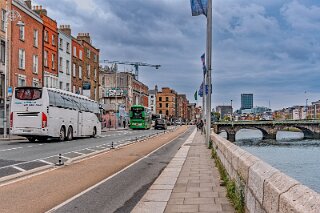
A VERY COMPLICATED STORY
ACCORDING TO A CONTACT THE ORMOND HOTEL SITE IS FOR SALE [BUT IT IS THE MORRISON HOTEL THAT IS ON THE MARKET]
The Ormond Hotel: A Landmark in Limbo
Introduction - The Silent Sirens on the Liffey
Occupying a prominent position on the historic Georgian quays of Dublin's River Liffey, the site of the former Ormond Hotel presents a stark paradox. For over a century, it was a landmark of Dublin hospitality, immortalised in world literature. Today, it is a void, a derelict building site boarded up and silent, a tangible absence in the city's architectural fabric. This state of dereliction, which has persisted for well over a decade, has led to considerable public speculation, including observations of auctioneers' signs that suggest the property has been abandoned and put up for sale.
However, an investigation into the commercial real estate market along Ormond Quay reveals a more complex picture. While there is no evidence that the Ormond Hotel site itself—comprising Nos. 7-13 Upper Ormond Quay—is for sale, the surrounding area is a hive of high-value property transactions. Properties such as the nearby Morrison Hotel, Ormond Court, and various buildings on Ormond Quay Lower have all been subjects of recent sales activity. The presence of these auctioneers' signs on neighbouring buildings likely explains the mistaken observation. This vibrant market context is essential for understanding the Ormond's story; it underscores the immense commercial value of the location and provides a powerful economic rationale for the developers' long and arduous commitment to the site's revival.
The hotel's saga is a uniquely Dublin narrative, a nexus where immense literary heritage collides with urban decay, protracted planning battles, and the intricate challenges of redevelopment. It is a tangible link to James Joyce's modernist masterpiece, Ulysses, that has become an emblem of the city's perpetual tension between preserving its past and building its future. Contrary to the appearance of abandonment, the Ormond Hotel is not a forgotten relic but a project caught in a protracted state of rebirth. Its long and troubled journey from celebrated landmark to derelict void, and now towards a reimagined future, reveals profound truths about Dublin's complex relationship with its own cultural and physical landscape.
A Tangled History - From Georgian Quay to Grand Hotel
The story of the Ormond Hotel is deeply embedded in the history of Dublin itself. The quays that give the hotel its name were first laid out in the late 17th century under the direction of James Butler, the first Duke of Ormond, then Lord Lieutenant of Ireland. The land on the north bank of the Liffey where the hotel stands was reclaimed from the river's marshy edges around 1675. The original buildings constructed along this new waterfront, including the structure that would eventually become the hotel's core at No. 8 Upper Ormond Quay, date from the first half of the 18th century.
The Ormond Hotel as a named entity began operating from No. 8 in 1889, under the proprietorship of James McHugh. This original establishment was modest in scale, occupying a building with a street frontage of just 18 feet. The hotel's subsequent history is one of gradual, piecemeal expansion, an organic growth that saw it absorb its neighbours to become the largest single component on the quay. This process of amalgamation, rather than purpose-built construction, is fundamental to understanding the building's architectural identity and the complexities of its preservation.
The first major expansion occurred in 1906, when the new owner, Mrs Nora de Massey, acquired the adjacent building at No. 9 and incorporated it into the hotel. This was followed by a more transformative phase in 1932, when then-owner P. J. O'Malley acquired Nos. 10 and 11. He combined all four properties into what was branded the "New Ormond Hotel". It was during this 1930s redevelopment that the collection of separate Georgian townhouses was given a unified stucco façade, an architectural choice that imposed a singular visual identity on the disparate structures and defined the hotel's appearance for the remainder of the 20th century. By 1971, the hotel's footprint had expanded once more to encompass the full range of Nos. 7-11 Upper Ormond Quay. In its final form, the building was an eleven-bay, four-storey hotel, a composite of structures built over a century. However, by the early 21st century, this grand façade had suffered from what the Irish Georgian Society termed "insensitive modernisation," most notably the replacement of its traditional timber sash windows with inappropriate uPVC frames, signalling the beginning of its physical decline.
Anachronism in Ulysses - Deconstructing a Literary Landmark
The Ormond Hotel's global fame rests almost entirely on its immortalisation in James Joyce's Ulysses. The hotel is the unequivocal setting for the novel's eleventh episode, 'Sirens', a chapter renowned for its experimental, musical prose. In the narrative, which chronicles the events of a single Dublin day—16 June 1904—protagonist Leopold Bloom dines in the hotel's restaurant while listening to Simon Dedalus and others sing in the adjoining saloon bar. This connection has made the hotel a site of pilgrimage for literary tourists and a cornerstone of Dublin's designation as a UNESCO City of Literature.
However, a deeper examination of the hotel's history reveals a fascinating and crucial anachronism at the heart of this literary heritage. Detailed architectural and historical analysis demonstrates that the hotel's layout as Joyce described it—with its distinct bar, saloon, and an adjacent dining room—simply did not exist on the fictional date of 16 June 1904. At that time, the hotel was confined to the narrow 18-foot frontage of No. 8, a space far too small to accommodate the separate, communicating rooms that are central to the action of the 'Sirens' episode.
The true inspiration for Joyce's fictional setting was the expanded hotel that he personally visited in August 1912. By then, Mrs de Massey had acquired No. 9 and converted its ground floor into the hotel's dining room, creating the precise spatial arrangement depicted in the novel. Joyce's presence at the hotel in 1912 is confirmed by a letter he wrote to his brother Stanislaus on 21 August of that year, in which he recounts meeting his father and his lawyer, George Lidwell, there. In writing
Ulysses, Joyce transposed his memory of the 1912 hotel onto his 1904 narrative. This means the object of preservation—the "Joycean" hotel of Bloomsday—is, in a strict historical sense, a literary construct. Fiction has retroactively sanctified a physical place, creating a powerful cultural heritage based on memory and art as much as on verifiable 1904 fact.
Despite this complexity, the physical site remains a powerful symbol. Heritage bodies have argued forcefully that the demolition of the 1930s hotel frontage would sever a "real and tangible link" to the literary masterpiece for tourists and citizens alike. Acknowledging this layered history, the planning permission ultimately granted for the new development includes a specific condition: the new hotel must reference its connection to
Ulysses by physically outlining the floor plan of the former Nos. 8 and 9 on the ground floor of the new public reception area. This architectural gesture is a direct response to the site's unique, anachronistic fame, an attempt to preserve the memory of a place made real by fiction.
The Long Decline and the Battle for Redevelopment
The Ormond Hotel ceased trading in 2006, beginning a long period of decay that saw the once-proud building become a derelict eyesore on the Liffey quays. The path to its redevelopment has been a protracted and contentious saga, marked by planning refusals, appeals, and legal challenges that created years of stagnation. This process serves as a compelling case study in the complexities of developing historically sensitive sites in Dublin.
The first major attempt at redevelopment came in 2013-14, when the new owners, Monteco Holdings, submitted a proposal for a €20 million project to demolish the existing structure and replace it with a six-storey, 170-bedroom hotel. This ambitious plan was met with stiff opposition from heritage organisations and local residents. In August 2014, An Bord Pleanála (the Irish planning appeals board) unanimously rejected the application. The board's reasoning was damning, criticising the proposal's "monolithic design and unsympathetic proportions" which, it ruled, would "seriously injure the surviving grain, rhythm and character of Ormond Quay Upper" and the Liffey Quays Conservation Area. The proposed height and bulk were also deemed "visually obtrusive" and detrimental to the residential amenities of neighbouring properties.
Learning from this comprehensive refusal, Monteco Holdings returned in 2016 with a revised, scaled-down application (planning reference 2555/16). This new plan demonstrated a significant compromise. It proposed a smaller, part-five and part-four storey hotel with 121 bedrooms. Crucially, while it still involved the demolition of the main hotel block at Nos. 7-11, it now included the sensitive refurbishment and integration of the adjoining historic buildings at No. 12 (a Protected Structure) and No. 13. This iterative process, moving from a maximalist commercial proposal to a more negotiated, heritage-cognisant design, is typical of development in Dublin's historic core. Despite continued appeals from local residents, An Bord Pleanála granted permission for this revised scheme in May 2017.
The project's troubles were not over. Just as demolition work was scheduled to commence in June 2018, the development was halted by two separate High Court challenges launched by the owners of the neighbouring properties at No. 5 and No. 6 Ormond Quay Upper. The legal action alleged that Monteco had failed to comply with pre-construction planning conditions related to the protection of adjacent structures and that the initial demolition work was creating a nuisance from dust and vibrations. Although a High Court judge ultimately dismissed these claims in August 2019, the legal proceedings added another significant delay to an already lengthy timeline, pushing the project's start date back even further.
The Current Proprietors and the Stalled Timetable
Clarification of the hotel's ownership is key to understanding the project's persistence. The initial query regarding a "Chinese Lady or a Chinese Company" is inaccurate. The site was acquired in 2012 by Monteco Holdings, an Irish-registered company. Monteco is a subsidiary of Plato Capital, a publicly listed investment company based in Kuala Lumpur, Malaysia. This parent company now operates under the brand name
Ormond Group, a hospitality firm with its roots in Southeast Asia. The CEO of the Ormond Group is Gareth Lim.
The Ormond Group's involvement is not that of a passive property fund, but of a dedicated international hotel operator with a specific and ambitious vision for the site. Their stated strategy is to leverage the rich history and literary fame of the Dublin property to launch a new global brand of boutique hotels called "Ormond Hotels". The revitalised Dublin hotel is intended to be the flagship property and namesake for this new international chain, with other locations planned for Kuala Lumpur and Melbourne. This long-term branding strategy provides a powerful motive for the group's decade-long commitment to the difficult Dublin project; the site is not merely an asset but the cornerstone of their premier brand.
This context helps to explain why the project has endured despite a timeline beset by severe disruptions. Following the resolution of the legal challenges in late 2019, the developers announced a revised completion date of early 2020 for the €25 million redevelopment. This timetable left almost no margin for error. The onset of the COVID-19 pandemic in early 2020, and the subsequent public health restrictions that led to widespread shutdowns of the Irish construction industry, made this deadline impossible to meet. While no public statements directly link the pandemic to the Ormond site, the industry-wide cessation of work, coupled with subsequent disruptions to global supply chains and labour availability, provides the most logical explanation for the extended period of inactivity on the site from 2020 through 2022. The project's "stalled" appearance is therefore not the result of a single failure, but the cumulative impact of a sequence of distinct and unfortunate events: a protracted planning process, followed by legal delays, which were in turn immediately followed by an unprecedented global pandemic.
The Path to Rebirth - Planning, Progress, and a Future Opening
Despite the years of apparent inactivity that have left the site a void on the Dublin quays, definitive evidence shows that the redevelopment project is not abandoned and its planning permission has not lapsed. A sequence of critical administrative and commercial steps taken since 2022 demonstrates a clear pattern of project remobilisation, pointing towards an active and ongoing revival.
The most crucial piece of evidence relates to the project's legal standing. The original planning permission, granted under Dublin City Council reference 2555/16, was approaching its expiration date. However, council records show that on 24th March 2022, the developers lodged a formal application, reference 2555/16/X2, for an "Extension of Duration of Permission". The granting of this extension is a significant legal confirmation that the project remains active and that the permission to build has not expired. This is a deliberate and costly procedural step that would not be undertaken for a defunct project.
Following this, further signs of life emerged. In 2023, the project team was expanded with the appointment of Fergal McGirl Conservation Architects as conservation consultants for the construction stage. This appointment signals that the detailed and sensitive work of building the new hotel while conserving the protected structures at Nos. 12 and 13 is being actively managed by a team of specialists, including lead architects DMOD and project managers Mitchell McDermott.
The most significant recent milestone occurred in April 2024, when the Ormond Group announced the appointment of Cycas Hospitality, a pan-European hotel management company, to operate the new Ormond Hotel upon its completion. This is a major commercial step, typically taken when a project is moving from the planning and pre-construction phase towards operational readiness. In the announcement, both the Ormond Group and Cycas Hospitality expressed their commitment to "re-establish the iconic Ormond Hotel and its culturally significant Joyceian connections as a stalwart of Dublin's hospitality scene".
The design for the reimagined 120-key hotel aims to honour this legacy, blending design cues from the hotel's 19th-century origins with the Avant Garde and Bohemian artistic movements of the 1920s. Plans include a reborn "Sirens Bar" and the inlaying of bronze text from
Ulysses into the floor, creating a modern hotel that is explicitly "tuned to its sense of place". Together, the planning extension, the appointment of specialist architects, and the hiring of an operational management company form an undeniable chain of evidence that, behind the hoardings, the project has been methodically revived and is now progressing towards completion.
Conclusion - Reawakening the Song on Ormond Quay
The story of the Ormond Hotel is one of resilience, complexity, and the enduring power of cultural memory. Its history charts a course from a collection of 18th-century Georgian townhouses to a celebrated Dublin institution, made world-famous through a literary anachronism in James Joyce's Ulysses. Its more recent history as a derelict void is not a story of abandonment, but of a redevelopment stalled by a formidable sequence of planning objections, legal challenges, and a global pandemic.
The evidence is now clear that the project, under the stewardship of its Southeast Asian owners, the Ormond Group, is firmly back on track. The planning permission has been formally extended, and key appointments of conservation and management experts in 2023 and 2024 signal a definitive move towards construction and eventual operation. The site is not for sale, nor is the project dead; it is simply a development that has been subject to exceptional delays.
Ultimately, the Ormond Hotel serves as a perfect microcosm of the forces shaping modern Dublin. It encapsulates the city's constant, often fraught, negotiation between protecting its rich heritage and accommodating commercial development. It highlights how literary culture can bestow a sacred status upon a physical place, complicating and enriching the debate over its future. It demonstrates the arduous and multi-layered nature of the Irish planning and legal systems, and it stands as a testament to the resilience of long-term development projects in the face of unforeseen global shocks. After years of silence on the Liffey, the evidence strongly suggests that the Sirens of Ormond Quay are, at last, preparing to sing again.
The Ormond Hotel: A Landmark in Limbo
Introduction - The Silent Sirens on the Liffey
Occupying a prominent position on the historic Georgian quays of Dublin's River Liffey, the site of the former Ormond Hotel presents a stark paradox. For over a century, it was a landmark of Dublin hospitality, immortalised in world literature. Today, it is a void, a derelict building site boarded up and silent, a tangible absence in the city's architectural fabric. This state of dereliction, which has persisted for well over a decade, has led to considerable public speculation, including observations of auctioneers' signs that suggest the property has been abandoned and put up for sale.
However, an investigation into the commercial real estate market along Ormond Quay reveals a more complex picture. While there is no evidence that the Ormond Hotel site itself—comprising Nos. 7-13 Upper Ormond Quay—is for sale, the surrounding area is a hive of high-value property transactions. Properties such as the nearby Morrison Hotel, Ormond Court, and various buildings on Ormond Quay Lower have all been subjects of recent sales activity. The presence of these auctioneers' signs on neighbouring buildings likely explains the mistaken observation. This vibrant market context is essential for understanding the Ormond's story; it underscores the immense commercial value of the location and provides a powerful economic rationale for the developers' long and arduous commitment to the site's revival.
The hotel's saga is a uniquely Dublin narrative, a nexus where immense literary heritage collides with urban decay, protracted planning battles, and the intricate challenges of redevelopment. It is a tangible link to James Joyce's modernist masterpiece, Ulysses, that has become an emblem of the city's perpetual tension between preserving its past and building its future. Contrary to the appearance of abandonment, the Ormond Hotel is not a forgotten relic but a project caught in a protracted state of rebirth. Its long and troubled journey from celebrated landmark to derelict void, and now towards a reimagined future, reveals profound truths about Dublin's complex relationship with its own cultural and physical landscape.
A Tangled History - From Georgian Quay to Grand Hotel
The story of the Ormond Hotel is deeply embedded in the history of Dublin itself. The quays that give the hotel its name were first laid out in the late 17th century under the direction of James Butler, the first Duke of Ormond, then Lord Lieutenant of Ireland. The land on the north bank of the Liffey where the hotel stands was reclaimed from the river's marshy edges around 1675. The original buildings constructed along this new waterfront, including the structure that would eventually become the hotel's core at No. 8 Upper Ormond Quay, date from the first half of the 18th century.
The Ormond Hotel as a named entity began operating from No. 8 in 1889, under the proprietorship of James McHugh. This original establishment was modest in scale, occupying a building with a street frontage of just 18 feet. The hotel's subsequent history is one of gradual, piecemeal expansion, an organic growth that saw it absorb its neighbours to become the largest single component on the quay. This process of amalgamation, rather than purpose-built construction, is fundamental to understanding the building's architectural identity and the complexities of its preservation.
The first major expansion occurred in 1906, when the new owner, Mrs Nora de Massey, acquired the adjacent building at No. 9 and incorporated it into the hotel. This was followed by a more transformative phase in 1932, when then-owner P. J. O'Malley acquired Nos. 10 and 11. He combined all four properties into what was branded the "New Ormond Hotel". It was during this 1930s redevelopment that the collection of separate Georgian townhouses was given a unified stucco façade, an architectural choice that imposed a singular visual identity on the disparate structures and defined the hotel's appearance for the remainder of the 20th century. By 1971, the hotel's footprint had expanded once more to encompass the full range of Nos. 7-11 Upper Ormond Quay. In its final form, the building was an eleven-bay, four-storey hotel, a composite of structures built over a century. However, by the early 21st century, this grand façade had suffered from what the Irish Georgian Society termed "insensitive modernisation," most notably the replacement of its traditional timber sash windows with inappropriate uPVC frames, signalling the beginning of its physical decline.
Anachronism in Ulysses - Deconstructing a Literary Landmark
The Ormond Hotel's global fame rests almost entirely on its immortalisation in James Joyce's Ulysses. The hotel is the unequivocal setting for the novel's eleventh episode, 'Sirens', a chapter renowned for its experimental, musical prose. In the narrative, which chronicles the events of a single Dublin day—16 June 1904—protagonist Leopold Bloom dines in the hotel's restaurant while listening to Simon Dedalus and others sing in the adjoining saloon bar. This connection has made the hotel a site of pilgrimage for literary tourists and a cornerstone of Dublin's designation as a UNESCO City of Literature.
However, a deeper examination of the hotel's history reveals a fascinating and crucial anachronism at the heart of this literary heritage. Detailed architectural and historical analysis demonstrates that the hotel's layout as Joyce described it—with its distinct bar, saloon, and an adjacent dining room—simply did not exist on the fictional date of 16 June 1904. At that time, the hotel was confined to the narrow 18-foot frontage of No. 8, a space far too small to accommodate the separate, communicating rooms that are central to the action of the 'Sirens' episode.
The true inspiration for Joyce's fictional setting was the expanded hotel that he personally visited in August 1912. By then, Mrs de Massey had acquired No. 9 and converted its ground floor into the hotel's dining room, creating the precise spatial arrangement depicted in the novel. Joyce's presence at the hotel in 1912 is confirmed by a letter he wrote to his brother Stanislaus on 21 August of that year, in which he recounts meeting his father and his lawyer, George Lidwell, there. In writing
Ulysses, Joyce transposed his memory of the 1912 hotel onto his 1904 narrative. This means the object of preservation—the "Joycean" hotel of Bloomsday—is, in a strict historical sense, a literary construct. Fiction has retroactively sanctified a physical place, creating a powerful cultural heritage based on memory and art as much as on verifiable 1904 fact.
Despite this complexity, the physical site remains a powerful symbol. Heritage bodies have argued forcefully that the demolition of the 1930s hotel frontage would sever a "real and tangible link" to the literary masterpiece for tourists and citizens alike. Acknowledging this layered history, the planning permission ultimately granted for the new development includes a specific condition: the new hotel must reference its connection to
Ulysses by physically outlining the floor plan of the former Nos. 8 and 9 on the ground floor of the new public reception area. This architectural gesture is a direct response to the site's unique, anachronistic fame, an attempt to preserve the memory of a place made real by fiction.
The Long Decline and the Battle for Redevelopment
The Ormond Hotel ceased trading in 2006, beginning a long period of decay that saw the once-proud building become a derelict eyesore on the Liffey quays. The path to its redevelopment has been a protracted and contentious saga, marked by planning refusals, appeals, and legal challenges that created years of stagnation. This process serves as a compelling case study in the complexities of developing historically sensitive sites in Dublin.
The first major attempt at redevelopment came in 2013-14, when the new owners, Monteco Holdings, submitted a proposal for a €20 million project to demolish the existing structure and replace it with a six-storey, 170-bedroom hotel. This ambitious plan was met with stiff opposition from heritage organisations and local residents. In August 2014, An Bord Pleanála (the Irish planning appeals board) unanimously rejected the application. The board's reasoning was damning, criticising the proposal's "monolithic design and unsympathetic proportions" which, it ruled, would "seriously injure the surviving grain, rhythm and character of Ormond Quay Upper" and the Liffey Quays Conservation Area. The proposed height and bulk were also deemed "visually obtrusive" and detrimental to the residential amenities of neighbouring properties.
Learning from this comprehensive refusal, Monteco Holdings returned in 2016 with a revised, scaled-down application (planning reference 2555/16). This new plan demonstrated a significant compromise. It proposed a smaller, part-five and part-four storey hotel with 121 bedrooms. Crucially, while it still involved the demolition of the main hotel block at Nos. 7-11, it now included the sensitive refurbishment and integration of the adjoining historic buildings at No. 12 (a Protected Structure) and No. 13. This iterative process, moving from a maximalist commercial proposal to a more negotiated, heritage-cognisant design, is typical of development in Dublin's historic core. Despite continued appeals from local residents, An Bord Pleanála granted permission for this revised scheme in May 2017.
The project's troubles were not over. Just as demolition work was scheduled to commence in June 2018, the development was halted by two separate High Court challenges launched by the owners of the neighbouring properties at No. 5 and No. 6 Ormond Quay Upper. The legal action alleged that Monteco had failed to comply with pre-construction planning conditions related to the protection of adjacent structures and that the initial demolition work was creating a nuisance from dust and vibrations. Although a High Court judge ultimately dismissed these claims in August 2019, the legal proceedings added another significant delay to an already lengthy timeline, pushing the project's start date back even further.
The Current Proprietors and the Stalled Timetable
Clarification of the hotel's ownership is key to understanding the project's persistence. The initial query regarding a "Chinese Lady or a Chinese Company" is inaccurate. The site was acquired in 2012 by Monteco Holdings, an Irish-registered company. Monteco is a subsidiary of Plato Capital, a publicly listed investment company based in Kuala Lumpur, Malaysia. This parent company now operates under the brand name
Ormond Group, a hospitality firm with its roots in Southeast Asia. The CEO of the Ormond Group is Gareth Lim.
The Ormond Group's involvement is not that of a passive property fund, but of a dedicated international hotel operator with a specific and ambitious vision for the site. Their stated strategy is to leverage the rich history and literary fame of the Dublin property to launch a new global brand of boutique hotels called "Ormond Hotels". The revitalised Dublin hotel is intended to be the flagship property and namesake for this new international chain, with other locations planned for Kuala Lumpur and Melbourne. This long-term branding strategy provides a powerful motive for the group's decade-long commitment to the difficult Dublin project; the site is not merely an asset but the cornerstone of their premier brand.
This context helps to explain why the project has endured despite a timeline beset by severe disruptions. Following the resolution of the legal challenges in late 2019, the developers announced a revised completion date of early 2020 for the €25 million redevelopment. This timetable left almost no margin for error. The onset of the COVID-19 pandemic in early 2020, and the subsequent public health restrictions that led to widespread shutdowns of the Irish construction industry, made this deadline impossible to meet. While no public statements directly link the pandemic to the Ormond site, the industry-wide cessation of work, coupled with subsequent disruptions to global supply chains and labour availability, provides the most logical explanation for the extended period of inactivity on the site from 2020 through 2022. The project's "stalled" appearance is therefore not the result of a single failure, but the cumulative impact of a sequence of distinct and unfortunate events: a protracted planning process, followed by legal delays, which were in turn immediately followed by an unprecedented global pandemic.
The Path to Rebirth - Planning, Progress, and a Future Opening
Despite the years of apparent inactivity that have left the site a void on the Dublin quays, definitive evidence shows that the redevelopment project is not abandoned and its planning permission has not lapsed. A sequence of critical administrative and commercial steps taken since 2022 demonstrates a clear pattern of project remobilisation, pointing towards an active and ongoing revival.
The most crucial piece of evidence relates to the project's legal standing. The original planning permission, granted under Dublin City Council reference 2555/16, was approaching its expiration date. However, council records show that on 24th March 2022, the developers lodged a formal application, reference 2555/16/X2, for an "Extension of Duration of Permission". The granting of this extension is a significant legal confirmation that the project remains active and that the permission to build has not expired. This is a deliberate and costly procedural step that would not be undertaken for a defunct project.
Following this, further signs of life emerged. In 2023, the project team was expanded with the appointment of Fergal McGirl Conservation Architects as conservation consultants for the construction stage. This appointment signals that the detailed and sensitive work of building the new hotel while conserving the protected structures at Nos. 12 and 13 is being actively managed by a team of specialists, including lead architects DMOD and project managers Mitchell McDermott.
The most significant recent milestone occurred in April 2024, when the Ormond Group announced the appointment of Cycas Hospitality, a pan-European hotel management company, to operate the new Ormond Hotel upon its completion. This is a major commercial step, typically taken when a project is moving from the planning and pre-construction phase towards operational readiness. In the announcement, both the Ormond Group and Cycas Hospitality expressed their commitment to "re-establish the iconic Ormond Hotel and its culturally significant Joyceian connections as a stalwart of Dublin's hospitality scene".
The design for the reimagined 120-key hotel aims to honour this legacy, blending design cues from the hotel's 19th-century origins with the Avant Garde and Bohemian artistic movements of the 1920s. Plans include a reborn "Sirens Bar" and the inlaying of bronze text from
Ulysses into the floor, creating a modern hotel that is explicitly "tuned to its sense of place". Together, the planning extension, the appointment of specialist architects, and the hiring of an operational management company form an undeniable chain of evidence that, behind the hoardings, the project has been methodically revived and is now progressing towards completion.
Conclusion - Reawakening the Song on Ormond Quay
The story of the Ormond Hotel is one of resilience, complexity, and the enduring power of cultural memory. Its history charts a course from a collection of 18th-century Georgian townhouses to a celebrated Dublin institution, made world-famous through a literary anachronism in James Joyce's Ulysses. Its more recent history as a derelict void is not a story of abandonment, but of a redevelopment stalled by a formidable sequence of planning objections, legal challenges, and a global pandemic.
The evidence is now clear that the project, under the stewardship of its Southeast Asian owners, the Ormond Group, is firmly back on track. The planning permission has been formally extended, and key appointments of conservation and management experts in 2023 and 2024 signal a definitive move towards construction and eventual operation. The site is not for sale, nor is the project dead; it is simply a development that has been subject to exceptional delays.
Ultimately, the Ormond Hotel serves as a perfect microcosm of the forces shaping modern Dublin. It encapsulates the city's constant, often fraught, negotiation between protecting its rich heritage and accommodating commercial development. It highlights how literary culture can bestow a sacred status upon a physical place, complicating and enriching the debate over its future. It demonstrates the arduous and multi-layered nature of the Irish planning and legal systems, and it stands as a testament to the resilience of long-term development projects in the face of unforeseen global shocks. After years of silence on the Liffey, the evidence strongly suggests that the Sirens of Ormond Quay are, at last, preparing to sing again.
A COMPLICATED STORY