Cabra's Wild Park Was Once A Toxic Brownsite But It Is Now A Dog Walking Paradise
The Urban Cartographer
Discover how Dublin’s Mount Bernard Park extension at the Cabra Luas stop transformed a contaminated industrial brownfield site into a thriving, wild urban nature reserve. Learn about Dublin City Council's sustainable rewilding approach to inner-city biodiversity and why local dog walkers love the new trails.
MOBILE FRIENDLY AND MUCH FASTER
GO THERE
PARKS AND GARDENS
SONY A7RVI
Presented By William Murphy - The Urban Cartographer - Sony A7RVI With Voigtlander 65mm Lens Photographed 3 July 2026
Cabra's Wild Park Was Once A Toxic Brownsite But It Is Now A Dog Walking Paradise
Author: William Murphy - The Urban Cartographer
|
03. Jul 2026
NO BIRDS TO BE HEARD OR SEEN * In The Year 2008
* In The Year 2011
* In The Year 2017
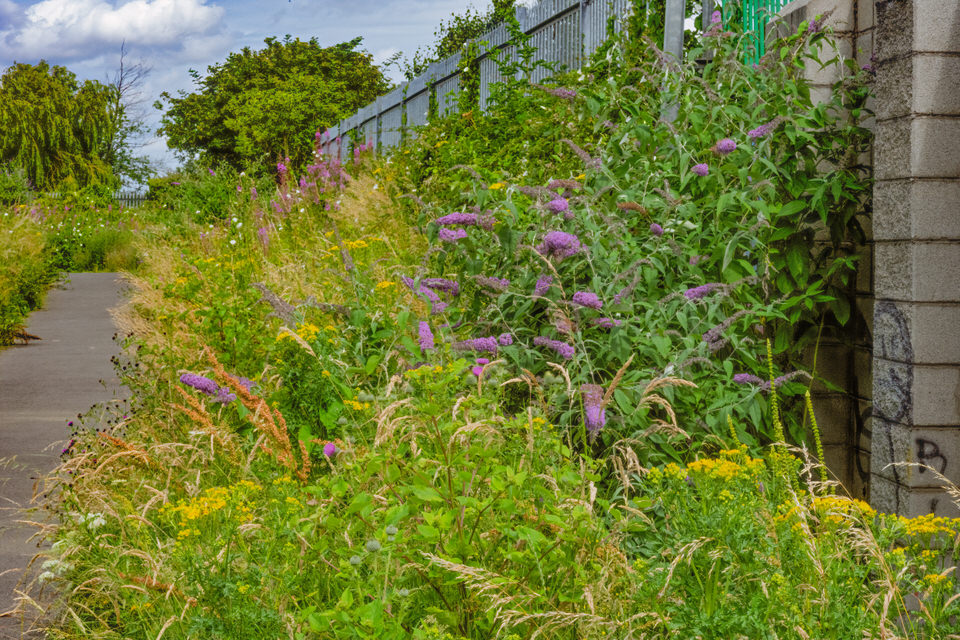
* Henrietta Back In 2010 From Toxic Brownfield to Dog Walker’s Paradise: Inside Cabra’s New "Wild" Park Extension An exciting urban transformation has taken place directly adjacent to the Cabra Luas (tram) stop in Dublin 7. The major expansion of Mount Bernard Park, which sits tucked just beside the light-rail line, represents a unique shift in Irish urban planning. For years, Mount Bernard Park was a relatively compact community green space, well-known locally for its tennis courts and sports pitches. However, the park has recently grown by over 50% in size by reclaiming a historical, disused industrial brownfield site extending northwards toward the Royal Canal. The Industrial Legacy and the "Wild" Approach The newly annexed lands were once owned by CIÉ (Ireland’s national transport operator) and were historically associated with old railway infrastructure and industrial yards. Left abandoned for decades, the soil beneath the surface carried industrial contamination—making it a classic urban brownfield site. When the Luas Cross City tram line was built through the old Broadstone railway cutting, these adjacent lands remained closed off. They effectively acted as an accidental sanctuary where nature took back control behind locked gates, slowly developing a thick, untamed ecosystem. Instead of executing a traditional, aggressive brownfield remediation—which would involve heavy excavation, turning over contaminated soil, and destroying the mature vegetation—Dublin City Council’s Parks Services, funded by the National Transport Authority, took a highly sustainable, low-intervention approach: Preserving Biodiversity: Because digging into the ground risked disturbing the locked-in pollutants, the council opted for minimal excavation. The vast majority of the "wild" volunteer vegetation, brambles, and self-seeded saplings have been left entirely intact. Light-Touch Infrastructure: Regeneration works focused on clearing just enough shrubbery to weave a dedicated, universal-access tarmac pathway around the perimeter of the extension. The Paradox of the "Green Desert" Why hasn't the wildlife caught up with the vegetation? While the site has plenty of green cover, much of what grew during its decades of abandonment consists of highly aggressive "pioneer" species. Brambles, ivy, and self-seeded trees like sycamore or buddleia excel at taking over derelict concrete. However, a dense thicket of brambles lacks the diverse hierarchy of wildflowers needed to support a continuous life cycle for insects. Without specific host plants for caterpillars or a steady succession of different blooming flowers from spring through autumn, butterflies and bees simply move on to more varied gardens nearby. A Hit with Local Dog Walkers While the insects and birds are taking their time to return, the human and canine residents of Cabra have claimed the space wholeheartedly. The extension has quickly become a massive hit with local dog walkers. Interestingly, dogs seem highly inclined to keep strictly to the new tarmac pathways. The dense, thorny nature of the unedited undergrowth—filled with decades of thick brambles and rough, industrial volunteer scrub—acts as a natural barrier. It keeps the dogs safely on the path, allowing them to enjoy the sights and smells of a wild woodland trail without disappearing into the dangerous undergrowth. True ecological restoration on a brownfield takes years. As the site settles down and more diverse flora takes root over the coming seasons, those missing bees and butterflies should slowly begin to filter back in from the banks of the nearby Royal Canal. Rediscovering the Voigtländer 65mm f/2 Macro APO-Lanthar A few days after purchasing the Voigtländer 65mm f/2 Macro APO-Lanthar, a severe fall in Belfast on a rotating flagstone resulted in damaged ribs and a terminally damaged Sony A7RIII. The lens survived with only a minor scratch, but it was placed on a shelf and forgotten during the long wait for a replacement camera. Now, on the first Friday of July 2026, plans are underway to return to Belfast for a five-day stay based in the Titanic Quarter. An unexpected turn of events has expanded the available equipment options to include a selection of flagship bodies, such as the Sony A1 II, a recently arrived A7RVI, and a Leica Q3. While initial intentions did not include acquiring the intermediate Sony models, they now form the core of the kit. Ongoing technical issues with a Fujifilm GFX100F mean it will remain behind, and despite recent stability improvements via firmware version 4.1.0, complete trust in the Leica Q3 has not yet been restored. Field testing reveals that the Sony A7RVI, when paired with high-quality compact glass, rivals or outperforms the Leica while maintaining a comparable footprint and weight. The upcoming trip serves as an opportunity to evaluate these systems, particularly regarding low-light performance. The finalised lens selection for the week includes the Sony 28-70mm GM, either the Sony 24mm f/1.4 GM or 35mm f/1.4 GM (with the Loxia 21mm remaining a strong alternative to the 24mm), and the Voigtländer 65mm as a distinct outlier. Below is an evaluation of the Voigtländer 65mm based on recent testing. Optical Precision and Sensor Performance The Voigtländer 65mm f/2 Macro APO-Lanthar stands out as one of the most optically precise lenses available for the Sony E-mount. Unlike lenses that prioritise maximum aperture speed, the 65mm APO trades low-light velocity for absolute optical perfection, making it a compelling match for high-resolution sensors like the 60MP+ A7RVI and the high-speed A1 II. Zero Chromatic Aberration: Bearing the "APO" (Apochromatic) designation, the lens successfully eliminates both lateral and axial colour fringing. High-contrast subjects—such as polished stone, metal structures, or sharp geometric edges against a bright sky—render with clean, flawless lines even when shooting wide open at f/2. Extreme Micro-Contrast: The lens delivers a clinical, biting sharpness that matches or exceeds the finest offerings in the G Master line, extracting the maximum performance from high-resolution sensors. 1:2 Macro Capability This is not a standard prime lens; it offers close-focusing capabilities down to a 1:2 magnification ratio (half life-size) at a minimum distance of approximately 31 cm. Detail Isolation: The close-focus capability allows for the precise isolation of textures, architectural reliefs, engravings, and structural elements without requiring a bulky, dedicated 90mm or 105mm macro lens. Electronic Integration: As a native E-mount lens with electronic contacts, it communicates data directly to the camera body. Turning the focus ring prompts the electronic viewfinder to magnify the view automatically, ensuring critical focus is achieved easily. Handling and Mechanical Realities The mechanical design offers distinct advantages for a handheld workflow, alongside a few practical considerations: The Mechanics: The all-metal, scalloped focus ring is mechanical and perfectly dampened, while the aperture ring provides clean clicks in 1/3 stops. In-Body Image Stabilisation (IBIS): Direct communication with the Sony bodies ensures that the advanced 5-axis image stabilisation works flawlessly out of the box, a critical factor for handheld shooting. Weight and Density: Despite a relatively compact physical length, the sheer volume of glass and metal results in a dense, heavy lens weighing approximately 625g.
Long Focus Throw: To allow for micro-adjustments at close macro distances, the focus ring features a massive rotation angle of around 290 degrees. Shifting focus quickly from a foreground detail to infinity requires significant rotation. Weather Sealing: In line with the standard Voigtländer catalogue, there is no rubber gasket at the lens mount. Final Verdict * Clontarf Railway Station
* Docklands Railway Station
* Malahide Railway Station
THE LEGACY CATALOG
A SELECTION OF HIGH RESOLUTION PHOTO GALLERIES
HIGH RESOLUTION PHOTOGRAPHS PLUS MAP
SONY A7RVI
LET MISTER SCREEN DIRECT YOU
GLOBAL INDEX OF PHOTO GALLERIES
BOTANIC GARDENS IN GLASNEVIN
THE URBAN CARTOGRAPHER
PARKS AND GARDENS
Cabra's Wild Park Was Once A Toxic Brownsite But It Is Now A Dog Walking Paradise - Presented By The William Murphy - The Urban Cartographer