The Hags With The Bags At The Halfpenny Bridge
The Urban Cartographer
Discover the history of Dublin's iconic 'Meeting Place' sculpture—affectionately known as 'The Hags with the Bags' on Liffey Street Lower. Learn about artist Jackie McKenna, the statue's cultural impact, and its recent restoration and reinstallation during the Liffey Street pedestrianisation upgrade.
MOBILE FRIENDLY AND MUCH FASTER
GO THERE
PARKS AND GARDENS
FUJIFILM GFX100RF
Presented By William Murphy - The Urban Cartographer - Fujifilm GFX100RF Photographed 5 AUGUST 2026
The Hags With The Bags At The Halfpenny Bridge
Author: William Murphy - The Urban Cartographer
|
06. Aug 2026
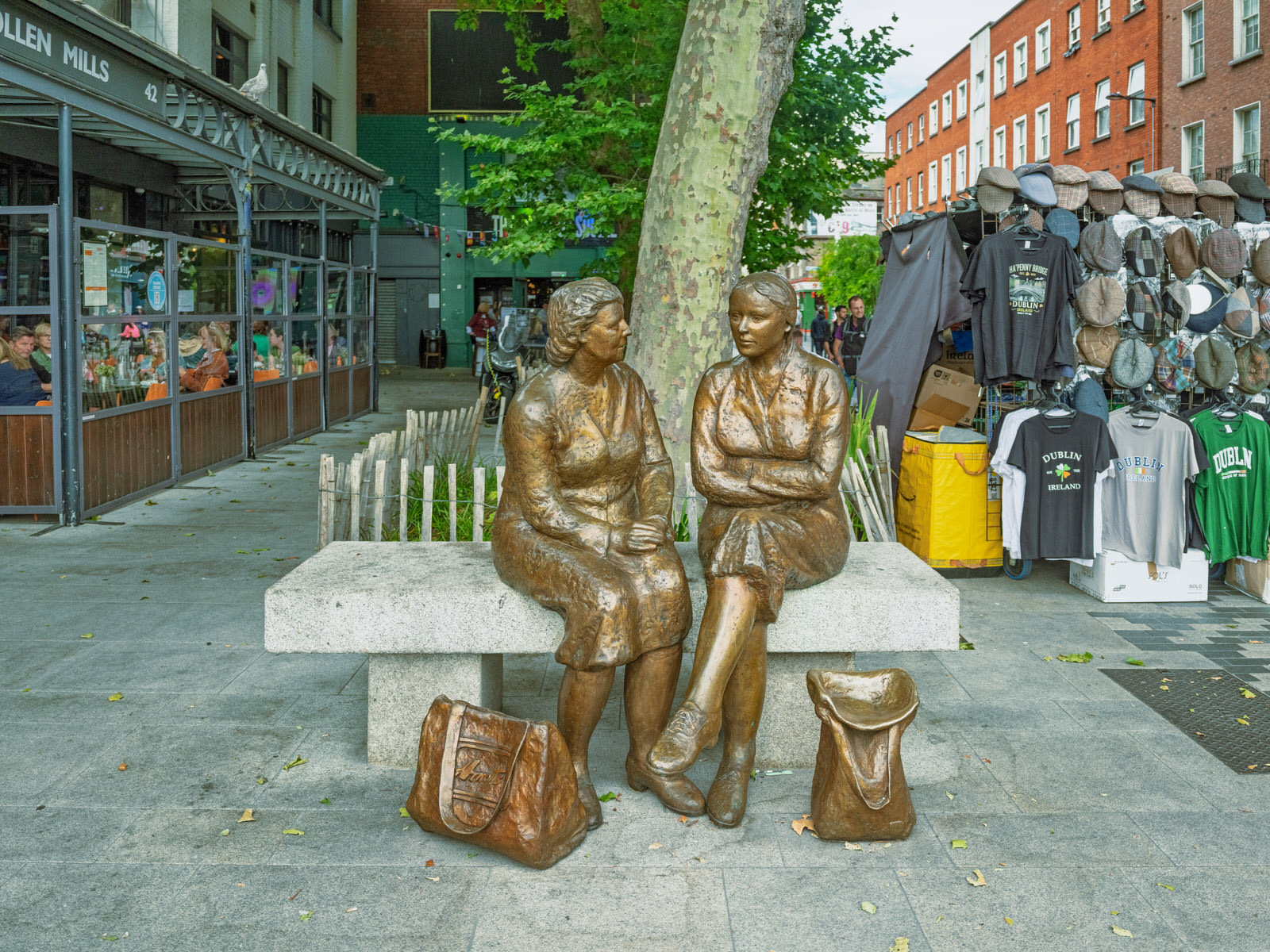
A VERY POPULAR SCULPTURE * In The Year 2008
* In The Year 2011
* In The Year 2017
* Henrietta Back In 2010 The Meeting Place Is The Official Name Meeting place, officially titled Meeting Place and affectionately known to Dubliners as "The Hags with the Bags", is one of Dublin’s most recognizable pieces of public art. Commissioned by Allied Irish Banks and unveiled in 1988 as part of the Dublin Millennium celebrations, the bronze sculpture depicts two everyday women resting on a bench with their shopping bags at their feet, engaged in conversation. It stands near the northern exit of the Ha'penny Bridge at Liffey Street Lower. The Sculpture and Its Cultural Significance Unlike conventional public monuments that honour historic statesmen or military figures, Meeting Place celebrates ordinary Dublin life and street culture. Relatability: The artwork captures an unscripted, human moment—two working-class shoppers pausing amidst a busy day on Dublin's main commercial thoroughfares. Dublin Humour: True to the city's penchant for cheeky rhyming nicknames for statues, the piece was quickly christened "The Hags with the Bags". Authentic Details: The detail on the bronze bags includes recognisable elements of Dublin life, including a bag from Arnotts department store. Notably, shortly after its installation in 1988, one of the heavy bronze shopping bags was stolen, leading to a replacement that was firmly bolted down. The Artist: Jackie McKenna Jackie McKenna is an Irish sculptor known for her figural works in bronze and stone. Artistic Focus: McKenna’s portfolio frequently centres on realistic, narrative-driven sculptures depicting human interaction, domesticity, and community heritage. Public Realm Work: Beyond Meeting Place, McKenna has produced numerous public commissions across Ireland, using tactile materials like bronze to bridge the gap between fine art and public accessibility.
Style and Legacy: Her approach in Meeting Place broke away from grand heroic statues, paving the way for contemporary public art that honours everyday life and social connection. Street Upgrade, Removal, Restoration, and Return As part of Dublin City Council's public realm enhancements for Liffey Street Lower, the area underwent a significant pedestrianisation upgrade to create a more accessible, pedestrian-friendly space between the Ha'penny Bridge and Henry Street. Removal and Conservation: During the heavy construction and paving works, the sculpture was temporarily removed from Liffey Street Lower to prevent damage. During this period off-site, the artwork underwent professional cleaning, bronze conservation, and structural restoration to repair decades of weathering and urban exposure. Return to Liffey Street Lower: Following the completion of the street's pedestrianisation and high-quality repaving works, the statue was returned to Liffey Street Lower. Relocation: It was reinstalled in a slightly altered position within the newly formatted, traffic-free pedestrian zone. The new location allows better pedestrian movement around the sculpture while retaining its role as a key meeting spot near the river. Dubliners have an instinct for instantly stripping grand public monuments of their solemnity by slapping them with irreverent, rhyming, or cheeky monikers. This practice—often dubbed "the Dublin wit"—serves as a cultural equaliser, cutting down artistic pretension and embedding corporate or civic architecture into the vernacular of the city. Classic Dublin Examples Dublin’s Public Art and the Wit Behind Their Nicknames Dublin is a city that refuses to take its public monuments too seriously. While civic leaders commission statues to commemorate literary giants, historical figures, and national allegories, Dubliners almost immediately rename them with sharp, irreverent, and affectionate rhyming slang. Here is a guide to some of the capital's most famous public sculptures, their real origins, and the local titles that stuck. Oscar Wilde Memorial (Merrion Square Park) Chariot of Life (Lower Abbey Street) Sculptor: Oisín Kelly (unveiled 1982) Location: The courtyard of the Irish Life Centre, Lower Abbey Street Local Monikers: "The Mad Milkman", "The Mad Horses" Commissioned by Irish Life, this massive bronze fountain features a driver struggling to control three powerful, rearing horses pulling a chariot. The frantic energy and galloping motion of the bronze horses led locals to quickly dub the piece "The Mad Milkman", imagining a delivery driver tearing down Dublin’s streets at full tilt. Molly Malone (Suffolk Street)** Sculptor: Jeanne Rynhart (unveiled 1988) Location: Outside St Andrew's Church, Suffolk Street (originally Grafton Street) Local Monikers: "The Tart with the Cart", "The Dish with the Fish", "The Trollop with the Scallop" Erected as part of the 1988 Dublin Millennium celebrations, this bronze statue commemorates the legendary fishmonger of the city's famous anthem Cockles and Mussels. The period dress designed for the statue features a low-cut 17th-century bodice, which instantly inspired Dubliners to coin "The Tart with the Cart". The Monument of Light / The Spike (O'Connell Street) Anna Livia (Croppies Acre Memorial Park) Is This Unique to Ireland and the UK? In Ireland and the UK: The inclination stems from a shared cultural resistance to self-importance. Cities across the UK practice this heavily: London: The Gherkin (30 St Mary Axe), The Walkie Talkie (20 Fenchurch Street), and The Cheese Grater (122 Leadenhall Street). Glasgow: Placing a traffic cone on the head of the Duke of Wellington statue is a physical manifestation of the exact same anti-authoritarian humour. Beyond Ireland and the UK: Other cultures rename landmarks, but the tone differs depending on local linguistic habits: Australia: Aussies lean into playful truncation and descriptive irony (e.g., Sydney’s Barangaroo Cutaway being nicknamed "The Bunker", or Melbourne's public artwork Vault dubbed "Yellow Peril"). Germany (Berlin): Berliners share Dublin’s dry, cynical edge. The Weltzeituhr (World Time Clock) was dubbed "the urn", and the Berliner Fernsehturm (TV Tower) was nicknamed Telespargel ("TV Asparagus"). France (Paris): Parisian naming tends to focus on visual disdain rather than rhyming play; the Tour Montparnasse is often called "the black scar". What makes Dublin's tradition distinct is the speed and poetic structure of the naming: the city almost demands that a new bronze figure rhyme with its context before it can be fully accepted into the urban landscape. The speed at which a moniker achieves universal adoption in a city like Dublin comes down to a mix of oral culture, media amplification, and social utility. Before the internet, these names moved at the speed of conversation; today, digital loops lock them in within hours. Word-of-Mouth Network Densities: In tight-knit urban environments, informal communication channels—pub banter, taxicab chatter, market trading, and commuter small talk—act as rapid distribution networks. A catchy phrase uttered on a Monday morning in a local shop can easily spread across an entire district by evening. Media Amplification: Local radio presenters, print columnists, and popular commentators often pick up street slang and repeat it on air. Once a broadcaster uses a nickname during a morning show or a newspaper columnist drops it into a piece, it transitions from casual street talk into the wider public consciousness. Digital Acceleration: Social media platforms, localised online forums, and meme accounts act as instant force multipliers. A single tweet or image caption referencing a new landmark by a clever moniker can trend locally within hours, effectively bypassing traditional word-of-mouth timelines. Linguistic Memorability: Names that stick almost always rely on sharp literary devices—alliteration, meter, internal rhyme, or vivid visual metaphors. Monikers like "The Tart with the Cart" or "The Floozie in the Jacuzzi" roll off the tongue far more naturally than formal corporate or civic titles. Social Utility and Navigation: Formal civic titles are often long, generic, or overly solemn (e.g., Meeting Place or The Spire of Dublin). A short, punchy nickname gives residents a practical, unambiguous shorthand for organising meetups or describing directions. Cultural Ownership and Subversion: Imposing a irreverent title on an expensive public installation allows locals to claim ownership over the urban environment. It transforms a top-down civic decision into something that belongs to the community's shared language, stripping away corporate or bureaucratic formality. Once a name crosses the threshold where it is universally understood across generations, it effectively replaces the official title in daily speech, securing its place in the city's living oral history. Testing the Fujifilm GFX100RF: Firmware, Fill Flash, and the Silent Geotagging Bug Yesterday, 4 August 2026, the GPS failed so when I returned home I spent hours trying to identify the problem. This morning I walked around the city photographing at random and the 93 images all showed the same location. I returned home and reset the camera back to factory defaults and reinstalled the app on the iPhone a paired the camera with the iPhone. This time when I visited the St Stephen's area of the city the tagging was accurate but I am not confident enough to bring the camera with me to Waterford next week. I have been testing the Fujifilm GFX100RF since receiving it in May 2025, and it has presented a few technical hurdles. Initial image sharpness fell short of expectations, and the geotagging functionality has proven unreliable—and in practical terms, incorrect mapping is considerably worse than no mapping at all. Addressing Image Sharpness with Fill Flash Without In-Body Image Stabilisation (IBIS), a 102-megapixel sensor is exceptionally sensitive to subtle camera shake. Increasing shutter speed eliminates motion blur but reduces ambient exposure, resulting in darker images and in fact many images were unusable. To solve this, I recently introduced a Godox iT30 Pro F fill flash to the kit. Shooting handheld at higher shutter speeds alongside lightweight TTL flash fill has effectively frozen micro-movements and noticeably improved frame clarity. I should mention that I also got a Godox for my Leica Q3 and my Sony cameras. The Geotagging Issue & Firmware Version 1.13 Geotagging remains an ongoing issue despite resetting the camera and applying the latest firmware updates: Version 1.13 (Released 30 June 2026): Addressed an issue where paired devices failed to automatically reconnect to the FUJIFILM XApp after power cycling the camera, whilst improving general Bluetooth/Wi-Fi connection stability. Version 1.12: Fixed a bug where the electronic viewfinder (EVF) eye sensor failed to activate automatically in preview mode. The Silent Cache Bug A major discovery during testing involves how the camera handles connection loss. Previously, a dropped location sync triggered a red or blinking warning icon on the EVF/LCD. Now, the issue is silent. The camera displays a solid white "connected" icon because the Bluetooth LE handshake remains active, even if the mobile operating system has frozen the XApp's background GPS updates. Consequently, the camera continues to stamp stale, cached coordinates onto new EXIF data without alerting the user. Field Verification Routine To ensure accurate GPS coordinates during a session: Open the FUJIFILM XApp on your mobile device to ensure the map preview reflects your live location.
Ensure smartphone settings for location are set to "Always Allow" rather than "While Using App", and turn off background battery optimization for the app.
Toggle the phone's Bluetooth off and on to force the camera's geotag icon from white to grey and back, clearing stale cached data. * Clontarf Railway Station
* Docklands Railway Station
* Malahide Railway Station 4 August 2026, I decided to devote time to resolving configuration issues with my Fujifilm GFX setup. I purchased a Godox iT30 Pro for Fuji cameras and updated the GFX100RF to its latest firmware. I chose the Bethesda Place complex and the perimeter of the Hugh Lane Gallery as my testing grounds. As soon as I arrived at Parnell Square, the sky opened up. I quickly learned that using direct fill-flash in heavy rain is problematic: the flash illuminates foreground raindrops into harsh, out-of-focus white specks across the frame. Additionally, the in-camera geotagging logged only my starting location and my exit onto Dorset Street, missing the intermediate laneway points. Despite being advised against pairing the compact Godox with the larger GFX system, the combo performed remarkably well overall. However, because my dealer noted a lack of suitable dedicated risers, navigating the lens hood geometry required specific workarounds: Lens Hood Geometry Note: On the GFX100RF, the lens-barrel filter adapter and hood assembly form an integral part of the weather-sealing system over the telescoping front element. Stripping that back just to clear a low-slung mini flash compromises the weather protection. Handling & Coverage Solutions Distance Shots (Beyond 1.5 m / 5 ft): The flash trajectory clears the top edge of the hood cleanly, delivering uniform illumination across the frame. Close-Up / Macro Range (Under 1 m / 3 ft): Because the iT30Pro head sits low relative to the hot shoe, the top lip of the weather-sealed hood casts a slight shadow at the bottom edge of the frame. Built-in Wide Panel (W Mode): Flipping down the iT30Pro’s built-in wide-angle diffuser spreads the light beam out. At moderate close-up distances, this softens the shadow edge enough to render it invisible in the frame. Godox TR-F Riser: If shooting close-up subjects or street portraits indoors where direct flash at tight distances is essential, adding a small Godox TR-F TTL hot shoe riser raises the flash head by 30 mm. This completely clears the hood rim at all distances while preserving full TTL and HSS communication. That dealer advice comes down to a tiny mechanical detail: the GFX100RF hot shoe uses standard Fujifilm TTL contacts, but its top-plate design and fixed-lens body profile can make generic or off-the-shelf hot-shoe extensions sit awkwardly or fail to lock down completely flat. While third-party risers like the Godox TR series pass through standard Fuji TTL signals, some camera shop staff steer users away from them on compact fixed-lens bodies because a high-profile riser introduces extra leverage onto the hot shoe mount—potentially straining the top plate if bumped during active street shooting. If you decide to clear that 35mm lens hood rim without adding vertical strain to the camera hot shoe, here are the most effective alternatives: Fuji Off-Camera TTL Cord (TTL Extension Cable): Using a dedicated TTL cord (or standard Canon OC-E3 compatible cord, which matches the Fuji contact pattern) lets you handhold the flash off-camera or mount it to a tiny side bracket. This completely bypasses the hood shadowing issue without putting leverage on the camera top plate. Godox Wireless Transmitter (X3 / X2T-F): Mounting a micro wireless trigger on the hot shoe and holding the iT30 Pro off-camera in your off hand gives you complete freedom over light direction, absolute clearance over the fixed-lens hood, and full TTL/HSS support. Flip-Down Wide Panel (W-Mode): For quick street work in the field, sticking with the built-in wide diffuser remains the cleanest zero-hardware solution to blend out lower-edge lens hood shadows.
THE LEGACY CATALOG
Everyone Refers To It As The Hags With The Bags
It Is Hard To Believe That I Am still Testing The Fujifilm GFX100RF
Railway Stations
Recommended Photo Galleries
Our Equipment Choices
Field Testing Equipment - Raindrops & Fill-Flash
The Dealer Advice
HIGH RESOLUTION PHOTOGRAPHS PLUS MAP
FUJIFILM GFX100RF
LET MISTER SCREEN DIRECT YOU
GLOBAL INDEX OF PHOTO GALLERIES
HENRY MOORE SCULPTURE AT TRINITY
THE URBAN CARTOGRAPHER
PARKS AND GARDENS
The Hags With The Bags At The Halfpenny Bridge - Presented By The William Murphy - The Urban Cartographer