Templebar Without The Overpowering Colour
The Urban Cartographer
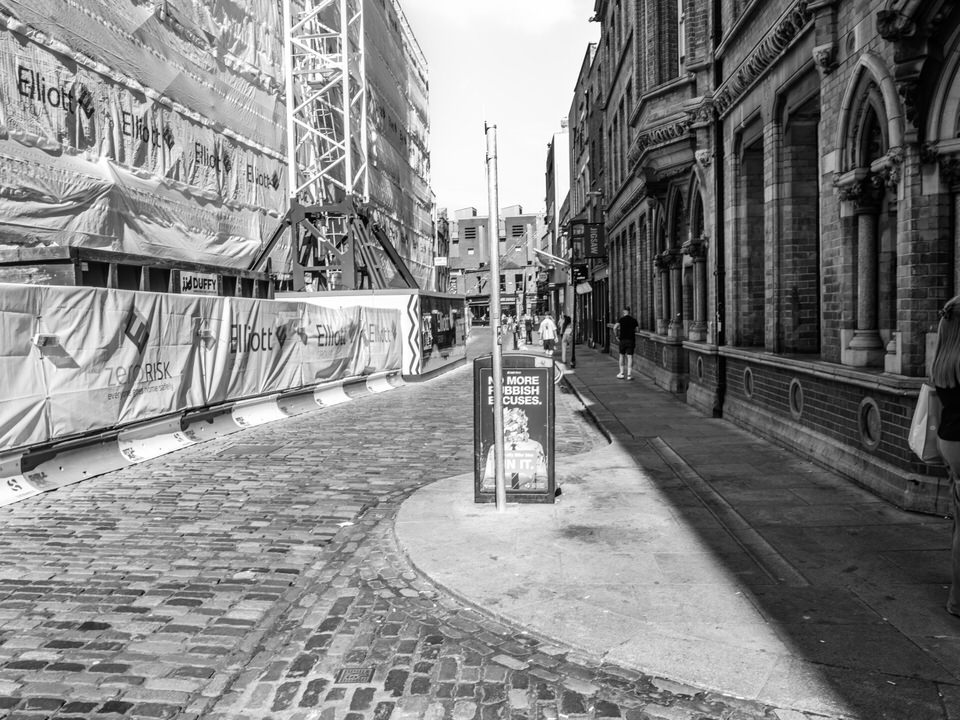
Discover why black and white photography remains a popular choice for artists, while exploring the counter-perspective of a photographer who prefers the vibrancy of colour. This piece reflects on the evolution of visual culture from the perspective of a veteran street photographer who lived through the transition from the grey landscapes of the 1950s to the modern, colour-saturated world of today.
MOBILE FRIENDLY AND MUCH FASTER
GO THERE
THE THREE FATES STATUES
I USED MY FUJIFILM GFX100RF
Presented By William Murphy - The Urban Cartographer - Fujifilm GFX100RF Photographed 27 June 2026
Templebar Without The Overpowering Colour
Author: William Murphy - The Urban Cartographer
|
28. Jun 2026
THE FUJIFILM GFX100RF OVERHEATED TODAY * In The Year 2008
* In The Year 2011
* In The Year 2017
* Henrietta Back In 2010 Beyond the Greyscale: Why We Still Reach for Monochrome In an era where our sensors capture billions of colours with clinical precision, the enduring allure of black and white photography remains one of the great paradoxes of the craft. Many practitioners argue that stripping away colour reveals the "truth" of an image—that by removing the distraction of hue, we are forced to confront the fundamental architecture of a scene: the interplay of light, shadow, texture, and form. Proponents of the monochromatic aesthetic often claim that it invites a deeper, more contemplative engagement from the viewer. Without the sensory overload of a vibrant palette, the eye is guided by composition, lead lines, and tonal contrast. It is, they suggest, a more "abstracted" version of reality, lending a sense of timelessness that colour often fails to achieve. However, for those of us who lived through the mid-twentieth century, this romanticised view can feel somewhat detached from the lived experience. Born in 1950, I grew up in a world where the monochrome medium was not an aesthetic choice—it was the pervasive, inescapable reality of our visual environment. For many, the transition to colour was not merely a technological advancement; it was a long-awaited release from the grey, often dull, visual monotony of the post-war years. Today, while I acknowledge the technical prowess required to master light and shadow in a B&W frame, I find myself firmly in the camp that treasures the vibrancy of the modern world. Colour provides context, emotion, and a sense of "now." It defines the modern urban landscape I spend my days documenting, from the rich hues of industrial steel to the subtle shifts in natural light across Dublin’s historic façades. Perhaps the preference for black and white is a luxury of those who did not have to live in it. For those of us who remember when the world truly was grey, colour is not just a feature—it is the very essence of life as we have come to know it. * Clontarf Railway Station
* Docklands Railway Station
* Malahide Railway Station
THE LEGACY CATALOG
A SELECTION OF HIGH RESOLUTION PHOTO GALLERIES
HIGH RESOLUTION PHOTOGRAPHS - TEMPLEBAR IN BLACK AND WHITE
I USED MY FUJIFILM GFX100RF
LET MISTER SCREEN DIRECT YOU
GLOBAL INDEX OF PHOTO GALLERIES
DUBLIN SOUTHSIDE
THE URBAN CARTOGRAPHER
THE THREE FATES STATUES
Templebar Without The Overpowering Colour - Presented By The William Murphy - The Urban Cartographer