Tanya Nunan Memorial Plaque At Mount St Lawrence Cemetery
The Urban Cartographer
An examination of the Tanya Nunan memorial plaque at Mount St Lawrence Cemetery, Limerick, exploring roadside shrines, the 2002 joyriding epidemic, and modern wrong-way motorway pursuits.
MOBILE FRIENDLY AND MUCH FASTER
GO THERE
MURALS BY SHANE SUTTON
SONY A7RVI
Presented By William Murphy - The Urban Cartographer - Sony A7RVI Photographed October 2026
Tanya Nunan Memorial Plaque At Mount St Lawrence Cemetery
Author: William Murphy - The Urban Cartographer
|
17. Oct 2026
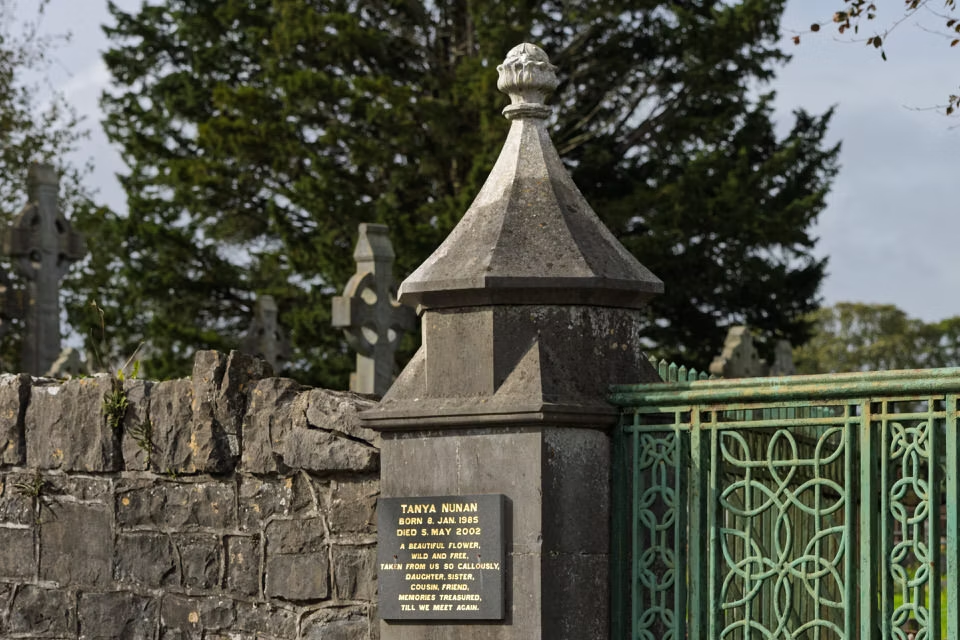
THE MOUNT ST LAWRENCE CEMETERY IN LIMERICK The Urban Cartographer Presents: Photographed By William Murphy Using A Sony A7RVI Tanya Nunan is buried in the Mount St Lawrence Cemetery Extension in Limerick, confirmed by family memorial and remembrance notices published by local press. Why the Memorial is on the Outer Wall: The placement is directly tied to the geography of the crash: Mount St Lawrence Cemetery sits along Kilmallock Road, immediately adjacent to Bengal Terrace. On the night of 5 May 2002, Tanya was struck down directly at Bengal Terrace. The outer wall/gate pillar of Mount St Lawrence Cemetery borders that exact roadway corridor. Placing the memorial plaque on the external perimeter serves as a roadside crash-site memorial, marking the precise public space where she was killed, while simultaneously affixing it to the consecrated boundary of the cemetery grounds where she rests. The Incident: On Sunday night, 5 May 2002, 17-year-old Tanya Nunan (from Moyross, Limerick) was walking with a friend along Bengal Terrace towards home. She was in the care of the Mid-Western Health Board and had missed her return deadline to a residential centre in O’Briensbridge. The Collision: A car stolen earlier that evening from a residence in Georgian Villas was being pursued by an unmarked Garda vehicle. The stolen car was travelling at speeds estimated up to 70 mph the wrong way down a one-way section. The vehicle struck Tanya and another youth at Bengal Terrace. The impact threw Tanya approximately six feet into the air and 15 feet forward, killing her instantly. The Driver and Legal Outcome: The driver, also 17, fled the scene without stopping and later claimed he did not realise someone had been killed until the following morning. He evaded arrest for several months before being apprehended in Dooradoyle, initially giving false details. He pleaded guilty at Limerick Circuit Court to dangerous driving causing death. Judge Carroll Moran sentenced him to four years' imprisonment, noting that while the crime warranted the maximum term, credit had to be given for the guilty plea—a sentence Tanya’s mother, Sharon Nunan, condemned outside court as far too lenient. Tanya’s death occurred against the backdrop of an epidemic of car theft and joyriding in Limerick during the late 1990s and early 2000s: Pervasive Antisocial Culture: "Joyriding" in housing estates across Limerick (particularly in areas like Moyross, Southill, and St Mary’s Park) was widely treated by youth gangs as entertainment and open defiance of authority. Cars were frequently stolen, raced at lethal speeds through narrow residential streets, and torched. Pursuits and Fatalities: Unmarked and marked Garda pursuits frequently escalated into catastrophic collisions involving pedestrians, innocent motorists, and joyriders themselves. Judge Moran noted during the sentencing that "Joyriding is a curse which runs the risk of killing someone." Community Trauma: The phenomenon destroyed community relations, drove public outrage over inadequate youth justice interventions and short custodial sentences, and directly contributed to the state establishing major urban regeneration initiatives in Limerick later that decade. Modern Parallels: Wrong-Way Motorway Driving The behaviour seen in 2002 has evolved into a dangerous pattern in Ireland involving organised burglary gangs: Evasion Strategy: Criminal gangs fleeing Garda checkpoints or high-speed pursuits deliberately enter motorways (such as the M7, M8, or N7) against oncoming traffic via exit ramps or roundabouts. Calculated Risk: Gangs use this lethal tactic knowing that Garda pursuit protocols (managed by the Garda National Command and Control Centre) require officers to stand down or abort high-speed pursuits immediately if pursuing the vehicle endangers oncoming public traffic. Tragic Consequences: The deadly potential of this practice was highlighted by the July 2021 collision on the N7 near Rathcoole, where three members of a burglary gang driving the wrong way in a BMW were killed in a head-on crash with a truck. Primary Motivation: 2002 (Limerick / Tanya Nunan): Localised thrill-seeking, boredom, posturing, and adolescent bravado within residential estates. 2020s (Modern Motorway Gangs): Organised criminal evasion (notably burglary networks) combined with performative social media clout. The Escalation: Shifted from chaotic youth alienation to hardened professional evasion and online exhibitionism. Geography & Environment: 2002: Urban streets, residential corridors, and narrow lanes like Bengal Terrace. 2020s: High-speed, multi-lane motorways and national dual carriageways such as the M7, N7, M9, and M50. The Escalation: A massive increase in vehicle speed, space, and kinetic energy. Tactics & Intention: 2002: Reckless evasion, weaving through neighbourhood streets, and speeding down one-way streets at 60 to 70 mph. 2020s: Deliberately weaponising safety protocols by entering motorway off-ramps head-on into 100 to 120 km/h oncoming traffic. The Escalation: Evolved from a panic response into a calculated tactic designed to force pursuing Gardaí to stand down. Vulnerability of Victims: 2002: Pedestrians walking on footpaths or crossing roads in urban communities. 2020s: Unsuspecting motorists, commercial hauliers, and families cruising at motorway speeds with virtually zero reaction time. The Escalation: Created mass-casualty risks for everyday drivers completely disconnected from the local criminal context. From Local Nuisance to Weaponised Protocol: In May 2002, the teenager driving the stolen car along Bengal Terrace was speeding the wrong way down a one-way street in a panic, trying to lose an unmarked Garda patrol before hitting Tanya. Today's criminal networks have turned that manoeuvre into a deliberate operational weapon. Knowing that Garda pursuit policy directs officers to stand down if a chase creates an intolerable public hazard, drivers plunge up motorway exit slips into oncoming traffic. What began as reckless corner-cutting has become institutional extortion: "If you follow me, I will trigger a mass-casualty pile-up." Kinetic and Technological Escalation: On a modern motorway like the M7 or N7, closure speeds between two vehicles travelling in opposite directions frequently exceed 200 to 240 km/h. The resulting impacts resemble high-explosive detonations rather than conventional road crashes, causing catastrophic engine fires, instant fatalities, and severe trauma to innocent lorry drivers or motorists travelling in the overtaking lane. Social Amplification and Online Subcultures: In the late 1990s and early 2000s, joyriding in Moyross or Southill was an insular street phenomenon. The audience was restricted to whoever happened to be standing on the corner or the green. Modern offenders livestream wrong-way runs on TikTok, Telegram, and Instagram, turning fatal endangerment into competitive digital performance art. The desire to outdo rival crews across Dublin, Kildare, and Limerick accelerates the willingness to take suicidal risks. Sentencing and Legal Paralysis: Sharon Nunan's anguish outside Limerick Circuit Court in 2002—watching a teenager receive a four-year sentence for killing her daughter—mirrors current public frustration. Decades later, repeat offenders frequently accumulate dozens or hundreds of road traffic and theft convictions while remaining active on the roads. Compounding this is the institutional paralysis surrounding pursuit guidelines and independent policing oversight (GSOC/Fiosrú). While designed to prevent lethal high-speed chases, these mechanisms have inadvertently created an operational loophole that organised gangs ruthlessly exploit. The tragedy of Bengal Terrace was treated in 2002 as a localised symptom of an urban crisis. Two decades later, the exact same impulse—using a stolen vehicle as an instrument of evasion and adrenaline—has migrated onto national motorway networks, endangering anyone travelling on an Irish road at night. At Bengal Terrace, the car travelled at roughly 70 mph through a confined street. The devastation was horrifying—throwing a teenager 15 feet—yet the collision radius was limited to a single neighbourhood intersection. Ireland (North and South): Northern Ireland: Unofficial plaques often carry strong political or paramilitary overtones (e.g., republican or loyalist memorial tablets affixed to walls, street corners, or housing estate gables). Local authorities and road services frequently refrain from removing them due to community friction and safety risks. Civic Tolerance in the Republic: Councils and religious cemetery trusts rarely enforce by-laws against dignified, permanent roadside plaques unless roadworks, visibility hazards, or complaints from property owners arise. Affixing Tanya's plaque to the exterior cemetery wall effectively blurs public street infrastructure with sacred grounds, giving it long-term community protection. United Kingdom: Similar tendencies exist, ranging from roadside floral tributes ("ghost bikes" for cyclists) to brass plaques attached without formal planning permission to park benches, trees, or bridge railings. UK highway authorities generally operate a "grace period" policy: temporary tributes are tolerated for 30 days to a year before being quietly removed or relocated, whereas permanent stone fixtures on council structures require formal permissions or risk removal during highway maintenance. International Context: United States & Latin America: The tradition of descansos (roadside markers/crosses) is widespread. Several US state Departments of Transportation have formalised this by installing standardised memorial signs ("Please Drive Safely: In Memory of...") to replace haphazard roadside crosses. Southern Europe: In Greece (kandylakia—small roadside shrines housing icons and oil lamps) and Italy, roadside shrines are culturally entrenched, recognised, and maintained by both families and passers-by.
THE TANYA NUNAN STORY
The Plaque, Burial, and Location
Tanya Nunan and the 2002 Hit-and-Run
Joyriding and Stolen Cars in Limerick
The Core Differences: 2002 Joyriding vs. Contemporary Motorway Gangs
How the Cycle Repeated in a Darker Form
Unofficial Memorial Plaques: Ireland, the UK, and Beyond
Some Related Topics
[[shortcode.limerick.0004]]
THE LEGACY CATALOG
Examples Of Waterford Walls Murals
ABOUT THE CEMETERY
SONY A7RVI
LET MISTER SCREEN DIRECT YOU
GLOBAL INDEX OF PHOTO GALLERIES
DEANSGRANGE CEMETERY
THE URBAN CARTOGRAPHER
MURALS BY SHANE SUTTON
Tanya Nunan Memorial Plaque At Mount St Lawrence Cemetery - Presented By The William Murphy - The Urban Cartographer