My First Solo Visit To Limerick And Hotel Rooms
The Urban Cartographer
A personal retrospective on navigating Limerick’s evolving hotel landscape from 2014 to 2026—from the lively quaysides of The Pier to the Georgian Quarter—exploring shifting city accommodation trends, mid-week travel dynamics, and quirky street photography discoveries.
MOBILE FRIENDLY AND MUCH FASTER
GO THERE
LIMERICK 2018 PHOTO COLLECTIONS
SONY NEX-7
Presented By William Murphy - The Urban Cartographer - Sony VG10E Camcorder Photographed June 2014
My First Solo Visit To Limerick And Hotel Rooms
Author: William Murphy - The Urban Cartographer
|
29. Aug 2026
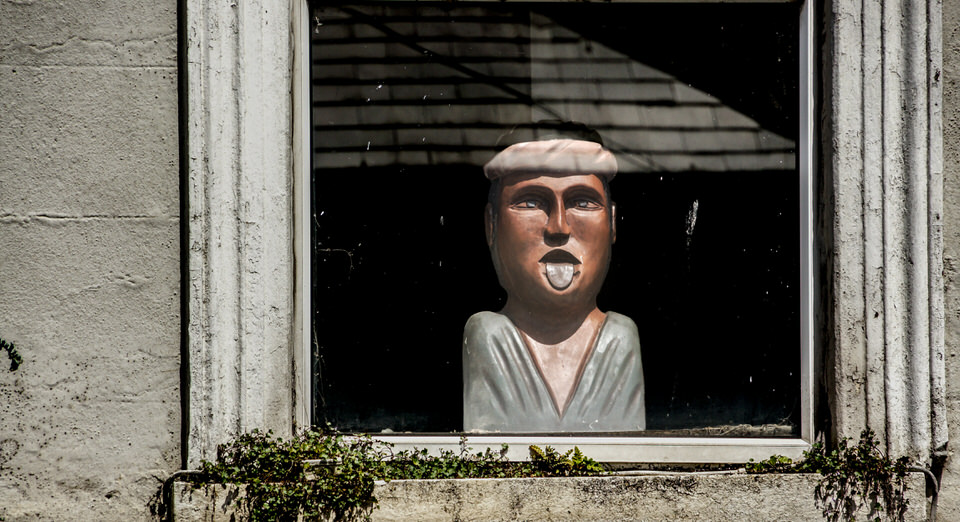
I USED A SONY VG10E CAMCORDER AND A NEX-7 Behind the weathered sill of an unpainted window frame in June 2014, a carved Māori figure stared out at the street with tongue firmly protruded. In a city where Munster rugby and the mythos of the All Blacks at Thomond Park rival traditional scripture, it initially looked like a bespoke domestic shrine to the haka. The accompanying note, however, revealed classic local deadpan humour: “They have gone back to New Zealand and left me all alone in this derelict building in Limerick.” An abandoned cultural icon turned accidental permanent resident, holding down the fort with a fierce whetero while the city carried on below. This is a Māori tekoteko or carved figure (or a replica thereof) depicting a stylised human form performing the whetero (the deliberate protruding of the tongue). Spotted in a Limerick window in June 2014: a carved Māori figure performing a defiant whetero. In most Irish towns, a bust in a front window might suggest an eclectic souvenir; in Limerick, where rugby is the undisputed civic religion and the ghost of the All Blacks at Thomond Park never quite fades, it reads like a domestic shrine to the haka. In Limerick, where Munster rugby genuinely rivals any traditional faith, a Māori figure staring out of a front window carrying out a fierce whetero (the defiant tongue-out challenge of the haka) makes perfect local sense. The 1978 Legend: Munster’s historic 12–0 victory over the touring All Blacks at Thomond Park remains the defining benchmark of Irish rugby mythology. The 2008 Rematch: When Munster faced the All Blacks to open the rebuilt Thomond Park in 2008, Munster’s squad of New Zealanders (Rua Tipoki, Doug Howlett, Lifeimi Mafi, and Jeremy Manning) famously performed their own haka in response, cementing the cultural cross-pollination into Limerick lore. Domestic Shrines: Placing an iconic symbol of Māori warrior spirit in a front window functions as a cheeky household emblem—a domestic salute to Thomond Park's greatest rivalries and Munster's deepest rugby connections. My first visit solo visit, with a photographic equipment, to Limerick was in June 2014 In October I plan to Visit Limerick and am taking a huge gamble with the weather as it is most likely that it will rain. However, when I first visited in 2014 an 2015 in June the rain was so persistent that my photography was very constrained especially as my Sony NEX-7 and NEX-5 as well as the VG10E camcorder were the opposite of being weather proof. Finding a Bed in Limerick: 2014 to 2026 Working through a twelve-year backlog of Limerick street photographs is a reminder of how much the city’s built environment has evolved—and how drastically its hotel landscape has shifted. The Mid-Market Squeeze: The Story of Pery’s That pushed me towards Pery’s Hotel on Glentworth Street. Pery’s was a traditional, long-standing institution operating since the Victorian era, offering modest, no-frills value. During my stays, the operational atmosphere had visibly shifted; while desk staff denied any formal management upheaval, the property was clearly transitioning away from the standard guest trade. Like several independent mid-tier hotels across Ireland, Pery’s pivoted its business model to guaranteed institutional block bookings—including student accommodation agreements (such as international study abroad programmes) and broader state accommodation contracts. The Wider Impact on Irish City-Centre Rates The Evolution: Absolute to No. 1 Pery Square RUGBY IS A RELIGION IN LIMERICK
* In The Year 2008
* In The Year 2011
* In The Year 2017
* Henrietta Back In 2010
Rugby Is A Religion In Limerick
The city’s sporting folklore is inextricably bound to New Zealand rugby
My First Solo Visit To Limerick
THE LEGACY CATALOG
HIGH RESOLUTION PHOTOGRAPHS PLUS MAP
SONY NEX-7
LET MISTER SCREEN DIRECT YOU
GLOBAL INDEX OF PHOTO GALLERIES
HENRY MOORE SCULPTURE AT TRINITY
THE URBAN CARTOGRAPHER
LIMERICK 2018 PHOTO COLLECTIONS
My First Solo Visit To Limerick And Hotel Rooms - Presented By The William Murphy - The Urban Cartographer