Modern High-Spec Infill Built on a Double Derelict Site
The Urban Cartographer
How the redevelopment of 12–13 Dorset Street Upper turned strict Dublin planning guidelines and severe traffic noise constraints into high-specification selling points, making a virtue out of necessity on a former double derelict site.
MOBILE FRIENDLY AND MUCH FASTER
GO THERE
PARKS AND GARDENS
FUJIFILM GFX100RF
Presented By William Murphy - The Urban Cartographer - Fujifilm GFX100RF with Godox Flash iT30 Pro F Photographed 4 August 2026
Modern High-Spec Infill Built on a Double Derelict Site
Author: William Murphy - The Urban Cartographer
|
04. Aug 2026
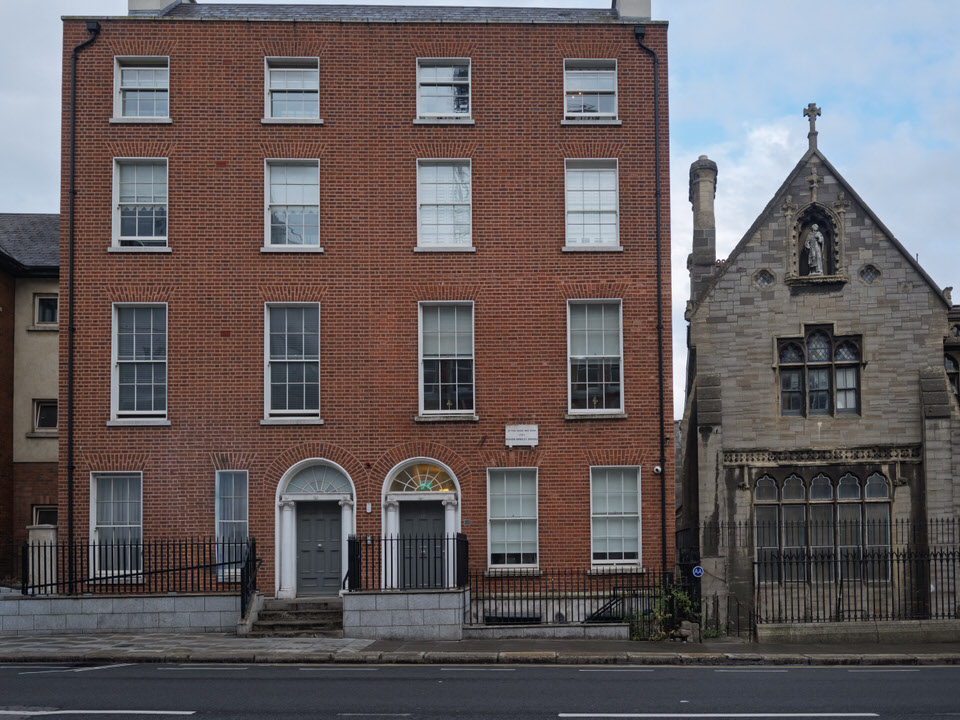
CLAIMS REGARDING HISTORIC RELEVANCE ARE INACCURATE * January
* February
* March
* April
* May
* June The narrative around 12–13 Dorset Street Upper is a classic Dublin urban myth born out of street renumbering and decades of dereliction. For years, local lore held that No. 13 was the historic birthplace of 18th-century playwright Sir Richard Brinsley Sheridan (born 1751). In reality, historical mapping and Dublin's extensive 19th-century street renumbering proved that Sheridan's actual birthplace was further up the street at what is now No. 44 Dorset Street Upper. By the time the redevelopment took place, 12–13 was not a preserved historic gem; it was little more than a eyesore consisting of a double derelict site and the shuttered, deteriorating carcass of The Moy pub. Why the High Standard if it wasn't Historic? Making a Virtue Out of Necessity Facade Design & Street Alignment: Planners demanded that the new build repair the visual scar left by the double derelict plot and respect the vertical proportion of the surrounding streetscape. Rather than an expensive design burden, the developer used the resulting crisp brick facade and traditional window alignment to project an image of luxury architectural prestige. Acoustic & Thermal Engineering: Living directly on one of Dublin's noisiest traffic corridors required heavy-duty acoustic insulation, triple-glazed units, and mechanical ventilation just to make the living spaces habitable. By choosing top-tier components to meet these environmental baselines, the developer easily rebranded standard compliance as "high-specification quiet urban living." Density & Floor Layouts: Strict planning limits on overall building footprint meant capping the layout at two apartments per floor. What was fundamentally a spatial constraint imposed by a narrow infill plot was turned into an exclusive selling point: low-density, quiet floor plates offering enhanced personal privacy. By taking strict Dublin City Council requirements and the harsh physical realities of the Dorset Street corridor and leaning into them, the project successfully converted basic planning survival into a high-spec narrative. Today, 4 August, I decided to devote time to resolving configuration issues with my Fujifilm GFX setup. I purchased a Godox iT30 Pro for Fuji cameras and updated the GFX100RF to its latest firmware. I chose the Bethesda Place complex and the perimeter of the Hugh Lane Gallery as my testing grounds. As soon as I arrived at Parnell Square, the sky opened up. I quickly learned that using direct fill-flash in heavy rain is problematic: the flash illuminates foreground raindrops into harsh, out-of-focus white specks across the frame. Additionally, the in-camera geotagging logged only my starting location and my exit onto Dorset Street, missing the intermediate laneway points. Despite being advised against pairing the compact Godox with the larger GFX system, the combo performed remarkably well overall. However, because my dealer noted a lack of suitable dedicated risers, navigating the lens hood geometry required specific workarounds: Lens Hood Geometry Note: On the GFX100RF, the lens-barrel filter adapter and hood assembly form an integral part of the weather-sealing system over the telescoping front element. Stripping that back just to clear a low-slung mini flash compromises the weather protection. Handling & Coverage Solutions Distance Shots (Beyond 1.5 m / 5 ft): The flash trajectory clears the top edge of the hood cleanly, delivering uniform illumination across the frame. Close-Up / Macro Range (Under 1 m / 3 ft): Because the iT30Pro head sits low relative to the hot shoe, the top lip of the weather-sealed hood casts a slight shadow at the bottom edge of the frame. Built-in Wide Panel (W Mode): Flipping down the iT30Pro’s built-in wide-angle diffuser spreads the light beam out. At moderate close-up distances, this softens the shadow edge enough to render it invisible in the frame. Godox TR-F Riser: If shooting close-up subjects or street portraits indoors where direct flash at tight distances is essential, adding a small Godox TR-F TTL hot shoe riser raises the flash head by 30 mm. This completely clears the hood rim at all distances while preserving full TTL and HSS communication. That dealer advice comes down to a tiny mechanical detail: the GFX100RF hot shoe uses standard Fujifilm TTL contacts, but its top-plate design and fixed-lens body profile can make generic or off-the-shelf hot-shoe extensions sit awkwardly or fail to lock down completely flat. While third-party risers like the Godox TR series pass through standard Fuji TTL signals, some camera shop staff steer users away from them on compact fixed-lens bodies because a high-profile riser introduces extra leverage onto the hot shoe mount—potentially straining the top plate if bumped during active street shooting. If you decide to clear that 35mm lens hood rim without adding vertical strain to the camera hot shoe, here are the most effective alternatives: Fuji Off-Camera TTL Cord (TTL Extension Cable): Using a dedicated TTL cord (or standard Canon OC-E3 compatible cord, which matches the Fuji contact pattern) lets you handhold the flash off-camera or mount it to a tiny side bracket. This completely bypasses the hood shadowing issue without putting leverage on the camera top plate. Godox Wireless Transmitter (X3 / X2T-F): Mounting a micro wireless trigger on the hot shoe and holding the iT30 Pro off-camera in your off hand gives you complete freedom over light direction, absolute clearance over the fixed-lens hood, and full TTL/HSS support. Flip-Down Wide Panel (W-Mode): For quick street work in the field, sticking with the built-in wide diffuser remains the cleanest zero-hardware solution to blend out lower-edge lens hood shadows. * Clontarf Railway Station
* Docklands Railway Station
* Malahide Railway Station
THE 2025 LEGACY CATALOG
The Derelict Reality vs. The Sheridan Myth
Field Testing Equipment - Raindrops & Fill-Flash
The Dealer Advice
Railway Stations
Recommended Photo Galleries
My Visits To Waterford
HIGH RESOLUTION PHOTOGRAPHS PLUS MAP
FUJIFILM GFX100RF
LET MISTER SCREEN DIRECT YOU
GLOBAL INDEX OF PHOTO GALLERIES
HENRY MOORE SCULPTURE AT TRINITY
THE URBAN CARTOGRAPHER
PARKS AND GARDENS
Modern High-Spec Infill Built on a Double Derelict Site - Presented By The William Murphy - The Urban Cartographer