A Vibrant Mesoamerican Dialogue At Trinity College
The Urban Cartographer
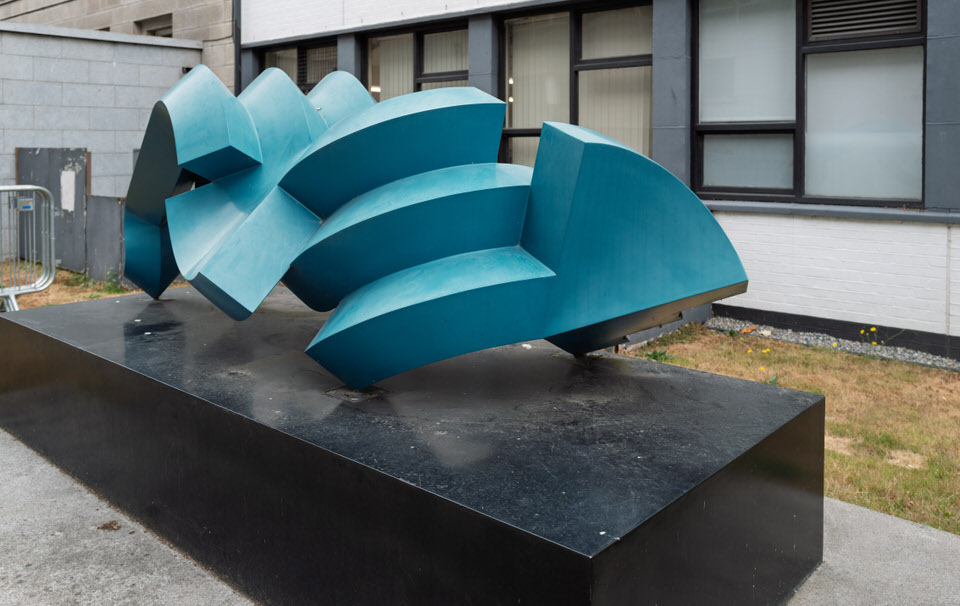
An architectural and art-historical review of Sebastián’s bright turquoise public sculpture Chac Mool at Trinity College Dublin, comparing its geometric steel form with Henry Moore’s biomorphic bronze Reclining Connected Forms nearby.
MOBILE FRIENDLY AND MUCH FASTER
GO THERE
HENRY MOORE SCULPTURE AT TRINITY COLLEGE
LEICA Q3
Presented By William Murphy - The Urban Cartographer - Leica Q3 - It Attracted Much Attention Today Photographed 27 July 2026
A Vibrant Mesoamerican Dialogue At Trinity College
Author: William Murphy - The Urban Cartographer
|
28. Jul 2026
MY TRINITY COLLEGE PUBLIC ART TRAIL * In The Year 2008
* In The Year 2011
* In The Year 2017
* Henrietta Back In 2010 Sebastián’s Chac Mool: A Vibrant Mesoamerican Dialogue at Trinity College Positioned near the Lincoln Gate entrance to Trinity College Dublin, Chac Mool (2002) by the renowned Mexican sculptor Sebastián (born Enrique Carbajal González) is a striking, steel-built intervention in the urban landscape. Formally unveiled on 18 September 2015 by Provost Dr Patrick Prendergast and the Mexican Ambassador to Ireland, Carlos García de Alba Zepeda, the piece was presented to mark 40 years of Mexican-Irish diplomatic relations. It is one of four public sculptures generously gifted to Ireland by the artist. Born in Chihuahua in 1947, Carbajal adopted the moniker "Sebastián" in homage to Sandro Botticelli’s depiction of the martyred Saint Sebastian. Today, he is internationally celebrated for his monumental geometric abstractions constructed from steel and concrete. The Evolutionary Lineage of Form The Origins of the Reclining Form The term Chac Mool refers to a distinct style of pre-Columbian Mesoamerican statue discovered across central Mexico and Yucatan temple sites. Serving as a sacred intermediary between mortals and deities, the figure traditionally sits in a reclining posture—knees drawn up, resting on its elbows, with its head turned sharply outward. In ancient frescoes and codices, the vivid turquoise blue chosen by Sebastián signified members of the priesthood and sacred rituals. While historians continue to study their exact ritual role, these figures are widely understood as altars for sacrificial offerings or memorials to fallen warriors. Chac Mool vs Reclining Connected Forms: A Campus Comparison Having both works on the Trinity College campus offers a fascinating lesson in art history. In the late 1920s, Henry Moore was profoundly inspired by a plaster cast of a Mayan Chac Mool he studied in Paris. That encounter led directly to his seminal 1929 Hornton stone Reclining Figure—a milestone he cited as the primary catalyst for his lifelong exploration of the reclining form. His 1969 bronze piece in Library Square, Reclining Connected Forms, represents the culmination of that journey, abstracting the body into smooth, bone-like shells and internal voids.
Sebastián approaches the very same archetype from a contrasting perspective. Where Moore softens stone and bronze into rolling, landscape-like curves, Sebastián uses folded, sheet-steel geometry and high-saturation turquoise paint. His Chac Mool translates an ancient sacred posture into a sharp, structural idiom. Standing at Trinity College, both sculptures establish an ongoing artistic dialogue across decades, bridging ancient Mesoamerica, 20th-century British modernism, and contemporary Mexican constructivism. * Clontarf Railway Station
* Docklands Railway Station
* Malahide Railway Station Today I received A Godox iT30Pro L for my Leica Q3 and I also received A Godox iT30Pro S for my Sony A1 II and Sony A7RVI. I will discuss the Leica version here. The Godox iT30Pro L is Godox's ultra-compact, dedicated TTL mini speedlite designed for Leica camera systems. Weighing a mere 120 g, it provides a portable, modern lighting solution for Leica M, Q, and SL series bodies without disrupting the balanced ergonomics of rangefinders or compact cameras. The Pros The Cons & Things to Be Aware Of Recommended Operational Settings Mount and Lock to Hot Shoe: Mechanical setup.
Turn off both camera and flash. Press and hold the quick-release lock button on the iT30Pro L base, slide the foot fully into the Leica hot shoe until seated, and release the button to secure the pin mechanism. Power On and Select Exposure Mode: Initial settings.
Power on the flash using the dedicated side power switch. Tap the top-left mode icon on the touchscreen to toggle between TTL (for automatic metering) or M (for manual power control). Adjust Diffuser Position: Light quality setup.
For focal lengths wider than 35 mm or close-up subjects, slide the side WN switch to "W". This drops the internal diffuser in front of the flash tube to broaden coverage and soften shadows. Configure Exposure Compensation / Power: Fine-tuning output.
In TTL mode, use the physical rear scroll wheel to dial in -1.0 EV FEC for natural fill. In Manual mode, spin the dial to set your desired output fraction (e.g. 1/32). Engage Touchscreen Lock: Essential step.
Long-press the lock icon on screen or press the quick-lock function to lock the touchscreen interface. This prevents accidental setting changes while shooting on location. While the Godox iT30Pro L retails brand new for ~€100 – €110, official Leica-branded speedlites command a substantial price premium. Pricing Context (EU Market) Key Reasons for the Leica Price Premium
THE LEGACY CATALOG
CHAC MOOL IN BLUE BY SEBASTIAN PHOTOGRAPHED USING A LEICA Q3
Chac Mool vs Reclining Connected Forms: A Campus Comparison
Railway Stations
Recommended Photo Galleries
Our Equipment Choices
Technical Specifications at a Glance
Technical Review: Pros, Cons & Forum Insights
Ideal Settings & Step-by-Step Setup
Step-by-Step Instructions
Why Are Official Leica-Branded Flashes So Expensive?
HIGH RESOLUTION PHOTOGRAPHS PLUS MAP
LEICA Q3
LET MISTER SCREEN DIRECT YOU
GLOBAL INDEX OF PHOTO GALLERIES
HENRY MOORE SCULPTURE AT TRINITY
THE URBAN CARTOGRAPHER
HENRY MOORE SCULPTURE AT TRINITY COLLEGE
A Vibrant Mesoamerican Dialogue At Trinity College - Presented By The William Murphy - The Urban Cartographer