A Bugs Bunny Mural By ADRE
The Urban Cartographer
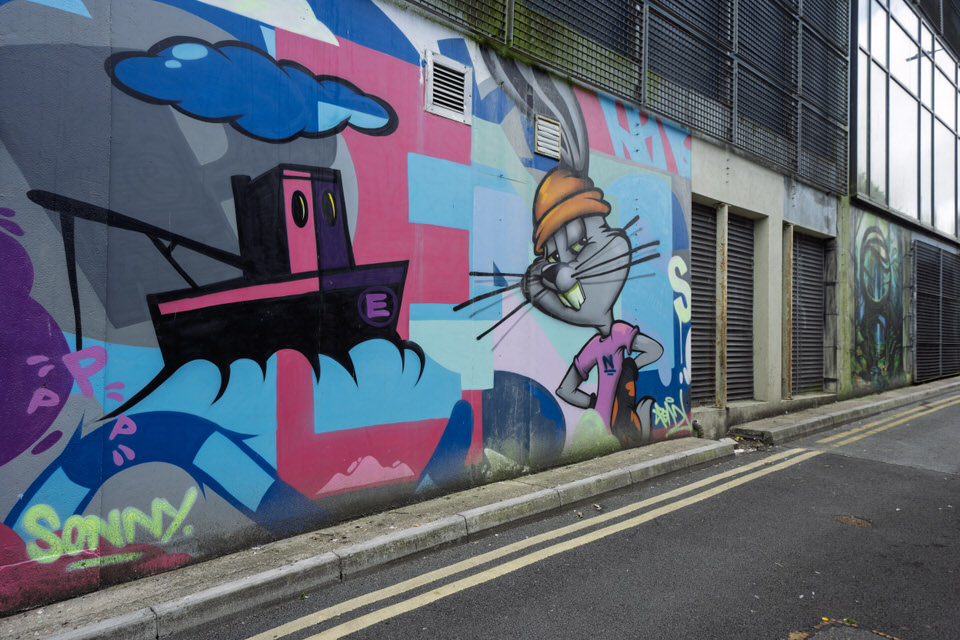
Explore the vibrant Bugs Bunny and tugboat mural by Irish street artists ADRE and Sonny at Glasshouse Lane, Waterford. A playful, cartoon-inspired graffiti jam blending pop-art geometry with classic animation subversion.
MOBILE FRIENDLY AND MUCH FASTER
GO THERE
PARKS AND GARDENS
SONY A7RVI
Presented By William Murphy - The Urban Cartographer - Sony A7RVI Photographed August 2026
A Bugs Bunny Mural By ADRE
Author: William Murphy - The Urban Cartographer
|
17. Aug 2026
ON VIEW AT GLASS HOUSE LANE * In The Year 2008
* In The Year 2011
* In The Year 2017
* Henrietta Back In 2010 Glass House Lane, Waterford | 13 August 2025 This playful, cartoon-inspired collaboration marks a distinct shift in tone for Glasshouse Lane, highlighting an energetic crew dynamic and a lighthearted approach to urban art. Artwork Overview & Artists The Character (Bugs Bunny): The stylised, beanie-wearing Bugs Bunny on the right is the work of Irish graffiti and street artist ADRE (@adre_letters). ADRE is widely recognised across the national scene for his crisp letterforms and subversive, contemporary twists on classic Looney Tunes iconography. The Background & Tugboat: The abstract graphic forms, floating cloud, and geometric pink-and-blue tugboat on the left were created by Sonny (@sonny_graffiti), signed off with a vibrant green "SONNY" handstyle in the lower corner. The Style: The mural is an exemplary collaborative cartoon jam. Moving away from somber or photorealistic themes, the artists combine bold pop-art geometry with classic street-character illustration, transforming a standard concrete wall partition into a vibrant visual narrative. Cataloguing every piece and identifying each artist along Glass House Lane was an exhaustive process. Attribution in underground spaces is notoriously fluid, with conflicting accounts that require careful cross-referencing. For instance, while one mural bearing the tag Novice was locally attributed to an Irish writer, stylistic signatures and records confirm it as the work of the contemporary French visual artist of the same name. Glass House Lane proved to be an exceptional discovery. Whoever dismissed this alleyway as "poor quality" simply confused the raw, unregulated nature of a communal graffiti wall with a lack of artistic merit. In reality, the lane preserves a vibrant, authentic tension between international fine-art muralism and grassroots street culture. The "Off-Grid" Fringe During the annual Waterford Walls Festival, the official programme operates on a tightly structured framework: Curated Placement: The festival pairs invited global artists with prominent, large-scale commercial facades. Formal Approvals: Concept designs require clearance through local council oversight, property owner agreements, and heritage guidelines. Extensive Logistics: Production relies on heavy machinery, cherry pickers, commercial paint sponsorships, and strict completion windows. Glass House Lane functions as the festival's spontaneous fringe. It is an open-source, collaborative canvas. Once visiting international artists finish their commissioned multi-storey murals for the day, they head down the lane with their remaining spray cans to join local writers for impromptu paint jams. Free from commercial briefs, bureaucratic sign-offs, and curatorial guidelines, artists paint side-by-side in pure, unregulated creative freedom. The works along the lane represent three distinct disciplines within contemporary urban art: Rems & Kyser: Precision-driven Wildstyle lettering. Executing balanced interlocking letterforms, crisp outer-glow keylines, and uniform 3D drop-shadows across jagged surfaces demands years of motor discipline and muscle memory. Staylo, Adre, & Sonny: Energetic character illustration. Staylo’s "sticker pack" arrangement delivers a sharp pop-art subversion of commercial iconography, converting weathered brickwork into a dense visual anthology. Ephemeral Value Because Glass House Lane is an unsanctioned, dynamic space, it is fundamentally transient. These layers will eventually be buffed or claimed by the next wave of visiting artists. Documenting the lane captures a distinct, unvarnished chapter in Waterford’s underground visual history—one that exists entirely beyond the margins of the official festival map. In the past I was told that Glass House Lane only featured "unapproved" or "poor quality" street art but I visited a few days ago and it featured some quality work. I have photographed all the art that is on display and after further research I will identify and discuss the art and artists. Street Art and Setting The Street Art Transformation: Historically treated as an unregulated tagging alley, Glass House Lane has evolved through initiatives like the Waterford Walls festival and independent muralists into a recognised canvas for high-caliber street art, large-scale character work, and stencil pieces. Urban Boundaries: The lane sits in The Glen quarter of Waterford City, running along the flank of the now-vacant former Aldi retail premises. Derelict Structures: The opposite side consists of boarded-up vernacular townhouses, overgrown boundary walls, and vacant brownfield plots illustrating Waterford’s historic inner-city urban decay. What They Are: Despite appearing like weathered copper pennies, these are crimped metal bottle caps (crown corks) embedded into the black bitumen sealant used to seal asphalt cracks. Why They Are There: This is a classic form of guerrilla urban intervention (similar to street kintsugi or pavement mosaics). While the bitumen crack sealant was still hot and pliable, bottle caps were pressed rim-down or face-down into the tar line. Visual Clues: The scalloped, 21-crimp fluted edge is visible on each disc, along with a painted yellow cap preserved near the bend. Traffic wear and environmental grime have stripped the paint and oxidised the underlying tinplate/steel, giving them a tarnished, coin-like appearance. Name and History The Penrose Glassworks: The lane takes its name from the original glasshouse founded in 1783 by Quaker merchants George and William Penrose. Birth of Waterford Crystal: This site, established between Anne Street and Glass House Lane, marked the genesis of Waterford's world-renowned flint glass industry. Quaker Heritage: The lane formed part of Waterford's 18th-century industrial Quaker quarter, situated alongside allied trades on Penrose Lane, Dyehouse Lane, and Meeting House Lane. A Waterford Civic Trust blue plaque on Glass House Lane commemorates the Penrose brothers. Derelict Sites & Future Plans Derelict Site Levies: The derelict domestic plots opposite are listed under municipal derelict sites monitoring to compel private redevelopment or facilitate future compulsory acquisition for urban infill housing. Zabou (France) VILE (Portugal) TELMO MIEL (Netherlands) MR CENZ (UK) MR.DHEO (Portugal) Fintan Magee (Australia) Dan Kitchener / DANK (UK) L7MATRIX (France/Brazil) Fio Silva (Argentina) DAN FERRER (Spain) CONSE (Spain) SPEKER (Italy) & SILYME (Italy) NOL (Netherlands) ADOR (France) KMG (Scotland) WRN (Brazil) & MARIE (Brazil) DAN LEO (Ireland) ROB HILKEN (Northern Ireland) SHANE HA (Ireland) RASK (Ireland) SOAK (Ireland) STAYLO (Ireland) MUL (UK/Ireland) OMIM (Ireland), NOVICE (Ireland), RO (Ireland), NIALLOL (Ireland), LAIDBACK (Ireland) EMBER (Ireland), KONE (Ireland), KAROL (Ireland), HMC (Ireland), ANDYMC (Ireland) Ailbhe Larsen (Ireland) * Clontarf Railway Station
* Docklands Railway Station
* Malahide Railway Station
THE LEGACY CATALOG
Bugs Bunny by ADRE
Glass House Lane Gallery
About The Art And The Artists
About The Location
The Road Surface Discs
Street Name And History
International Artists
Irish & Northern Irish Artists
Photographic Field Strategy
Railway Stations
Examples Of Waterford Walls Murals
HIGH RESOLUTION PHOTOGRAPHS PLUS MAP
SONY A7RVI
LET MISTER SCREEN DIRECT YOU
GLOBAL INDEX OF PHOTO GALLERIES
HENRY MOORE SCULPTURE AT TRINITY
THE URBAN CARTOGRAPHER
PARKS AND GARDENS
A Bugs Bunny Mural By ADRE - Presented By The William Murphy - The Urban Cartographer