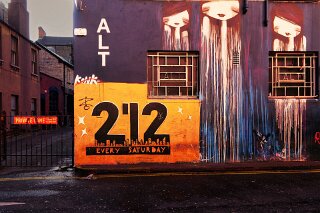
I PHOTOGRAPHED HER IN 2013 USING A SONY NEX-7
ANDREWS LANE THEATRE BECAME A MUSIC VENUE 2007-2016 [PHOTOGRAPHED OCTOBER 2013 USING A SONY NEX-7]
Urban Character & Street Art: During the late 20th and early 21st centuries, the laneway became a back-corridor for Dublin’s music and hospitality scenes (flanked by rehearsal rooms, venue rear entrances, and instrument shops like Music Maker nearby). Prior to modern redevelopment, its brick walls and corrugated hoardings were canvases for Dublin street artists, including notable pieces by Maser.
The History of the Andrews Lane Theatre
The Andrews Lane Theatre (often abbreviated as ALT) was established in August 1989 by private theatrical and commercial interests without state funding. The venue was officially opened on 31 August 1989 by the legendary stage actress Maureen Potter.
Designed to provide an intimate performance space in the city centre, the building contained two distinct performance areas:
A main auditorium seating 220 patrons.
A smaller studio space upstairs with an 80-seat capacity.
Throughout the 1990s and early 2000s, the theatre played an important role in Dublin’s independent performing arts ecosystem. It hosted productions by emerging and established Irish playwrights (including Jimmy Murphy, Dolores Walshe, Deirdre Kinahan, and Colin Teevan), alongside comedy showcases, experimental fringe plays, and international touring acts.
Why It Ceased and What Replaced It
1. Why Did It Cease?
Theatre Closure (2007): By the mid-2000s, escalating operating overheads, fierce competition from state-subsidised institutions, and shifting commercial real estate dynamics made operating an independent, unsubsidised theatre financially unsustainable. In April 2007, owner-producer Pat Moylan announced the closure of theatrical operations.
Nightclub & Gig Venue Transition (2007–2016): Rather than standing idle, the venue was converted into a live music venue and nightclub known as ALT (and frequently hosted nights like The Lost Society and various dance/indie promotions).
Sale & Redevelopment (2016–2018): In April 2016, the building was sold for around €4.4 million to property developers planning a high-density "compact" hotel. Despite local protests over the continued loss of cultural spaces in Dublin, planning permission was granted, and the former theatre building was completely demolished in 2018.
2. What Replaced It?
Wren Urban Nest
The site was redeveloped into Wren Urban Nest, a 137-room sustainable micro-boutique hotel built with a timber-frame modular structure that opened in 2021.
In a nod to the location’s cultural heritage, the hotel’s ground-floor bar and casual restaurant was christened ALT.
History of the Laneway (St Andrew’s Lane)
St Andrew’s Lane is a narrow, kinked passage connecting Trinity Street to Exchequer Street, running parallel between Dame Street and Dame Lane.
Medieval & Early Origins: The lane is named after St Andrew’s Parish, whose historic round church and ancient assembly ground (Thingmote/Thingmount—the Viking parliamentary assembly mound) stood nearby near College Green and Suffolk Street.
18th and 19th Century Industrial Yard: Cartographic records from John Rocque (1756) and later Ordnance Survey maps show the laneway evolving through several layouts, historically functioning as service mews, coach houses, workshops, and bottling stores serving properties on Dame Street and Exchequer Street.
Urban Character & Street Art: During the late 20th and early 21st centuries, the laneway became a back-corridor for Dublin’s music and hospitality scenes (flanked by rehearsal rooms, venue rear entrances, and instrument shops like Music Maker nearby). Prior to modern redevelopment, its brick walls and corrugated hoardings were canvases for Dublin street artists, including notable pieces by Maser.
The History of the Andrews Lane Theatre
The Andrews Lane Theatre (often abbreviated as ALT) was established in August 1989 by private theatrical and commercial interests without state funding. The venue was officially opened on 31 August 1989 by the legendary stage actress Maureen Potter.
Designed to provide an intimate performance space in the city centre, the building contained two distinct performance areas:
A main auditorium seating 220 patrons.
A smaller studio space upstairs with an 80-seat capacity.
Throughout the 1990s and early 2000s, the theatre played an important role in Dublin’s independent performing arts ecosystem. It hosted productions by emerging and established Irish playwrights (including Jimmy Murphy, Dolores Walshe, Deirdre Kinahan, and Colin Teevan), alongside comedy showcases, experimental fringe plays, and international touring acts.
Why It Ceased and What Replaced It
1. Why Did It Cease?
Theatre Closure (2007): By the mid-2000s, escalating operating overheads, fierce competition from state-subsidised institutions, and shifting commercial real estate dynamics made operating an independent, unsubsidised theatre financially unsustainable. In April 2007, owner-producer Pat Moylan announced the closure of theatrical operations.
Nightclub & Gig Venue Transition (2007–2016): Rather than standing idle, the venue was converted into a live music venue and nightclub known as ALT (and frequently hosted nights like The Lost Society and various dance/indie promotions).
Sale & Redevelopment (2016–2018): In April 2016, the building was sold for around €4.4 million to property developers planning a high-density "compact" hotel. Despite local protests over the continued loss of cultural spaces in Dublin, planning permission was granted, and the former theatre building was completely demolished in 2018.
2. What Replaced It?
Wren Urban Nest
The site was redeveloped into Wren Urban Nest, a 137-room sustainable micro-boutique hotel built with a timber-frame modular structure that opened in 2021.
In a nod to the location’s cultural heritage, the hotel’s ground-floor bar and casual restaurant was christened ALT.
History of the Laneway (St Andrew’s Lane)
St Andrew’s Lane is a narrow, kinked passage connecting Trinity Street to Exchequer Street, running parallel between Dame Street and Dame Lane.
Medieval & Early Origins: The lane is named after St Andrew’s Parish, whose historic round church and ancient assembly ground (Thingmote/Thingmount—the Viking parliamentary assembly mound) stood nearby near College Green and Suffolk Street.
18th and 19th Century Industrial Yard: Cartographic records from John Rocque (1756) and later Ordnance Survey maps show the laneway evolving through several layouts, historically functioning as service mews, coach houses, workshops, and bottling stores serving properties on Dame Street and Exchequer Street.