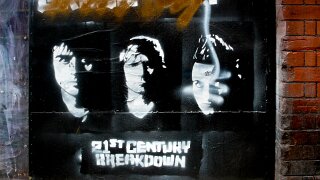
FEATURING COMMERCIAL STREET ART PROMOTING A GREEN DAY ALBUM
STREET ART ON THE WALLS OF ANDREWS LANE THEATRE [FEATURING COMMERCIAL STREET ART PROMOTING A GREEN DAY ALBUM]
Photographed in June 2009 using a 2006 Panasonic Lumix DMC-LX2. During the next few weeks I intend to publish more photographs produced by the DMC-LX2
Urban Character & Street Art: During the late 20th and early 21st centuries, the laneway became a back-corridor for Dublin’s music and hospitality scenes (flanked by rehearsal rooms, venue rear entrances, and instrument shops like Music Maker nearby). Prior to modern redevelopment, its brick walls and corrugated hoardings were canvases for Dublin street artists, including notable pieces by Maser.
There is an example of a major international "guerrilla marketing" campaign deployed by Warner Bros. / Reprise Records in May 2009 to promote Green Day’s eighth studio album, 21st Century Breakdown. The stencilled portraits depict (from left to right) drummer Tré Cool, bassist Mike Dirnt, and frontman Billie Joe Armstrong.
The Band's Status in 2009
In 2009, Green Day were at the absolute zenith of their commercial power and cultural visibility, operating not merely as a punk outfit but as one of the biggest arena rock bands in the world.
Following Up a Global Phenomenon: The band had spent the preceding five years riding the massive global wave of their 2004 multi-platinum rock opera, American Idiot. That album had revitalised their career, sold over 16 million copies, won multiple Grammys, and firmly repositioned them from mid-90s pop-punk veterans to politicised, stadium-filling rock titans.
Release of 21st Century Breakdown (May 2009): Released on 15 May 2009 after nearly five years of intense anticipation, 21st Century Breakdown was another ambitious, politically charged concept album produced by Butch Vig. It was an instant commercial juggernaut:
Debuted at No. 1 on the Billboard 200 in the US, the UK Albums Chart, and the Irish Albums Chart (IRMA).
Led by major hit singles like "Know Your Enemy" and "21 Guns".
Went on to win the Grammy Award for Best Rock Album at the 52nd Annual Grammy Awards.
Massive World Stadium Tour: In mid-2009, they launched the massive 21st Century Breakdown World Tour, selling out major arenas and stadiums across Europe, North America, Asia, and Oceania, including high-profile stops in Ireland (such as Dublin's The O2 / 3Arena in October 2009).
Broadway Transition: By late 2009, the stage musical adaptation of American Idiot had premiered in Berkeley and was preparing its high-profile transfer to Broadway in early 2010, further cementing their crossover into mainstream theatrical culture.
The Marketing Campaign
Because the album’s visual identity centred on street art, graffiti, and a stylised spray-painted aesthetic (the album cover itself featured a stencil of a kissing couple created by artist Sixten against a weathered wall), the record label orchestrated a worldwide guerrilla stencilling campaign. Stencil installations identical to this one appeared across urban walls, hoardings, and music quarters in London, New York, Los Angeles, Berlin, Paris, and Dublin to drum up street-level buzz leading up to the May 2009 release date.
The hand-drawn additions on the faces in your image (the "666", the heart, and the pentagram) are classic Dublin street-level additions made by passers-by over the official promotion.
The History of the Andrews Lane Theatre
The Andrews Lane Theatre (often abbreviated as ALT) was established in August 1989 by private theatrical and commercial interests without state funding. The venue was officially opened on 31 August 1989 by the legendary stage actress Maureen Potter.
Designed to provide an intimate performance space in the city centre, the building contained two distinct performance areas:
A main auditorium seating 220 patrons.
A smaller studio space upstairs with an 80-seat capacity.
Throughout the 1990s and early 2000s, the theatre played an important role in Dublin’s independent performing arts ecosystem. It hosted productions by emerging and established Irish playwrights (including Jimmy Murphy, Dolores Walshe, Deirdre Kinahan, and Colin Teevan), alongside comedy showcases, experimental fringe plays, and international touring acts.
Why It Ceased and What Replaced It
1. Why Did It Cease?
Theatre Closure (2007): By the mid-2000s, escalating operating overheads, fierce competition from state-subsidised institutions, and shifting commercial real estate dynamics made operating an independent, unsubsidised theatre financially unsustainable. In April 2007, owner-producer Pat Moylan announced the closure of theatrical operations.
Nightclub & Gig Venue Transition (2007–2016): Rather than standing idle, the venue was converted into a live music venue and nightclub known as ALT (and frequently hosted nights like The Lost Society and various dance/indie promotions).
Sale & Redevelopment (2016–2018): In April 2016, the building was sold for around €4.4 million to property developers planning a high-density "compact" hotel. Despite local protests over the continued loss of cultural spaces in Dublin, planning permission was granted, and the former theatre building was completely demolished in 2018.
2. What Replaced It?
Wren Urban Nest
The site was redeveloped into Wren Urban Nest, a 137-room sustainable micro-boutique hotel built with a timber-frame modular structure that opened in 2021.
In a nod to the location’s cultural heritage, the hotel’s ground-floor bar and casual restaurant was christened ALT.
History of the Laneway (St Andrew’s Lane)
St Andrew’s Lane is a narrow, kinked passage connecting Trinity Street to Exchequer Street, running parallel between Dame Street and Dame Lane.
Medieval & Early Origins: The lane is named after St Andrew’s Parish, whose historic round church and ancient assembly ground (Thingmote/Thingmount—the Viking parliamentary assembly mound) stood nearby near College Green and Suffolk Street.
18th and 19th Century Industrial Yard: Cartographic records from John Rocque (1756) and later Ordnance Survey maps show the laneway evolving through several layouts, historically functioning as service mews, coach houses, workshops, and bottling stores serving properties on Dame Street and Exchequer Street.
The Camera That I Did Not Like And Did Not Know Why
Back in 2009, faced with persistent mechanical frustrations on my primary full-frame kit, I needed a dependable, pocketable travel camera for a trip across Sweden. On paper, the Panasonic Lumix DMC-LX2 seemed like an inspired choice. It was robust, tactile, and engineered with genuine photographic intent. Yet, despite its flawless mechanical performance throughout the journey, I could never warm to the images it produced. Shortly after returning, I passed the camera along to a friend, who, remarkably, still puts it to work all these years later.
Looking back across the technical history, contemporary reviews, and user discussions of the era, that sense of dissatisfaction was far from an isolated reaction.
The Promise of the Hardware
Introduced in 2006 alongside its cosmetic twin, the Leica D-Lux 3, the LX2 occupied a distinct niche. It delivered a physical aspect-ratio toggle on the lens barrel, full manual exposure controls, a crisp Leica DC Vario-Elmarit 28–112mm equivalent f/2.8–4.9 optic, and a native 16:9 multi-aspect 10.2-megapixel CCD sensor. In the hand, it felt purposeful, responsive, and wonderfully compact.
The Image Quality Conundrum
The real divide lay beneath the metal casing:
Aggressive Processing: The Venus Engine III employed heavy-handed internal noise reduction to tame the densely packed 1/1.65-inch sensor. Low-contrast textures, architectural brickwork, and distant foliage frequently took on a smudged, waxy character—often described across enthusiast forums as the dreaded "watercolour effect."
Base Sensitivity Noise: Even at base ISO 100, fine chromatic and luminance grain hovered in flat tonal areas. At ISO 200 and beyond, resolution deteriorated rapidly.
The RAW Imperative: While dedicated users squeezed acceptable results from the sensor by capturing strictly in RAW and applying third-party decoding software, the underlying dynamic range remained narrow, with brittle highlight roll-off.
The Sensor Divide: Transitioning from the organic tonality, subtle micro-contrast, and clean transitions of professional large-sensor cameras rendered the LX2's compressed, digital rendering starkly apparent.
Panasonic clearly took the widespread criticism to heart. With the subsequent Lumix LX3, they ceased chasing megapixel counts, opting instead for a redesigned, lower-density sensor and an ultra-fast f/2.0 optic to eliminate the smearing that compromised the LX2.
As a durable, everyday visual notebook, the LX2 possessed undeniable charm—explaining why it still enjoys active service today. But for exacting documentation where pure image fidelity and clean rendering matter, its output was always a compromise.
Photographed in June 2009 using a 2006 Panasonic Lumix DMC-LX2. During the next few weeks I intend to publish more photographs produced by the DMC-LX2
Urban Character & Street Art: During the late 20th and early 21st centuries, the laneway became a back-corridor for Dublin’s music and hospitality scenes (flanked by rehearsal rooms, venue rear entrances, and instrument shops like Music Maker nearby). Prior to modern redevelopment, its brick walls and corrugated hoardings were canvases for Dublin street artists, including notable pieces by Maser.
There is an example of a major international "guerrilla marketing" campaign deployed by Warner Bros. / Reprise Records in May 2009 to promote Green Day’s eighth studio album, 21st Century Breakdown. The stencilled portraits depict (from left to right) drummer Tré Cool, bassist Mike Dirnt, and frontman Billie Joe Armstrong.
The Band's Status in 2009
In 2009, Green Day were at the absolute zenith of their commercial power and cultural visibility, operating not merely as a punk outfit but as one of the biggest arena rock bands in the world.
Following Up a Global Phenomenon: The band had spent the preceding five years riding the massive global wave of their 2004 multi-platinum rock opera, American Idiot. That album had revitalised their career, sold over 16 million copies, won multiple Grammys, and firmly repositioned them from mid-90s pop-punk veterans to politicised, stadium-filling rock titans.
Release of 21st Century Breakdown (May 2009): Released on 15 May 2009 after nearly five years of intense anticipation, 21st Century Breakdown was another ambitious, politically charged concept album produced by Butch Vig. It was an instant commercial juggernaut:
Debuted at No. 1 on the Billboard 200 in the US, the UK Albums Chart, and the Irish Albums Chart (IRMA).
Led by major hit singles like "Know Your Enemy" and "21 Guns".
Went on to win the Grammy Award for Best Rock Album at the 52nd Annual Grammy Awards.
Massive World Stadium Tour: In mid-2009, they launched the massive 21st Century Breakdown World Tour, selling out major arenas and stadiums across Europe, North America, Asia, and Oceania, including high-profile stops in Ireland (such as Dublin's The O2 / 3Arena in October 2009).
Broadway Transition: By late 2009, the stage musical adaptation of American Idiot had premiered in Berkeley and was preparing its high-profile transfer to Broadway in early 2010, further cementing their crossover into mainstream theatrical culture.
The Marketing Campaign
Because the album’s visual identity centred on street art, graffiti, and a stylised spray-painted aesthetic (the album cover itself featured a stencil of a kissing couple created by artist Sixten against a weathered wall), the record label orchestrated a worldwide guerrilla stencilling campaign. Stencil installations identical to this one appeared across urban walls, hoardings, and music quarters in London, New York, Los Angeles, Berlin, Paris, and Dublin to drum up street-level buzz leading up to the May 2009 release date.
The hand-drawn additions on the faces in your image (the "666", the heart, and the pentagram) are classic Dublin street-level additions made by passers-by over the official promotion.
The History of the Andrews Lane Theatre
The Andrews Lane Theatre (often abbreviated as ALT) was established in August 1989 by private theatrical and commercial interests without state funding. The venue was officially opened on 31 August 1989 by the legendary stage actress Maureen Potter.
Designed to provide an intimate performance space in the city centre, the building contained two distinct performance areas:
A main auditorium seating 220 patrons.
A smaller studio space upstairs with an 80-seat capacity.
Throughout the 1990s and early 2000s, the theatre played an important role in Dublin’s independent performing arts ecosystem. It hosted productions by emerging and established Irish playwrights (including Jimmy Murphy, Dolores Walshe, Deirdre Kinahan, and Colin Teevan), alongside comedy showcases, experimental fringe plays, and international touring acts.
Why It Ceased and What Replaced It
1. Why Did It Cease?
Theatre Closure (2007): By the mid-2000s, escalating operating overheads, fierce competition from state-subsidised institutions, and shifting commercial real estate dynamics made operating an independent, unsubsidised theatre financially unsustainable. In April 2007, owner-producer Pat Moylan announced the closure of theatrical operations.
Nightclub & Gig Venue Transition (2007–2016): Rather than standing idle, the venue was converted into a live music venue and nightclub known as ALT (and frequently hosted nights like The Lost Society and various dance/indie promotions).
Sale & Redevelopment (2016–2018): In April 2016, the building was sold for around €4.4 million to property developers planning a high-density "compact" hotel. Despite local protests over the continued loss of cultural spaces in Dublin, planning permission was granted, and the former theatre building was completely demolished in 2018.
2. What Replaced It?
Wren Urban Nest
The site was redeveloped into Wren Urban Nest, a 137-room sustainable micro-boutique hotel built with a timber-frame modular structure that opened in 2021.
In a nod to the location’s cultural heritage, the hotel’s ground-floor bar and casual restaurant was christened ALT.
History of the Laneway (St Andrew’s Lane)
St Andrew’s Lane is a narrow, kinked passage connecting Trinity Street to Exchequer Street, running parallel between Dame Street and Dame Lane.
Medieval & Early Origins: The lane is named after St Andrew’s Parish, whose historic round church and ancient assembly ground (Thingmote/Thingmount—the Viking parliamentary assembly mound) stood nearby near College Green and Suffolk Street.
18th and 19th Century Industrial Yard: Cartographic records from John Rocque (1756) and later Ordnance Survey maps show the laneway evolving through several layouts, historically functioning as service mews, coach houses, workshops, and bottling stores serving properties on Dame Street and Exchequer Street.
The Camera That I Did Not Like And Did Not Know Why
Back in 2009, faced with persistent mechanical frustrations on my primary full-frame kit, I needed a dependable, pocketable travel camera for a trip across Sweden. On paper, the Panasonic Lumix DMC-LX2 seemed like an inspired choice. It was robust, tactile, and engineered with genuine photographic intent. Yet, despite its flawless mechanical performance throughout the journey, I could never warm to the images it produced. Shortly after returning, I passed the camera along to a friend, who, remarkably, still puts it to work all these years later.
Looking back across the technical history, contemporary reviews, and user discussions of the era, that sense of dissatisfaction was far from an isolated reaction.
The Promise of the Hardware
Introduced in 2006 alongside its cosmetic twin, the Leica D-Lux 3, the LX2 occupied a distinct niche. It delivered a physical aspect-ratio toggle on the lens barrel, full manual exposure controls, a crisp Leica DC Vario-Elmarit 28–112mm equivalent f/2.8–4.9 optic, and a native 16:9 multi-aspect 10.2-megapixel CCD sensor. In the hand, it felt purposeful, responsive, and wonderfully compact.
The Image Quality Conundrum
The real divide lay beneath the metal casing:
Aggressive Processing: The Venus Engine III employed heavy-handed internal noise reduction to tame the densely packed 1/1.65-inch sensor. Low-contrast textures, architectural brickwork, and distant foliage frequently took on a smudged, waxy character—often described across enthusiast forums as the dreaded "watercolour effect."
Base Sensitivity Noise: Even at base ISO 100, fine chromatic and luminance grain hovered in flat tonal areas. At ISO 200 and beyond, resolution deteriorated rapidly.
The RAW Imperative: While dedicated users squeezed acceptable results from the sensor by capturing strictly in RAW and applying third-party decoding software, the underlying dynamic range remained narrow, with brittle highlight roll-off.
The Sensor Divide: Transitioning from the organic tonality, subtle micro-contrast, and clean transitions of professional large-sensor cameras rendered the LX2's compressed, digital rendering starkly apparent.
Panasonic clearly took the widespread criticism to heart. With the subsequent Lumix LX3, they ceased chasing megapixel counts, opting instead for a redesigned, lower-density sensor and an ultra-fast f/2.0 optic to eliminate the smearing that compromised the LX2.
As a durable, everyday visual notebook, the LX2 possessed undeniable charm—explaining why it still enjoys active service today. But for exacting documentation where pure image fidelity and clean rendering matter, its output was always a compromise.