IT RELOCATED TO GROSS GUNS BRIDGE]
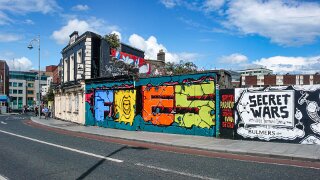
THE BERNARD SHAW PUB DID NOT EXIST IN 1895 BUT I PHOTOGRAPHED IT IN 2009
The building I photographed in 2009 at 11–12 South Richmond Street was genuinely constructed in 1895, but the establishment known as "The Bernard Shaw" was not an antique institution. It was a modern hospitality and entertainment concept that inhabited an older Victorian shell, creating a layered illusion of vintage provenance.
The South Richmond Street Era (2006–2019)
The structure on South Richmond Street carried an authentic raised date plaque reading 1895 beneath its moulded parapet cornice. Built near the Portobello canal basin, it operated for generations under various guises, including Bambrick’s and later Sonny King’s Loftus Lounge.
In 2006, hospitality collective Bodytonic acquired the premises and rebranded it as The Bernard Shaw, a playful nod to playwright George Bernard Shaw, who was born nearby on Synge Street. By 2009, it had become the epicentre of Dublin's indie, hipster, and arts culture. While the exterior retained its late-Victorian joinery, sash windows, and 1895 datestone, the inside and rear yard were radically
The vacant beer garden was fitted out with the Big Blue Bus serving wood-fired pizza.
The boundary walls became a dynamic, rotating canvas for Dublin’s contemporary street artists and muralists.
The interior blended surviving traditional pub snugs and timber panelling with DJ decks, craft beers, and modern alternative club nights.
Many casual visitors took the 1895 date plaque as proof that "The Bernard Shaw" was a storied, century-old Victorian public house. In reality, the name and identity were a mid-2000s commercial creation existing inside historic architecture.
The Impending Demolition & Relocation
By the late 2010s, escalating land values along South Richmond Street and the Grand Canal corridor earmarked the site for urban redevelopment. Despite significant public resistance and heritage campaigns, planning permission was granted for hotel and office blocks, forcing Bodytonic to vacate the premises in October 2019. The 1895 building was subsequently demolished.
The Northside Reincarnation: Cross Guns Bridge
In late 2019, Bodytonic proved that "The Bernard Shaw" was a portable lifestyle brand rather than a place-bound heritage pub by transferring the entire operation to the Northside of Dublin.
The Location: They took over the former Porterhouse North (originally The Whitworth) overlooking the Royal Canal at Cross Guns Bridge, bordering Phibsborough and Glasnevin.
The Concept Reassembled: They transported their operational fixtures, including the Big Blue Bus, the Eatyard food vendor market, open-air gig spaces, and graffiti walls.
The Present Identity: Today, the Cross Guns Bridge venue operates as a sprawling cultural complex with food markets, live gigs, and pub spaces. Just as in Portobello, new generations of patrons often assume the establishment has been an enduring fixture at the canal bridge for decades, when it remains an adaptable, highly successful commercial reimagining of Dublin pub culture.
The Bernard Shaw
The original 1895 building itself has not been completely demolished.
Because 11–12 South Richmond Street is listed on the Record of Protected Structures (RPS Ref. 7306), the core Victorian street-facing building was protected from total razing.
Current Status and Planning Outcome
Survival of the Victorian Façade and Core: The two-storey, five-bay 1895 structure—complete with its raised date plaque, moulded parapet, sash windows, and timber pubfront—remains standing on the streetscape.
Demolition of the Ancillary Yard: The areas cleared for site assembly and redevelopment were the rear yards, extensions, and adjacent derelict plots that formerly held the beer garden, the Big Blue Bus, and outdoor event spaces.
Redevelopment Scheme: After years of planning battles, An Bord Pleanála granted permission on appeal for a major mixed-use development on the expanded site. The scheme involves constructing an eight-storey commercial block that wraps around and subsumes the site, while requiring the retention, conservation, and integration of the original 1895 protected pub building rather than its wholesale levelling.
The building I photographed in 2009 at 11–12 South Richmond Street was genuinely constructed in 1895, but the establishment known as "The Bernard Shaw" was not an antique institution. It was a modern hospitality and entertainment concept that inhabited an older Victorian shell, creating a layered illusion of vintage provenance.
The South Richmond Street Era (2006–2019)
The structure on South Richmond Street carried an authentic raised date plaque reading 1895 beneath its moulded parapet cornice. Built near the Portobello canal basin, it operated for generations under various guises, including Bambrick’s and later Sonny King’s Loftus Lounge.
In 2006, hospitality collective Bodytonic acquired the premises and rebranded it as The Bernard Shaw, a playful nod to playwright George Bernard Shaw, who was born nearby on Synge Street. By 2009, it had become the epicentre of Dublin's indie, hipster, and arts culture. While the exterior retained its late-Victorian joinery, sash windows, and 1895 datestone, the inside and rear yard were radically
The vacant beer garden was fitted out with the Big Blue Bus serving wood-fired pizza.
The boundary walls became a dynamic, rotating canvas for Dublin’s contemporary street artists and muralists.
The interior blended surviving traditional pub snugs and timber panelling with DJ decks, craft beers, and modern alternative club nights.
Many casual visitors took the 1895 date plaque as proof that "The Bernard Shaw" was a storied, century-old Victorian public house. In reality, the name and identity were a mid-2000s commercial creation existing inside historic architecture.
The Impending Demolition & Relocation
By the late 2010s, escalating land values along South Richmond Street and the Grand Canal corridor earmarked the site for urban redevelopment. Despite significant public resistance and heritage campaigns, planning permission was granted for hotel and office blocks, forcing Bodytonic to vacate the premises in October 2019. The 1895 building was subsequently demolished.
The Northside Reincarnation: Cross Guns Bridge
In late 2019, Bodytonic proved that "The Bernard Shaw" was a portable lifestyle brand rather than a place-bound heritage pub by transferring the entire operation to the Northside of Dublin.
The Location: They took over the former Porterhouse North (originally The Whitworth) overlooking the Royal Canal at Cross Guns Bridge, bordering Phibsborough and Glasnevin.
The Concept Reassembled: They transported their operational fixtures, including the Big Blue Bus, the Eatyard food vendor market, open-air gig spaces, and graffiti walls.
The Present Identity: Today, the Cross Guns Bridge venue operates as a sprawling cultural complex with food markets, live gigs, and pub spaces. Just as in Portobello, new generations of patrons often assume the establishment has been an enduring fixture at the canal bridge for decades, when it remains an adaptable, highly successful commercial reimagining of Dublin pub culture.
The Bernard Shaw
The original 1895 building itself has not been completely demolished.
Because 11–12 South Richmond Street is listed on the Record of Protected Structures (RPS Ref. 7306), the core Victorian street-facing building was protected from total razing.
Current Status and Planning Outcome
Survival of the Victorian Façade and Core: The two-storey, five-bay 1895 structure—complete with its raised date plaque, moulded parapet, sash windows, and timber pubfront—remains standing on the streetscape.
Demolition of the Ancillary Yard: The areas cleared for site assembly and redevelopment were the rear yards, extensions, and adjacent derelict plots that formerly held the beer garden, the Big Blue Bus, and outdoor event spaces.
Redevelopment Scheme: After years of planning battles, An Bord Pleanála granted permission on appeal for a major mixed-use development on the expanded site. The scheme involves constructing an eight-storey commercial block that wraps around and subsumes the site, while requiring the retention, conservation, and integration of the original 1895 protected pub building rather than its wholesale levelling.