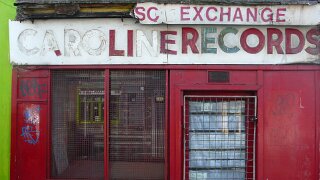
CAROLINE RECORDS IN PORTOBELLO IN 2009
I once operated my own record business but decided to close in 1979 as I was offered a position with Memorex in the USA - they manufactured high quality audio cassettes and eventually migrated to manufacturing floppy disks.
The rise, decline, and gradual revival of independent record shops in Dublin reflects the broader cultural and economic shifts of the city over the last half-century.
The Golden Era: 1970s to the Mid-1990s
Throughout the 1970s, 1980s, and early 1990s, Dublin sustained a dense, thriving ecosystem of independent record shops. Unlike major department stores or general retailers, these shops functioned as vital community hubs, counter-culture meeting grounds, and informal distribution points for gig tickets, fanzines, and demo tapes.
Caroline Records (34 South Richmond Street, Portobello): Situated just north of the Grand Canal, Caroline Records was a beloved neighbourhood fixture known for its distinctive red-and-white painted façade, cluttered racks, and deep second-hand vinyl crates. By the time it closed in 2003, it had stood as an emblem of old-school crate-digging culture before remaining boarded up and derelict for years.
Rhythm Records (Bedford Row / Aston Quay): Positioned near the quays and the edge of Temple Bar, Rhythm Records was well known in the 1980s and 1990s among local collectors for hard-to-find imports,
tapes, bootleg gig recordings, and rock memorabilia.
The Temple Bar & City Centre Hubs: During Temple Bar's bohemian boom before full-scale commercial redevelopment, the laneways were packed with specialist music spots, including Comet Records on Cope Street, Road Records on Fade Street, Abbey Discs off Liffey Street, Base X, and Borderline Records.
The Great Squeeze: 1998 to 2010
The late 1990s and 2000s brought severe disruption to independent music retail across Ireland:
Format Shifts & Digital Disruption: The transition to MP3s, peer-to-peer file sharing (Napster, Soulseek), and CD burning rapidly undercut mainstream music sales, while streaming later removed the need for casual consumer purchases.
Commercial Rent Pressures: The Celtic Tiger era brought escalating retail rents, making dedicated shop floors in central Dublin financially untenable for niche margins.
Chain Domination & Eventual Collapse: Large corporate mega-chains initially undercut independent retailers before collapsing under the same digital pressures.
By the late 2000s, legendary independent institutions such as Road Records (Fade Street) and Comet Records had shuttered, leaving behind only the ghost signs and memories of Dublin’s tactile music
Surviving Independent Record Shops
Despite the downturn, several true independent record shops navigated the crisis by specialising in niche genres, curating quality second-hand vinyl, and embracing the vinyl revival.
Tower Records in Dublin represents one of the most remarkable survival stories in modern music retail. While the global empire founded by Russ Solomon collapsed in 2006, the Dublin operation survived precisely by cutting its corporate ties and operating as a fully autonomous, Irish-owned independent business.
The Franchise Breakout (2003)
Local Buyout: Tower Records first opened in Dublin in 1993 on Wicklow Street before expanding to a flagship site on Dawson Street.
Separation Before the Crash: In 2003, as the US parent company sank under heavy debt and digital disruption, Irish entrepreneur and landlord Ronnie Delany purchased the Irish operations as a franchise.
Weathering the Liquidation: When Tower Records US went into total bankruptcy and liquidation in late 2006, shuttering almost every store across America and the UK, Tower Records Ireland was entirely unaffected legally and operationally. Along with Tower Records Japan (which similarly split into a separate corporate entity), Dublin became one of the rare places in the world where the iconic red-and-yellow neon stayed lit.
How Dublin’s Tower Adapted
Rather than shrinking into a generic entertainment outlet, Tower Dublin leaned into specialist retail:
Format Balance: While big chains like HMV and Virgin Megastore collapsed under the weight of falling CD sales, Tower retained massive physical depth—stocking extensive niche catalogues in jazz, classical, world music, and indie imports alongside major releases.
The Vinyl Pivot: Tower embraced the vinyl resurgence early, converting substantial floor space back to 12-inch records and turntables.
Dedicated Hi-Fi & In-Stores: The flagship Dawson Street store integrated Tower Hi-Fi (turntables, amplifiers, styli, and speakers) and regularly hosts live acoustic sets and album signings for Irish and international acts, maintaining its role as a cultural meeting spot.
Today, operating from No. 7 Dawson Street and a branch in the Eason building on Lower O'Connell Street, Tower Records functions as Ireland’s largest independent record retailer.
Tower Records
Sound Cellar
Sound Cellar is Dublin's oldest surviving specialist music shop, operating continuously out of its subterranean premises on Nassau Street since 1973.
Atmosphere: An authentic, unvarnished rock and metal institution with decades of gig posters and memorabilia lining the basement walls.
Speciality: Deep focus on hard rock, heavy metal, progressive rock, classic vinyl, and official gig merchandise.
Legacy: Founded by music promoter Pat Egan and long helmed by Tommy Keenan, it outlasted every major music chain in the city.
Freebird Records
Freebird Records was established on Grafton Street in 1978 before navigating multiple moves (including Eden Quay and Temple Bar) to settle into the back of The Secret Book and Record Store on Wicklow Street.
Atmosphere: Cosy, labyrinthine setting shared with second-hand books, drawing casual browsers and dedicated collectors alike.
Speciality: Extensive catalogue of second-hand and newly pressed indie, alternative rock, jazz, folk, and classic vinyl.
Survival Strategy: Downsizing floor space and integrating with an independent bookstore allowed it to withstand the worst retail downturns.
Spindizzy Records
Spindizzy Records has been a cornerstone of the George's Street Arcade for decades, maintaining an expansive footprint within the Victorian indoor market.
Atmosphere: Vibrant open-front market stall with crates spilling into the arcade aisle.
Speciality: Broad curation spanning techno, house, reggae, soul, funk, indie, and collectible second-hand rock vinyl.
Community Role: One of the most active crate-digging spots in Dublin for DJ 12-inch singles and rare reissues.
All City
All City on Crow Street in Temple Bar established a distinct identity by anchoring itself to Dublin's graffiti, hip-hop, and electronic subcultures.
Atmosphere: Multi-disciplinary creative hub stocking spray paint, art supplies, streetwear, and vinyl.
Speciality: Hip-hop, beatmaker culture, techno, house, ambient, and Irish electronic releases on their own in-house record label.
Community Role: A gathering point for Dublin's underground producers, graffiti writers, and DJs.
Would you like more details on specific lost record shops from particular Dublin neighbourhoods, or a closer look at independent labels that originated out of these spaces?
The rise, decline, and gradual revival of independent record shops in Dublin reflects the broader cultural and economic shifts of the city over the last half-century.
The Golden Era: 1970s to the Mid-1990s
Throughout the 1970s, 1980s, and early 1990s, Dublin sustained a dense, thriving ecosystem of independent record shops. Unlike major department stores or general retailers, these shops functioned as vital community hubs, counter-culture meeting grounds, and informal distribution points for gig tickets, fanzines, and demo tapes.
Caroline Records (34 South Richmond Street, Portobello): Situated just north of the Grand Canal, Caroline Records was a beloved neighbourhood fixture known for its distinctive red-and-white painted façade, cluttered racks, and deep second-hand vinyl crates. By the time it closed in 2003, it had stood as an emblem of old-school crate-digging culture before remaining boarded up and derelict for years.
Rhythm Records (Bedford Row / Aston Quay): Positioned near the quays and the edge of Temple Bar, Rhythm Records was well known in the 1980s and 1990s among local collectors for hard-to-find imports,
tapes, bootleg gig recordings, and rock memorabilia.
The Temple Bar & City Centre Hubs: During Temple Bar's bohemian boom before full-scale commercial redevelopment, the laneways were packed with specialist music spots, including Comet Records on Cope Street, Road Records on Fade Street, Abbey Discs off Liffey Street, Base X, and Borderline Records.
The Great Squeeze: 1998 to 2010
The late 1990s and 2000s brought severe disruption to independent music retail across Ireland:
Format Shifts & Digital Disruption: The transition to MP3s, peer-to-peer file sharing (Napster, Soulseek), and CD burning rapidly undercut mainstream music sales, while streaming later removed the need for casual consumer purchases.
Commercial Rent Pressures: The Celtic Tiger era brought escalating retail rents, making dedicated shop floors in central Dublin financially untenable for niche margins.
Chain Domination & Eventual Collapse: Large corporate mega-chains initially undercut independent retailers before collapsing under the same digital pressures.
By the late 2000s, legendary independent institutions such as Road Records (Fade Street) and Comet Records had shuttered, leaving behind only the ghost signs and memories of Dublin’s tactile music
Surviving Independent Record Shops
Despite the downturn, several true independent record shops navigated the crisis by specialising in niche genres, curating quality second-hand vinyl, and embracing the vinyl revival.
Tower Records in Dublin represents one of the most remarkable survival stories in modern music retail. While the global empire founded by Russ Solomon collapsed in 2006, the Dublin operation survived precisely by cutting its corporate ties and operating as a fully autonomous, Irish-owned independent business.
The Franchise Breakout (2003)
Local Buyout: Tower Records first opened in Dublin in 1993 on Wicklow Street before expanding to a flagship site on Dawson Street.
Separation Before the Crash: In 2003, as the US parent company sank under heavy debt and digital disruption, Irish entrepreneur and landlord Ronnie Delany purchased the Irish operations as a franchise.
Weathering the Liquidation: When Tower Records US went into total bankruptcy and liquidation in late 2006, shuttering almost every store across America and the UK, Tower Records Ireland was entirely unaffected legally and operationally. Along with Tower Records Japan (which similarly split into a separate corporate entity), Dublin became one of the rare places in the world where the iconic red-and-yellow neon stayed lit.
How Dublin’s Tower Adapted
Rather than shrinking into a generic entertainment outlet, Tower Dublin leaned into specialist retail:
Format Balance: While big chains like HMV and Virgin Megastore collapsed under the weight of falling CD sales, Tower retained massive physical depth—stocking extensive niche catalogues in jazz, classical, world music, and indie imports alongside major releases.
The Vinyl Pivot: Tower embraced the vinyl resurgence early, converting substantial floor space back to 12-inch records and turntables.
Dedicated Hi-Fi & In-Stores: The flagship Dawson Street store integrated Tower Hi-Fi (turntables, amplifiers, styli, and speakers) and regularly hosts live acoustic sets and album signings for Irish and international acts, maintaining its role as a cultural meeting spot.
Today, operating from No. 7 Dawson Street and a branch in the Eason building on Lower O'Connell Street, Tower Records functions as Ireland’s largest independent record retailer.
Tower Records
Sound Cellar
Sound Cellar is Dublin's oldest surviving specialist music shop, operating continuously out of its subterranean premises on Nassau Street since 1973.
Atmosphere: An authentic, unvarnished rock and metal institution with decades of gig posters and memorabilia lining the basement walls.
Speciality: Deep focus on hard rock, heavy metal, progressive rock, classic vinyl, and official gig merchandise.
Legacy: Founded by music promoter Pat Egan and long helmed by Tommy Keenan, it outlasted every major music chain in the city.
Freebird Records
Freebird Records was established on Grafton Street in 1978 before navigating multiple moves (including Eden Quay and Temple Bar) to settle into the back of The Secret Book and Record Store on Wicklow Street.
Atmosphere: Cosy, labyrinthine setting shared with second-hand books, drawing casual browsers and dedicated collectors alike.
Speciality: Extensive catalogue of second-hand and newly pressed indie, alternative rock, jazz, folk, and classic vinyl.
Survival Strategy: Downsizing floor space and integrating with an independent bookstore allowed it to withstand the worst retail downturns.
Spindizzy Records
Spindizzy Records has been a cornerstone of the George's Street Arcade for decades, maintaining an expansive footprint within the Victorian indoor market.
Atmosphere: Vibrant open-front market stall with crates spilling into the arcade aisle.
Speciality: Broad curation spanning techno, house, reggae, soul, funk, indie, and collectible second-hand rock vinyl.
Community Role: One of the most active crate-digging spots in Dublin for DJ 12-inch singles and rare reissues.
All City
All City on Crow Street in Temple Bar established a distinct identity by anchoring itself to Dublin's graffiti, hip-hop, and electronic subcultures.
Atmosphere: Multi-disciplinary creative hub stocking spray paint, art supplies, streetwear, and vinyl.
Speciality: Hip-hop, beatmaker culture, techno, house, ambient, and Irish electronic releases on their own in-house record label.
Community Role: A gathering point for Dublin's underground producers, graffiti writers, and DJs.
Would you like more details on specific lost record shops from particular Dublin neighbourhoods, or a closer look at independent labels that originated out of these spaces?